


Photo: Master Corporal Antoine Brochu, Canadian Armed Forces Combat Camera
Members of Land Task Force NUNAKPUT walk to their observation post during Operation NANOOK-NUNAKPUT near Pond Inlet, Nunavut, on September 9, 2025.
Issue 26.1 returns to diverse content received by way of regular submissions, following a series of special issues in volume 25: CMJ’s 25th anniversary. Issue 25.1 offered a deep dive into character-based leadership and concepts in Fighting Spirit to complement the CAF’s new ethos; 25.2 was a collaboration with our colleagues at the Dallaire Centre of Excellence for Peace and Security to showcase work on human security; 25.3 covered the Arctic, human security, historical perspectives, resilience, and a lived experience piece related to the cover, featuring original artwork by Master Warrant Officer (retired) Robert Bradley; 25.4 explored commitments and burden sharing within NATO.
CMJ issue 26.1 features articles on aviation, the Canadian Military Colleges (CMCs), innovation and evaluation, history, and a book review of The Enduring Crown Commonwealth: The Past, Present, and Future of the UK-Canada-ANZ Alliance and Why It Matters. Two aviation-related articles explore how technology and strategies of the past might be of use to Canada in the future. Alexander Michael Daniel’s “Over-the-Horizon Radar: Overcoming the ‘Aurora Challenge” will interest radar enthusiasts who remember when the “Arctic” and “Polar” over-the-horizon radar (OTHR) were first introduced. The article demystifies the June 2022 announcement regarding the introduction of a “Northern Approaches Surveillance System” to modernize the North American Aerospace Defense Command (NORAD). That initiative relies on older OTHR technology. Daniel questions the wisdom of modernizing this technology.
As the Government of Canada releases an Indo-Pacific Strategy and engagement priorities, Captain M.K. O’Brien argues that we should consider the history of Canada’s engagement in the Indo-Pacific region. “How Canada’s Aviation Past in the Indo-Pacific can Shape its Future” highlights some of Canada’s previous engagements in the region: maritime patrol, transportation in Burma, and flying to China.
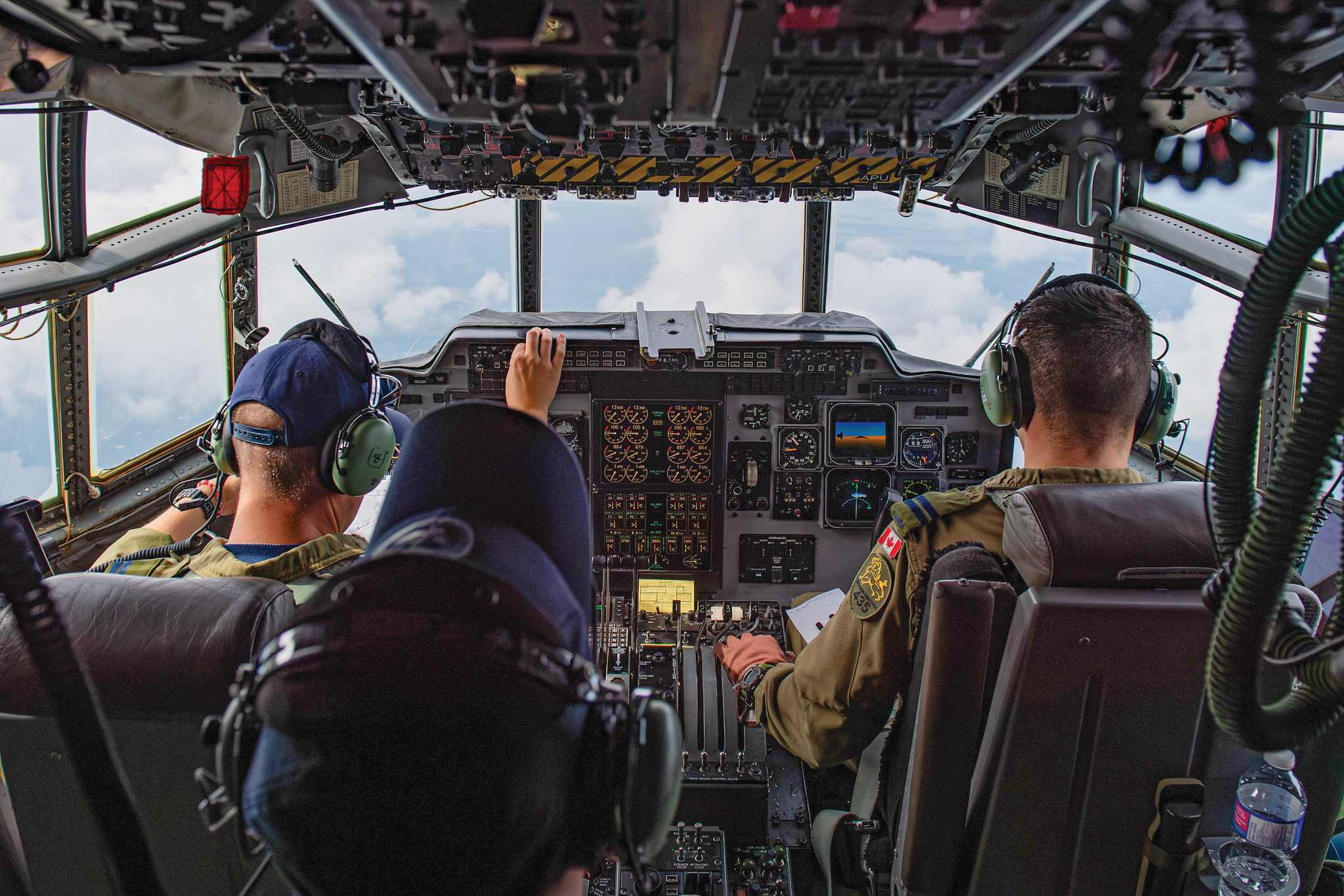
Photo: Aviator Nicholas Zahari, 17 Operations Support Squadron, Imaging Flight
435 Transport and Rescue Squadron transports evacuees from Oxford House, Manitoba, due to forest fires during Operation Lentus, Northern Manitoba on August 14, 2024.
Modernization is also a topic of interest for Davis’ “Innovation by Design: A Design-Thinking Strategy for the Canadian Armed Forces.” The government plans to foster a “culture of innovation”, which is echoed in Canada’s 2024 defence policy update, Our North Strong and Free. In response, the Government of Canada has developed two innovation programs. Although well-intentioned, Davis argues that the strategy overlooks the CAF’s internal capacity to innovate. “Innovation” is not necessarily the first descriptor that comes to mind for government departments. Yet, the military necessarily is in constant transformation to adapt to a changing environment. Referencing several design and organizational models, Davis suggests that the CAF might become a “truly innovative organization, with a culture that embraces innovation”—provided conditions are right. What are those conditions, exactly? The article lays them out.
In a nod to CMJ’s 23.2 issue on CMCs, this issue includes two articles that analyze how institutions foster resilient leaders and experts in the Professions of Arms. Both articles reprise a question from the 1998 Wither’s report: What type of junior officer should the CMCs produce? For Chérif, Wilkin, and Townson, the answer is resilient members of the CAF. In “Antifragility at the Canadian Military Colleges: The Resilience Plus Program,” the authors outline how the Resilience Plus Program educates and prepares psychologically healthy N/OCdts to become antifragile leaders. The Resilience Program was developed with core CMC values in mind, and includes five components: research, education, training, mentoring, and coaching. The article provides an overview of the program’s implementation at CMCs and reviews preliminary findings.
In, “Schrödinger’s Soldiers: Reviewing How and Why the Military Colleges Create ‘Experts’ In the Profession of Arms,” Major Dr. Fejes argues that CMCs should produce officers who are experts in the Profession of Arms. These institutions should impart knowledge-based education so that future CAF leaders can apply their skills in new situations, rather than just scenarios for which they have been trained. The expectation that junior officers should be trained to follow orders and leverage their 40 credits of an undergraduate degree to think critically demonstrates a tension similar to Schrödinger’s thought experiment, in which a cat was thought to be both dead and alive. Similarly, CMC graduates cannot be both, at once. Yet, current expectations suggest that they should be critical thinkers who follow lawful orders quickly and proficiently. To de-conflict these tensions, Fejes proposes that CMCs be provided with a clearer mandate, more focused on education.
How to measure the performance of junior officers generated by the CMCs? In, “Measuring the Performance of Canada’s Military Personnel System,” Hlywa, Hachey, and Urban outline the process used to develop the CAF’s performance measurement framework. “What gets measured gets managed,” and so the ability to identify areas of strength and improvement should improve results. These articles are snapshots of the CAF’s evolution. What were the creators of the performance management system thinking when they developed the program? What issues did they encounter? The article also summarizes lessons learned.
On the topic of innovation and development within the Canadian defence community, NATO Defence College fellow Professor Bessma Momani and her colleague Professor Michele Mosca provide insight into how quantum technology changes the potential for intelligence gathering in defence and security. “Quantum Technologies in Defence and Intelligence Security” calls for a greater investment in quantum research and development.
Lessons learned also inform this issue’s section on military history, which features an article by Major Bryce Simpson, “The Second War Without Battles: Canadian Army Deterrence in Germany (1951-1993) and Latvia (2017-Present).” Simpson analyzes the Army’s experience with deterrence in Germany from 1951 to 1993, and then thematically explores the relevance of lessons learned about strategy, doctrine, equipment, sustainment, and personnel issues to the contemporary Op Reassurance mission in Latvia.
A book review of The Enduring Crown Commonwealth: The Past, Present, and Future of the UK-Canada-ANZ Alliance and Why It Matters concludes this issue.
A note to regular readers, many of whom have contacted us over recent months—we always appreciate hearing from you: resource constraints imposed a delay on printing and subsequent distribution of recent issues. The CMJ editorial and production team is striving to resume our regular quarterly printing schedule. Readers should now have received all four issues of volume 24. Readers can always access the latest and previous issues digitally at journal.forces.gc.ca. We hope to be able to share good news soon about newly transformed ways for readers to access CMJ digitally. Meanwhile, please email cmj.rmc@forces.gc.ca to update your subscription details. Thank you for your patience as we adjust to changing resource constraints while transforming the way CMJ is produced and delivered, online and in print.
CMJ Editorial Team