

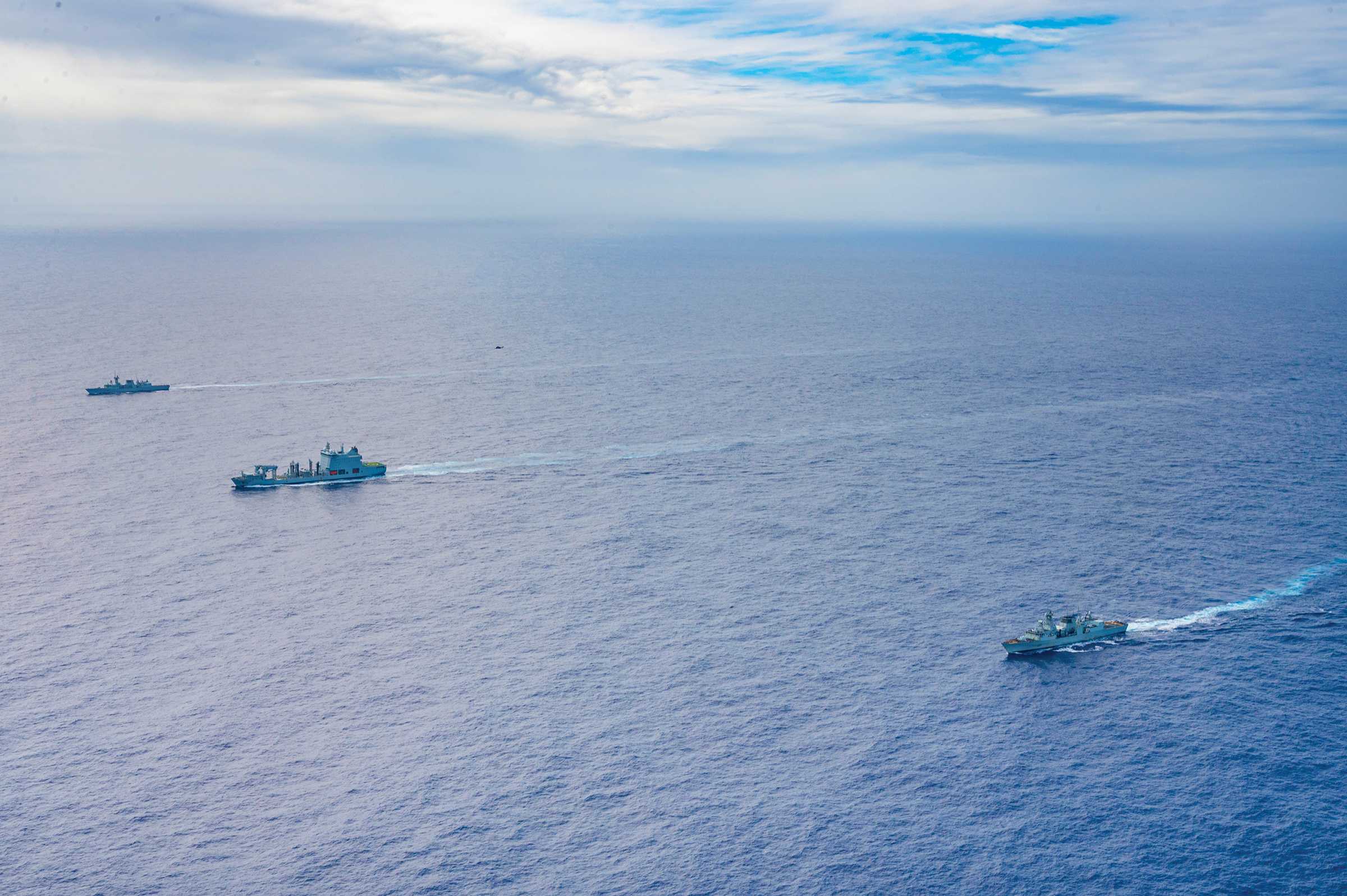
Photo: Corporal Alisa Strelley, Canadian Armed Forces Photo
(From front to back) His Majesty’s Canadian Ship (HMCS) Vancouver, Motor Vessel (MV) Asterix and HMCS Ottawa conduct a PHOTOEX in the Pacific Ocean on December 1, 2023.
Captain M.K. O’Brien is a serving RCAF officer who has deployed to the Indo-Pacific four times. They are in the process of completing their Master of War Studies program at RMC.
“Canada is a Pacific nation. The Indo-Pacific is our neighbourhood.”
On 27 November 2022, Canada released its own Canadian Indo-Pacific Strategy (CIPS), which offers commitments for additional military and intelligence capacity in the Indo-Pacific (I-P).Footnote1 The CIPS signals a clear shift in Canadian foreign policy alignment towards Asia. As a by-product of history and geography, Canada has traditionally been attached to its neighbour to the south and its founding nations across the Atlantic. Given the predominance of Western liberal democracies over the last two centuries, this approach has served Canadian interests well. However, the winds are changing. The I-P is quickly trending towards becoming the economic and political centre of the world, with the rise of China and India contributing significantly to this phenomenon.Footnote2 Concurrent with this ascension, there have been challenges to the rules-based international order (RBIO) by an increasingly hostile People’s Republic of China (PRC), Russia, and to a lesser extent, North Korea, all three located in the I-P. We now enter the era of Great Power Competition, with the Indo-Pacific region playing the dominant theatre.Footnote3
The Indo-Pacific includes much of the Asian continent and Oceania, the vastness of the Pacific and Indian oceans, and 25,000 islands, big and small. The geographic scale and numerous seas that divide it make the Indo-Pacific region a particularly suitable theatre for Air and Navy elements.Footnote4 But in what capacity could Canada meaningfully contribute to the CIPS? Canada has not had significant regional operational experience since the Korean War. Three of Canada’s closest NATO allies, the United States, the United Kingdom, and France, have overseas bases and territories in the region that have hosted their forces for decades. Two other Five Eye allies, Australia and New Zealand, call the Indo-Pacific their home. Compared to these countries footprints, Canada’s newfound desire to operate in the region might seem misplaced and unsuitable, even if the CIPS makes clear our intent to show our resolve to friends and partners alike.
Despite the distance since Canada’s last major operational activities, a significant historical legacy could be built upon. Canada’s contributions of Air Power in the Indo-Pacific during the Second World War warrant discussion on two metrics: personality and modern relevance. Regarding personality, it is beneficial to bring the faces and names of heroes to the limelight as part of a public relations strategy. In one study on the formation of stereotypes and attitudes towards countries, “famous personalities” were one of the key cultural dimensions people looked towards.Footnote5 Personality can provide credibility to Canadian presence and add an intimate connection to the region. The sacrifice of named individuals who committed great feats during wartime makes Canada’s current operations in the theatre look more like a continuation of such heroics rather than an out-of-place policy conjecture.
Second, Canada’s greatest activities and contributions in the region during the Second World War are within capabilities we still maintain and excel at. While technology and tactical practices have changed over the years, there is clear evidence that Canada has maintained and perfected niche capabilities that we used during the Second World War right up into the present day. Through an analysis of Canadian activities and personalities during the Second World War, this paper argues that Canada has a vital regional air power legacy, which it can build upon to become a valued partner. This essay sheds light on Canadian success stories by examining and analyzing case studies in each capability. It offers avenues of approach for future Canadian activities in the Indo-Pacific among allies and partners.
Case Study 1: Maritime Patrol in the Indian Ocean
The Second World War pushed Canada to adopt a total war footing. This change meant a complete mobilization of the nation’s resources, manufacturing, and people towards war with the Axis powers of Nazi Germany, Fascist Italy, and the Japanese Empire. Canada would have numerous great achievements during the war, such as the Liberation of Holland, the Juno Beach landings, the Battle of the Atlantic, and the Italian campaign. Less scholarly and public attention is directed at our more modest contributions in the Indo-Pacific, where thousands of Canadians served in the Pacific War against Japan.
By mid-1942, Japan was at its peak in size and strength, having conquered much of the Far East. There had been a series of devastating Allied losses in the months prior, among them the fall of Hong Kong (where Canadian troops were garrisoned), Singapore, the Dutch East Indies, the Philippines, and the strike on Pearl Harbor. China had been at war with Japan for over five years by this point and lost large swaths of territory, including its capital city. Many Allied commanders had completely underestimated the Japanese and were shocked at the efficiency and speed of their advances and the scale of their losses.Footnote6
The remnants of defeated British forces in the region consolidated in Ceylon (Sri Lanka), waiting for any possible reinforcements. While news of American participation in the war was the silver lining in an otherwise desperate situation, there were still real fears that the Japanese could completely cut off the British sea lines of communication in the region, leaving India, Australia, and other Commonwealth nations completely isolated.Footnote7 In these circumstances, the British called on Canada to provide further air power in two capabilities: maritime air patrol and transportation.
Royal Canadian Air Force No. 413 Squadron was formed on 1 July 1941 in Stranraer, Scotland.Footnote8 It operated variants of the Consolidated PBY Catalina seaplanes, which were the workhorses of maritime aviation in the North Atlantic.Footnote9 In the months following British losses in the Pacific, No. 413 Squadron was hastily re-located to Ceylon to conduct patrols in the Indian Ocean.Footnote10 It was feared that the British Raj in India would be the next logical target on the back of Japanese offensive successes in the Far East. No. 413 Squadron would spend the rest of the war operating out of a small coastal town called Koggala in southern Ceylon. Their primary role is to provide early warning of the region’s Japanese surface and sub-surface activities.
The most prominent Canadian involved in No. 413 Squadron was Air Commodore (then Squadron Leader) Leonard Joseph Birchall. Birchall’s role was as pilot and aircrew commander for a Catalina. Within a day of arriving in Ceylon, his crew was expected to begin their patrols immediately. His aircraft was assigned the most southern sector and conducted their searches by flying east-west lines for 150 nautical miles, diverting south by 50 nm, and repeating the process.Footnote11 It was on the last leg of one patrol that the Catalina’s navigator persuaded Birchall that he could more accurately confirm their position using the moon if they flew one more sweep south. By this point of the mission, they were approximately 350 nm from the southern tip of Ceylon and were not expected back to base until dawn. This completely banal decision to fly one more leg ultimately impacted history in an extraordinary fashion. Birchall’s crew spotted a speck on the horizon, which, through curiosity, led them closer to it. It was immediately realized that this was a Japanese carrier fleet heading straight towards Ceylon. Birchall’s radio operator relayed this information back to base, though they decided to fly closer to the fleet to gauge its size and strength more accurately.Footnote12
Japanese Zero fighters were launched from one of their carriers and shot at the Catalina, forcing Birchall to make an emergency water landing, the crew having to disembark with floatation devices. Two of Birchall’s crew were killed when a Zero strafed and sank the floating aircraft. The rest of the crew were picked up by the Japanese destroyer Isokaze. During the violent interrogation of the captured crew, Birchall attempted to deflect the question of whether they provided advanced warning to Ceylon by claiming (falsely) that the only one who knew was the radio operator, and the radio operator was one of the dead. The radio operator was safe and among the captured, but the Japanese had no way to confirm their identities or roles. Birchall also claimed that their squadron was based out of Colombo, Ceylon. Japanese signals intelligence eventually proved that Birchall’s crew did provide advance warning (which led to severe beatings). However, the Japanese bought the lie that the aircraft flew out of Colombo. It was this quick decision that would likely save the bulk of No. 413 Squadron during the Easter Sunday raids on Ceylon, as Koggola was spared from devastating air attacks.Footnote13
Winston Churchill is reported to have said that “the most dangerous moment of the war […] was when the Japanese fleet was heading for Ceylon and the naval base there.”Footnote14 Despite Birchall’s warning, the response from Allied forces was mixed. Colombo’s garrison and RAF fighter squadrons were stood up in high readiness while the harbour quickly cleared out. Approximately 60 warships and merchant vessels departed. Despite being on high readiness, the RAF fighter squadrons had not taken to the air first thing in the morning. In fact, some pilots had stood down to make time for breakfast. Allied intelligence, by this point, continued to underestimate Japanese capabilities, even with the numerous offensive successes from the months previously. In this case, the British believed the carrier-based Zeros did not have the combat radius for direct strikes on Colombo.Footnote15 Further adding to their woes, Colombo’s radar installation had been down for routine maintenance, providing no situational awareness beyond visual line of sight. Japanese Zeros made numerous air strikes upon Ceylon over the coming week, destroying nearly 50 aircraft between strafing and air combat. A few ships were also sunk, notably HMS Cornwall and HMS Dorsetshire, which similarly discounted the combat radius of Zeros while sailing within range of the Japanese carrier group.Footnote16
Despite the appearance of Japanese victory, the Indian Ocean raid holds some similarities to the Battle of Dunkirk some two years prior. In both cases, the Axis forces did not exploit their victory, allowing a sizable body of Allied forces to retreat and live to fight another day safely. But this retreat was only made possible with Birchall’s advance warning. Had the Japanese accomplished a similar feat as found in Pearl Harbor, that being a complete surprise, it is possible that the fleet’s destruction would allow a follow-on force to occupy Ceylon and dominate the Indian Ocean. This would have threatened Commonwealth allies in the region, the supply lines to China, and Allied access to essential resources, such as rubber and oil.Footnote17 Birchall’s warning ensured the survival of the British fleet and spared the relatively defenceless Koggala airfield from Japanese destruction. Birchall would go on to spend the rest of the war as a POW in Japan and serve as an exemplary figure of leadership in the harshest of conditions.Footnote18 He would also retain some connection to Ceylon, having returned there in 1994 as an official election observer. He later led efforts to donate several tons of supplies to local hospitals in need.Footnote19
The analysis section will examine this capability, its importance, and the significance of Birchall’s actions. The following two case studies will examine Canadian capabilities in transportation and resupply on the tactical and strategic levels, respectively.
Case Study 2: Transportation in Burma
The China-Burma-India (CBI) theatre includes the previous navy-centric activities in Ceylon and the more army-intense Burmese campaign. In this case, Canadians were called upon in 1944 to provide air resupply to ground operations. Here, they would serve in the bordering regions of Burma, with thick, lush jungles, tropical disease, dangerous wildlife, and limited amenities or infrastructure. The terrain and climate were unforgiving; monsoon season would cause seemingly never-ending spells of rainfall, which flooded the lowlands and made what few remaining road networks transform into mud pits. Estimates of the number of Canadian aviators who served vary between 3000 and 7500.Footnote20 The wide discrepancy is due to many aviators being dispersed and assimilated into RAF aircrews already stationed there. Effective logistics stood between life and death in a place with rugged terrain and limited infrastructure. Without constant re-supplies, the fielded troops were at dire risk of starvation, exhaustion, and illness.Footnote21
Two Canadian squadrons, No. 435 and No. 436, served in the region in 1944-1945. Between the two squadrons, they delivered nearly 60,000 tons of cargo and transported about 30,000 passengers (many of them wounded and sick).Footnote22 Due to the lack of infrastructure, much of this cargo was air-dropped in place. Canadian crews flying Dakotas would circle the drop zone at no more than 600 feet while aircrew would kick the cargo on target. The correct terrain for circling and an experienced crew of “kickers” to know the right moment to jettison the cargo was key to effective delivery.Footnote23 There was very little leeway for error. A missed drop could mean a platoon not eating, or perhaps wasting valuable time scouring for supplies that landed in crocodile-infested swamps.
Every flight held its own inherent risks. In addition to the weather, terrain, disease, and wildlife risks that all soldiers in Burma faced, there was also a significant threat of Japanese interception in the air. Throughout the campaign, Japanese fighters would constantly patrol and harass Allied aircraft in the skies, which then necessitated the RAF to launch Hurricanes, Spitfires, and Thunderbolts as a protection measure.Footnote24 Even with air supremacy, there was no guarantee of safety, and many Canadians made the ultimate sacrifice during this time. This was the case for the crew of one Dakota that was entirely Canadian in composition and was shot down in January 1945 southwest of Imphal.Footnote25
Other aircraft disappeared, either due to mechanical troubles or weather, and, due to the thick jungle that covers much of the region, could never be found. One Dakota that had been missing and presumed crashed was that of F/O Joseph Kyle’s crew. In June of 1945 (only two months before the end of the war against Japan), his crew took off to conduct operations in the morning but failed to return from their mission. In the disheartening letter that Joe’s commanding officer, T.P. Harnett, wrote to his mother, he laments, “[w]e lost one of our best crews when this aircraft failed to return for it had already been mapped out for a great future with my squadron. Joe had many operational trips to his credit and was fast becoming one of my most dependable pilots.”Footnote26 The mystery of the fate of the Canadian crew would eventually be solved in 1995, when a hunter in the Burmese jungle found a pocket-watch with Joe’s name inscribed on the back, along with wreckage pieces of the aircraft. These were eventually repatriated to Canada and displayed in the Canadian War Museum.Footnote27
The sacrifices were not in vain, however. The impact of Canadian (and American) resupply is seen when contrasted with the Japanese troops fighting in the same region with limited resources. During the 1944-45 failed Axis offensive into India and subsequent retreat, their losses were estimated at around 100,000, the majority of which were not from combat but rather from untreated wounds, illness, and malnutrition.Footnote28 In the same time frame, British losses were approximately 15,000.Footnote29 A newspaper reported, “[a]ir transport is an essential factor in the [Burmese] campaign. We can use this great transport power just where we like […] Nothing of this detracts from the magnificent work of the army. Still, we must not overlook the essential factor of air supremacy, without which the campaign could not have developed as it did.”Footnote30 The introduction of Canadian and American air transportation ultimately turned the tide in one of the most challenging and treacherous campaigns up to that point.
The transportation in the Burmese campaign was inherently tactical. The following case study will examine transportation on a more strategic level, where aircraft are used to bring large quantities of supplies from one centralized hub to another in support of an entire campaign or theatre.
Case Study 3: Flying the Hump to China
The civil aviation sector also provided crucial support within the CBI theatre. The Second World War demanded that society transform for total war, just like it did during the First. This meant an expanded military and a transformation of resource distribution and human capital within civilian sectors. Just as the merchant marine fleet was crucial in keeping Britain afloat with commercial and essential goods, civilian airlines performed the same role, but in the air.
As the Japanese Empire expanded, it became dangerous for Allied ships, merchant or military, to sail freely in the Pacific. China had been at war with Japan since 1937 and lost access to all its major ports, from Qingdao to Hong Kong. Japan also had enough control in Southeast Asia to block rail traffic to China. This presented a massive logistical challenge for the Allies. American President Franklin Roosevelt expressed in a letter to General George C. Marshall that “it is of utmost urgency that the pathway to China be kept open.”Footnote31 Keeping Japan entangled in a war of attrition with China was essential to the grand strategy of focusing resources in Europe to defeat Germany first before moving on to the Pacific. Had China been defeated, the Japanese could have reallocated troops for service in Burma and India, thus completely undoing the Allied grand strategy.Footnote32
With ports and land traffic occupied, the only available access to China was through the air. And the only direct route was from Assam (northern India), across the Himalayas, and into Kunming (southern China). This difficult route was called “the hump.” Any aviator would fly in the most dangerous conditions, even in the calmest times of the year. Weather was incredibly unpredictable and nearly unflyable during monsoon season, as heavy rain drenched the countryside and would generally be enough to ground all air operations.Footnote33 The debris of hundreds of downed aircraft littered the corridor, creating an “aluminum trail” of destruction.Footnote34 The terrain was mountainous, with thick jungle lining both sides, making any hope of safe emergency landings impossible. By the time the Japanese caught wind of it, they began patrolling the route with fighters based out of Burma. Despite the near-suicidal odds, the India-China airlift delivered over 650,000 tons of supplies, fuel, weapons, and equipment over three years.Footnote35 The brave aviators who undertook such a task were called “flying tigers.”Footnote36
Flying tigers of the China National Aviation Corporation (CNAC) were quite diverse in origin. Despite being a Chinese-state sponsored company, most of its aircrew were American or American-born Chinese. A prominent minority of the crew who served in all roles (navigators, radio operators, engineers, and pilots) were also Canadian, including Archie St. Louis, Russell Weaver, and Harold Chinn.Footnote37 Most prominent of all were two Chinese-Canadian brothers, Albert and Cedric Mah, of Prince Rupert, British Columbia. They initially found wartime employment as flight instructors for the British Commonwealth Air Training Plan. Still, a patriotic desire to be at the front eventually led them both to sign up for the CNAC.Footnote38
The brothers eagerly took up the profession, flying some of the campaign’s most dangerous and tale-worthy flights. Combined, the two brothers would fly nearly 800 roundtrips across the hump.Footnote39 A particularly memorable flight for Cedric was when his crew was tasked with transporting millions of dollars in Chinese paper currency that had been printed in America. One of the engines in the aircraft went out, and the plane had yet to climb to a safe height above the mountain tops. The aircraft was losing altitude fast, and to prevent a dive, they had to dump nearly all their payload to lose weight. They eventually made it safely to their destination. Still, Cedric, in an interview, expressed amusement over the fact that somewhere in the Himalayan mountains was millions of dollars in unclaimed currency.Footnote40
Albert Mah displayed one phenomenal act of bravery while on furlough. After landing in Kunming, Albert wanted to visit his remaining family members in China. He disguised himself as a deaf-mute peasant to evade questioning, as his spoken Chinese and comprehension were limited. He also had to find creative ways to get past Japanese-controlled border crossings, and at one point, hid inside of a coffin as cargo in the back of a riverboat.Footnote41 He spent six weeks on leave and arranged to sneak his sister out of China before returning to Kunming.
Recognizing Canada’s contribution to the “Flying Tigers” offers additional credibility as a Force Sustainer. The Mah brothers’ story shows explicitly the prominent role that Asian Canadians have in supporting Canadian foreign and defence policy in the region. These stories offer a brief snapshot of Canadians’ more significant role in the I-P.
Analysis
The three case studies contain similar themes while divulging the diversity of Canadian experience in the I-P. The three case studies show the value of having identifiable personalities who exemplify courage, sacrifice, and heroism. Having one personality embody such magnitude to their singular actions is perfectly encapsulated in Winston Churchill’s quote, “[n]ever was so much owed by so many to so few.”Footnote42 In case study 1, Leonard Birchall was dubbed the Savior of Ceylon for his actions, and the government of Sri Lanka has not forgotten it. The significance of this is only realized with the retrospective hindsight that Ceylon was spared a brutal occupation by Japanese forces. The brutality of such occupations could be seen in China, Korea, Indonesia, Burma, and the Philippines, where Japanese focuses committed mass war crimes.Footnote43 The Sri Lankan High Commissioner to Canada once made a pilgrimage to No. 413 Squadron in Greenwood, Nova Scotia, to pay homage to Birchall’s home squadron.Footnote44 The activities of Leonard Birchall, both in Ceylon and the POW camps of Japan, should demonstrate the leadership, dedication, strength, honour, integrity, and peaceful intentions of the Canadian people.
In case study 3, the Mah brothers’ familial ties and beliefs in a free China demonstrate Canada’s connection to the land and its future. In case study 2, Joseph Kyle shows one of many Canadian aviators making the ultimate sacrifice, a sacrifice that supported the Allied cause of liberation in Asia. All three are among the many personalities and key figures that Canada could use in a strategic communications campaign to signal our historical commitment to the region and people of the Indo-Pacific.
Despite these case studies all happening during the Second World War, the capabilities detailed are still incredibly relevant today within the Indo-Pacific. In case study 1, it is notable that Canada was specifically chosen for a role in maritime patrol based on our proven record in the Battle of the Atlantic, which Canadian Rear Admiral Leonard Warren Murray commanded. In 1942, it was reported that Canadians were responsible for nearly half of all U-boat kills.Footnote45 Countless other submarines were spotted by maritime patrol aircraft, which then provided the directional warning to naval assets to either evade the enemy or seek and destroy them. Leading the theatre gave Canada significant institutional wartime fighting experience in anti-submarine warfare (ASW) and maritime aviation patrol (MAP).
This experience continued after the war when Canada “earned […] international admiration and respect as a capable and reliable ally” for the incredible endurance and capability of our CP-107 Argus aircraft patrolling during the Cuban Missile Crisis.Footnote46 Canada also led many ASW exercises within NATO, such as EX Maple Royal II, which showed “the growth in stature of the RCN in the NATO forces.”Footnote47 Decades later, the skillset has been successfully passed on and indoctrinated between generations of aircrew. This is seen in how Canada has annually hosted the largest NATO ASW exercise, EX Cutlass Fury, in recent years.Footnote48 Canada has also won competitive maritime air patrol exercises like the Arctic Maritime Patrol ChallengeFootnote49 and EX Sea Dragon.Footnote50 All these successes suggest that the MAP and ASW role perfectly suits a country like Canada. Indeed, Canada currently employs MAP in the I-P as part of Operation NEON, which is the Canadian contribution to United Nations Security Council sanctions against North Korea. This operation has been ongoing since 2018 and has involved the employment of the CP-140 Aurora and Halifax-class frigates to conduct patrols of the East China Sea.Footnote51
Case studies 2 and 3 both respectively deal with Force Sustainment. The strategic and tactical airlift operations within the CBI theatre were conducted in rugged terrain, terrible weather, and with only basic infrastructure in place. Additionally, many strategic airfields and bases in the I-P are located on small, isolated islands with thousands of miles between them. These conditions are very similar to those found in Canada’s very harsh and barren climate in the north (albeit Canada’s arctic weather could be considered less ideal). One RCAF officer said, “Due to the long distances, largely desolate landscape, lack of infrastructure and communications, and difficult weather conditions experienced in Canada’s Arctic region, [sustainment missions in the north] should be considered a domestic expeditionary operation.”Footnote52 To illustrate the distance of sustainment, 8 Wing Trenton to CFS Alert is approximately 4200 km, roughly the same distance as Okinawa, Japan, to Singapore.
Expeditionary operations conducted today also ensure that Canadian airlift capabilities are utilized in a multitude of climates and terrain, including Operation IMPACT in Kuwait, where the CC-130 Hercules provided tactical airlift capability to allies and partners;Footnote53 or Operation HESTIA, where CC-177 Globemasters provided a mass of food aid, mobile hospitals, and military resources to Haiti during the 2010 earthquake.Footnote54
The next natural question is where Canada could contribute these capabilities to the I-P. The United States, New Zealand and Australia are among three of Canada’s closest allies. They have begun conducting maritime air patrols in the South China Sea (SCS) with their P-8 Poseidon aircraft, basing them out of the Philippines, Malaysia, or Singapore.Footnote55 These mission sets partly support the interests of ASEAN nations, which have expressed discomfort and concern over the PRC’s belligerent SCS policy.Footnote56 Providing a CP-140 to conduct operations here could go a long way in gaining influence with nations who desire situational awareness over PRC intrusions in their economic exclusion zones. All these missions for allies and partners would require sustainment, mainly if a permanent Canadian presence existed in one or two locations in the I-P. ASEAN nations, such as the Philippines, have already expressed interest in expanding this capability to meet their needs.Footnote57
Base location-wise, Canada could seek to integrate into existing alliance blocs. The Five Power Defence Arrangement involves the United Kingdom, Australia, New Zealand, Singapore, and Malaysia, all Commonwealth nations. Part of the alliance entails accessing the Australian RMAF Butterworth Air Base in Penang, Malaysia, and the British Defence Singapore Support Unit in Sembawang, Singapore. Another option would be the AUKUS, which involves three FVEY nations, the United States, Australia, and the United Kingdom. I-P nations, such as Japan and Singapore, have offered public support for AUKUS, with Singapore specifically requesting Australia to take a more significant part in regional security.Footnote58 The Philippines has also shown itself open to greater integration, with its military now conducting joint patrols with Australia in the South China SeaFootnote59 and opening four bases to the United States.Footnote60 Canada, as part of Operation HORIZON and NEON, has already temporarily used existing military infrastructure to conduct expeditionary operations in the I-P. The next natural step in the CIPS is making this enduring by seeking permanent basing accommodations and conducting operations all year round as our closest allies already do. This is the only way to signal that Canada’s desire to conduct operations, defend the RBIO, and seek greater integration with the I-P is severe and not transactional.
Conclusion
The Indo-Pacific is a vast, diverse, and engaging region quickly becoming the world’s most economically important hub. It offers excellent trade opportunities for Canadian investors. However, it also poses significant risks and potential for conflict. A delicate Canadian touch is most necessary in these developing fault lines.
With the CIPS now released, Canada’s political and military leaders must look for avenues of approach for diplomatic exchange and operational opportunities. Looking back at the history of Canadian engagement provides us with the basis on where we should start, what kind of activities we should do, and on what credible basis or right we must do it in the first place. Bringing personalities to the forefront of strategic communications makes selling the message easier, as it shows the inherent character of the Canadian people on display. This amplifies the CIPS’s message, that Canada is a Pacific nation and the I-P is our neighbourhood.