

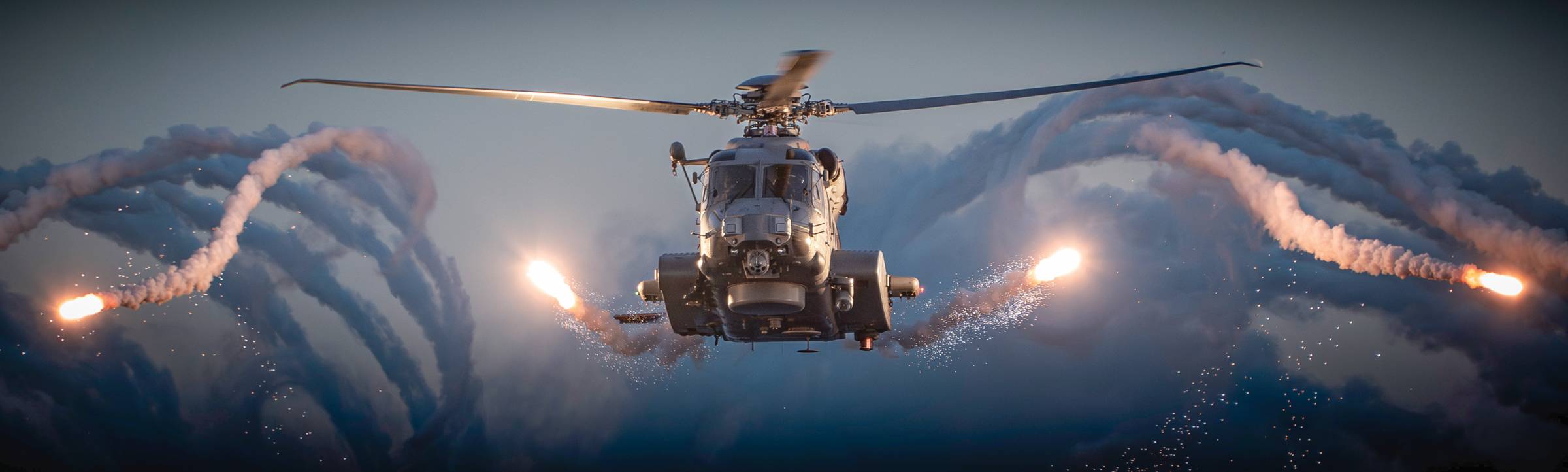
Photo: Aviator Gregory Cole, Canadian Armed Forces Photo
HMCS Charlottetown’s embarked CH-148 Cyclone helicopter “OSPREY” performs a flare countermeasure shoot during flight operations in the Mediterranean Sea while deployed on Operation REASSURANCE on August 19, 2024.
Michel Maisonneuve served as Academic Director of RMC Saint-Jean from 2007 to 2018. He completed 35 years of service in the Canadian Armed Forces in 2007. He was named the 30th laureate of the Vimy Award in 2020. In addition to his Canadian decorations, he is an Officer of the French Legion of Honour, an Officer of the U.S. Legion of Merit and a recipient of the NATO Meritorious Service Medal. He published his first book in 2024: “In Defence of Canada : Reflections of a Patriot”.
Dominique Trinquand is an officer in the Arme blindée cavalerie française (French armoured cavalry) whom I have known for 47 years. We met as young lieutenants when I was serving as a Canadian Exchange Officer with the 12e Régiment de chasseurs at Sedan in the Ardennes (which, at the time, was paired with the 12e Régiment blindé du Canada). His extraordinary career led him to be present at a number of politico-military events of the past few decades and to influence them. His experiences have made him an important commentator, able to discuss events and issues in plain language, and he is much sought after by Francophone media. This book provides an excellent overview of the events of the 20th century and up to the present day. It is also peppered with anecdotes from his own experience that illustrate his role in the events, or as an observer, and his direct experience lends credibility to what he has to say.
The author identifies the Russian invasion of Ukraine as the primary element which demonstrates the breakdown of the global order, but he also goes back in time to point out the signs that should have alerted us to that situation. This is the “butterfly effect” he describes, with the support of a series of excellent maps at the end of the book.
The lack of international reaction following the annexation of Crimea in 2014 undoubtedly emboldened Putin to invade Ukraine eight years later. Like Trinquand, I did not believe it at the time: surely he would not try to invade a country whose armed forces had 200,000 members, when Russia’s had only 150,000 troops massed along the border? But Putin was likely counting on being welcomed as a savior.
Trinquand comments on the decline of the United States, saying that the country is continuing to disrupt the global order and no longer knows how to re-establish it. The problem is ongoing, and even worsening: “the global policeman” now seems incapable of successfully playing that role. Trinquand tells the story of France’s refusal to associate itself with the actions of the U.S. in Iraq, which reminds us that Canada took the same position. When I arrived in Norfolk, Virginia, in 2003 as Chief of Staff of NATO’s Supreme Allied Command Atlantic, there was still tension among the generals and admirals there regarding the positions of our two countries … and “freedom fries” were still being served in restaurants.
Trinquand writes about the French fighter pilots en route to Syria after Obama’s “Red Line” had been crossed. They had to turn around in mid-mission because Obama lost his nerve. The author also comments on the rise of China after a stay there, sharing his impressions of Taiwan and of China’s ability to annex that “province.”
Trinquand served as Military Advisor to the French diplomatic mission to the United Nations (a position that was created after he demonstrated its value). His accounts give us a front-row seat at the often-difficult debates in which he participated. He worked with Kofi Annan, Sergio de Mello, and successive French ministers and ambassadors, and that part of the story is compelling, especially now that we have witnessed the results of the decisions made there.
Trinquand comments positively on France’s actions in Africa, and he shows by example that France is able to accomplish more than the United States in Africa by means of its agility and the relationships it has there. He even organized a visit by the entire UN Security Council to Bunia, which was certainly an excellent way to demonstrate France’s ability to accomplish a high-profile mission with tact.
Regarding Iran, he believes that President Trump’s withdrawal from the Joint Comprehensive Plan of Action (JCPOA) was a mistake. I do not share his opinion, but Trinquand provides good arguments to support his views. France has always had a particularly close relationship with Iran. During my service in France with Dominique in 1979, the Shah’s wife (the Shabanou) had ordered Hermès scarves with a cavalry motif. After the couple’s exile, the scarves were offered to members of the Regiment at a reduced price.
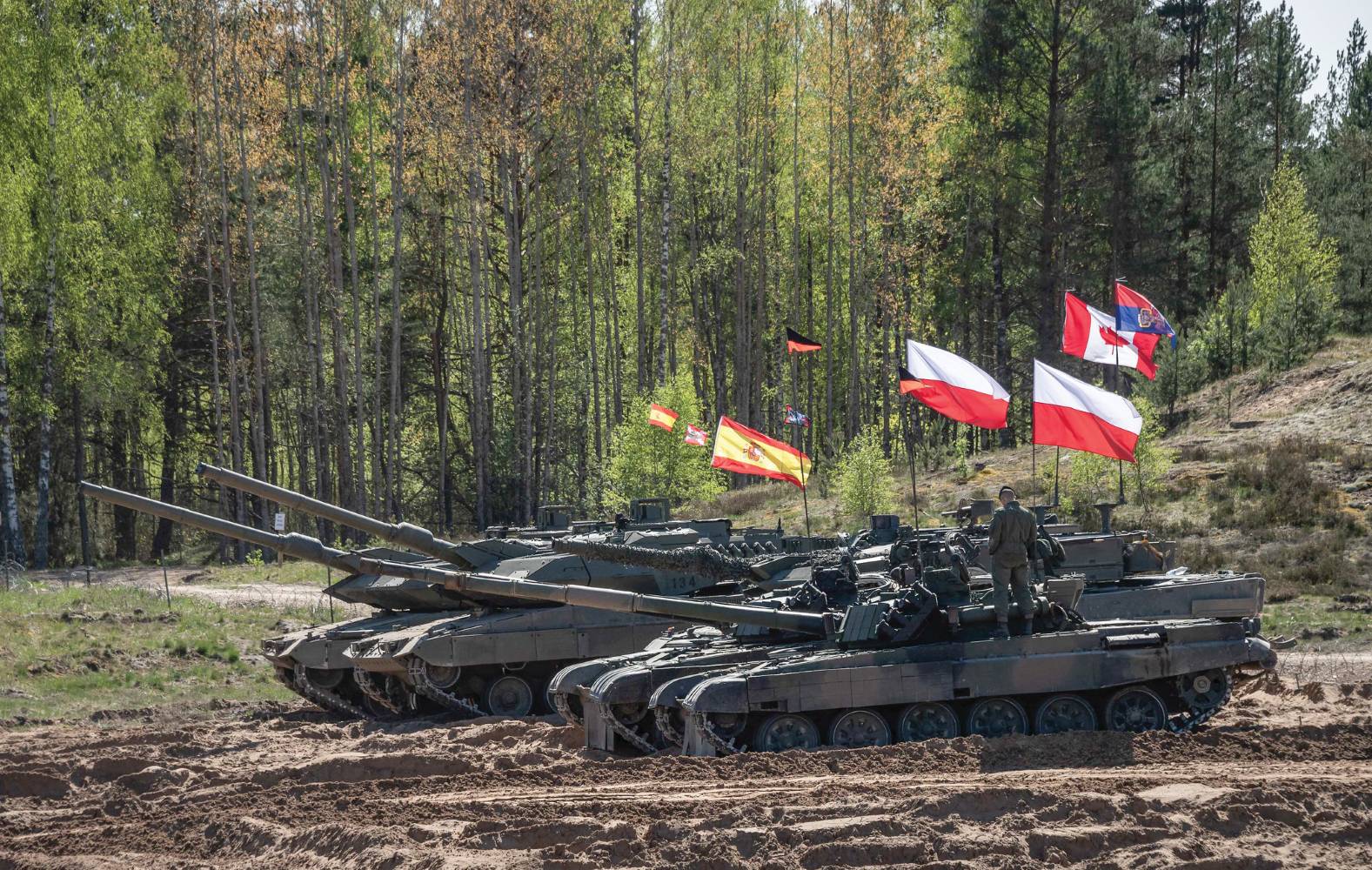
Photo: 8 Wing Imaging, Canadian Armed Forces
CH-146 Griffon after a landing on top of a mountain as part of a flight training, North of Whitehorse Cadet Training Center as part of OP NANOOK-TAKUNIQ 2025, Yukon Territory, on 11 March 2025.
Trinquand warmly relates his service as the personal advisor to the French general Jean Cot, the Commander of UNPROFOR, in 1993. That is where Trinquand and I met again for the first time since my departure from France in 1980. We were both personally involved in the actions at Medak Pocket, where a Canadian battalion group supported by two French companies had driven back Croatian forces from a salient they had just captured. Cot, an operational general and a strong leader, commanded UNPROFOR superbly and Trinquand supported him brilliantly in his heavy responsibilities.
He describes his early years as a student at the École spéciale militaire de Saint-Cyr. Later, he was appointed to command a regiment in Bitche that had to be disbanded the following year, and he explains how he motivated his troops. That is a typical example of Trinquand’s leadership: using a crisis as an opportunity.
The final chapters of the book comment on France’s current position, which also applies to Canada: decline; citizens’ apathy and complacency; poor budget management; rising deficit and debt—all while both countries have so much potential. He mounts a frontal attack on authoritarianism and relates his experiences during the events of September 11, 2001, when he was in the United States for large-scale manoeuvres. That leads to a discussion of the dangers that religious extremism and question of identity pose for France and the world. Are youth attracted to the certainty that Islam offers when their identity is contested?
The discussion segues into the last section, which focuses on the peril of individualism that is threatening the West. Individualism is fed by social media, which reduces personal contact to virtual messages and TikTok videos and which was taken to a new level during the pandemic. He reiterates the idea of “service” to country; not necessarily obligatory military service, but that would prioritize service to others and to country. In my view, an important prescription for France as well as Canada: There are many ways to serve!
Ce qui nous attend is an important overview that also delivers interesting anecdotes and fascinating reflections. The book is timely and applies equally to France and Canada, and it offers useful perspectives for any engaged citizen. I strongly recommend it.