

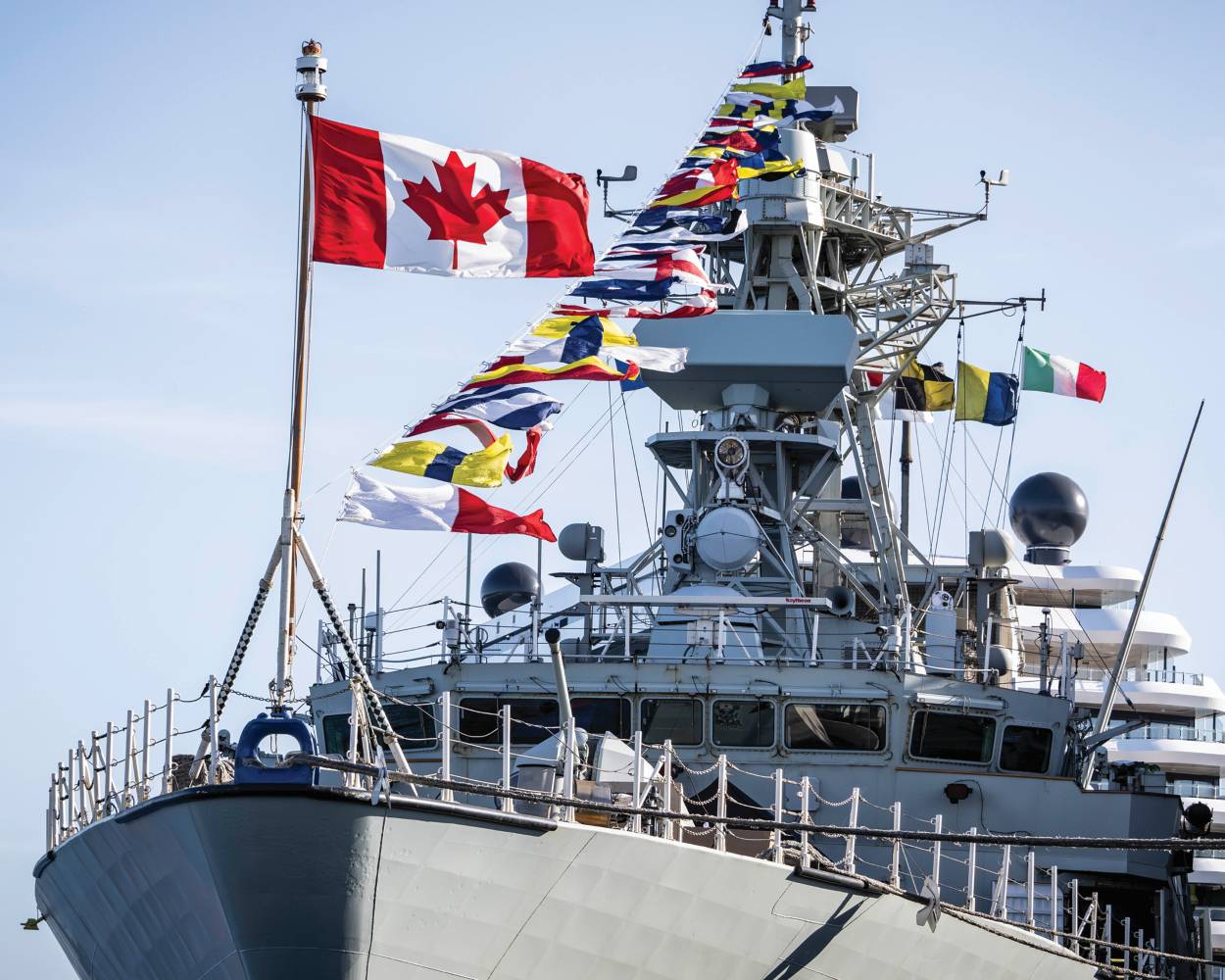
Photo: Aviator Gregory Cole, Canadian Armed Forces Photo
HMCS Charlottetown celebrates Spanish National Day while alongside ESPS Cantabria and ESPS Cristóbal Colón as the ships conduct a port visit in Catania, Italy, during Operation REASSURANCE on October 12, 2024.
Dr. Alessandro Marrone is Head of the Defence, Security and Space Programme at the Institute of International Affairs (Istituto Affari Internazionali [IAI]) in Rome. He has been working at IAI since 2007 and currently manages research projects and publications related to European and transatlantic security as well as to Italy’s defence policy. Since 2018, he has also been a Professor at the Istituto Superiore di Stato Maggiore Interforze of the Italian Ministry of Defence.
This article addresses the question of how NATO burden-sharing is debated and understood in Italy. First, it outlines Italy’s threat assessment, objectives and levels of ambition for national security and defence policy and also provides an overview of the Italian armed forces’ personnel, budget, and operational deployments. Second, it discusses Italy’s expectations of NATO and Rome’s priorities regarding the transatlantic alliance’s agenda. Third, the article analyzes the domestic debate on defence matters, NATO and burden-sharing. Lastly, it outlines how the Italian establishment frames such burden-sharing and what it means for the country’s defence policy.
1. Grounds for the national defence policy
1.1 Threat assessment and needs
Over the past decade, Italy’s threat assessment has had to consider two main fronts: south and east. On the one hand, the security challenges stemming from the “enlarged Mediterranean” region, encompassing continental Europe, North Africa, the Sahel, the Horn of Africa, and the Middle East,Footnote1 represent a primary front. Such challenges include instability, terrorism, smuggling of migrants, and threats to the sea lines of communication and to energy supplies. Italian institutions and governments have conceived of the country’s national security and interests primarily in relation to this area, even more so after the destabilizing effects of the turmoil that occurred in Arab countries from 2011 onwards. The US retrenchment from North Africa and the Middle East, which culminated in the NATO retreat from Afghanistan in 2021, opened the door to more aggressive actions by a number of countries in the regions as well as external powers including Russia. Italy felt deeply threatened by the proliferation of tensions, crises, and conflicts in the enlarged Mediterranean and their negative repercussions on its national interests.
On the other hand, there is NATO’s eastern flank and Russian aggressiveness. Notably, for a variety of historical, geographical, economic, and cultural reasons, Italy did not consider Russia to be a direct and significant threat after the 2014 illegal annexation of Crimea. Italian institutions and the Italian government took stock of the tensions on the Eastern flank and committed to NATO reassurance and deterrence measures, first with the Enhanced Forward Presence by deploying some 250 soldiers in Latvia,Footnote2 but the focus remained mostly on the enlarged Mediterranean. Moreover, from 2014 until 2021 public opinion and the electorate in Italy held a rather mixed view of Russia and Ukraine, with different perceptions and misperceptions about what happened in Donbas and Crimea and why.
That threat assessment changed somewhat after the 2022 full-scale invasion of Ukraine, particularly within Italy’s establishment and institutions. Italy is much more aware of the threat posed by Russia as well as the risk of escalation and direct involvement of European countries in the conflict. But such change is still a work in progress, and currently a plurality of views on the extent and level of Russian threat coexist in the institutions, along the political spectrum and in public opinion, and the process of determining the war’s strategic implications for Italy is continuing.Footnote3 Against this backdrop, NATO represents an important framework for making Italian institutions and stakeholders more aware of the threat posed by Russia, also thanks to information sharing and constant politico-military consultation, and is the cornerstone for Italy’s contribution to Europe’s collective deterrence and defence.
While the assessment of the Russian threat has definitively worsened since February 2022 among policy makers and even more in public opinion, there is still a strong prioritization of the protection and promotion of national interests in the enlarged Mediterranean region, which continues to be the main path for Italian foreign and defence policy.Footnote4 Accordingly, Italy’s defence policy and armed forces need to maintain the ability to perform a continuum of tasks, ranging from stabilization operations to crisis management to collective deterrence and defence. They are also mandated to remain active in Europe, Africa and the Middle East. Notably, in 2022-2025, Italy did deploy a further 900 military personnel on NATO’s eastern flank, namely in Bulgaria as lead nation of NATO Enhanced Vigilance Activity, but did not withdraw from any of its 34 military operations abroad and even launched new missions in Africa.Footnote5 In 2024, Italy took tactical command of the EU naval operation Aspides in the Red Sea to counter the Houthis organization’s attacks against commercial shipping, and it continues to deploy naval assets in that mission in 2025. As a whole, that means the Italian military has to do more than in the previous decade in terms of both quality and quantity, and that it therefore needs robust and long-term investments and modernization of its capabilities in order to maintain balanced and effective armed forces. Despite such increased activism and certain media coverage of operations abroad such as Aspides, defence continued to rank rather low among national budgetary priorities and even lower in broader public opinion in comparison with other policies, until 2024. That has not prevented the Italian government from pursuing a quite robust level of ambition.
Notably, in 2025 three factors led Italian media and citizens to engage in more discussion about international security and military spending. First, the Trump administration had a huge media impact with its announcements and/or decisions regarding Ukraine, Russia, Gaza, and Iran, which fuelled a variety of reactions including growing concern about the predictability and reliability of the United States. Second, the European Union (EU) initiative on defence expenditures attracted much attention from politicians and the general public, notably regarding the possibility of activating the “escape clause” within the EU Stability and Growth Pact for up to 1.5% of defence spending, as well as the SAFE instrument to lend €150 billion to member states. Lastly, the new NATO targets agreed upon at the summit in The Hague had a huge echo because of their expected impact on the national budget and on the Italian aerospace and defence industries. Those three elements in turn increased Italy’s level of ambition in terms of defence spending and military capabilities.
1.2 Ambitions and objectives
Italy traditionally pursues its foreign and defence policy within three overlapping circles: the transatlantic one, including both NATO and Italy’s bilateral relations with the US; the European one, encompassing recent EU defence initiatives but also the traditional partnership with the UK and the recently strengthened ones with France and Germany;Footnote6 and the enlarged Mediterranean, whereby Rome engages more and more bilaterally with partners in the region and strives to have both NATO and the EU take greater responsibility for the area’s security and stability.Footnote7
Accordingly, Italy seeks NATO cohesion and EU defence integration as a win-win approach.Footnote8 Italian governments see NATO as a politico-military alliance to serve national and collective interests, by maintaining a 360-degree approach to security threats and challenges, and as the best way to keep the US engaged in Europe.Footnote9 At the same time, the EU is the framework for achieving greater “integration of resources and capabilities”Footnote10 in terms of capability development, procurement, industry, and technology, which would benefit European countries that are members of both the Union and the Alliance. Thus, Italy supports an appropriate level of European strategic autonomy, in complementarity and synergy with NATO, and strongly pursues NATO-EU strategic partnership. In particular, Italian governments, as well as Italians holding policy-making positions within EU institutions, have often put forward the motto “Strategic autonomy not from someone, but to do something.”Footnote11 That means preserving NATO as the cornerstone for Europe’s collective defence, while building European capacities to act where the Atlantic Alliance is unwilling or unable to do so, for example, in terms of stability operations in Africa and the Middle East, and, broadly speaking, framing a positive agenda for strategic autonomy which is sustainable at the transatlantic level.Footnote12 This approach goes hand in hand with the traditional Italian support for a “strong European pillar” of NATO,Footnote13 to the benefit of the whole alliance, restated by Prime Minister Giorgia Meloni at The Hague summit.Footnote14
As mentioned before, the enlarged Mediterranean had already become a priority for Italy after the 2011 revolutions in Arab countries, and it remains so despite the Russian invasion of Ukraine. Italian military commitment in Africa and the Middle East has grown in parallel with the NATO retreat from Afghanistan.Footnote15 Since 2022, Meloni’s government has put a renewed political emphasis on the region, where Italy wants to establish a leading role. This goes hand in hand with the government’s “Mattei Plan for Africa,” a long-term initiative aimed at establishing wide-ranging, fair partnerships with African countries concerning trade, infrastructure, energy, migration, and stability.Footnote16 A coordinating body has been set up to ensure a whole-of-government approach and the involvement of the private sector and civil society, and in 2024 the first-ever Italy-Africa summit was held,Footnote17 followed by a second in 2025.
Meloni’s government is relatively stable in the Italian institutional landscape, having been in charge since 2022. Its defence policy shows a remarkable degree of continuity with previous prime ministers, albeit with a conservative tinge stressing the importance of the Atlantic alliance as well as of more autonomous action in the enlarged Mediterranean. Broadly speaking, the Head of State (who is also the supreme commander of the armed forces) and the diplomatic, military, and intelligence apparatus are quite closely aligned on the aforementioned basics of Italian defence policy in terms of both ambitions and objectives. Moreover, in the post–Cold War period, a bipartisan consensus supported Italian missions abroad, as demonstrated by the track record of parliamentary votes regardless of the composition of the ruling majority,Footnote18 thus reinforcing the stability and continuity of the Italian defence posture. Interestingly, according to different surveys, by the end of the 2010s a majority of Italians approved military operations abroad under the aegis of NATO, the UN or the EU, albeit preferring non-combat missions.Footnote19 Such an attitude creates a favourable political context for the pursuit of foreign and defence policy goals.
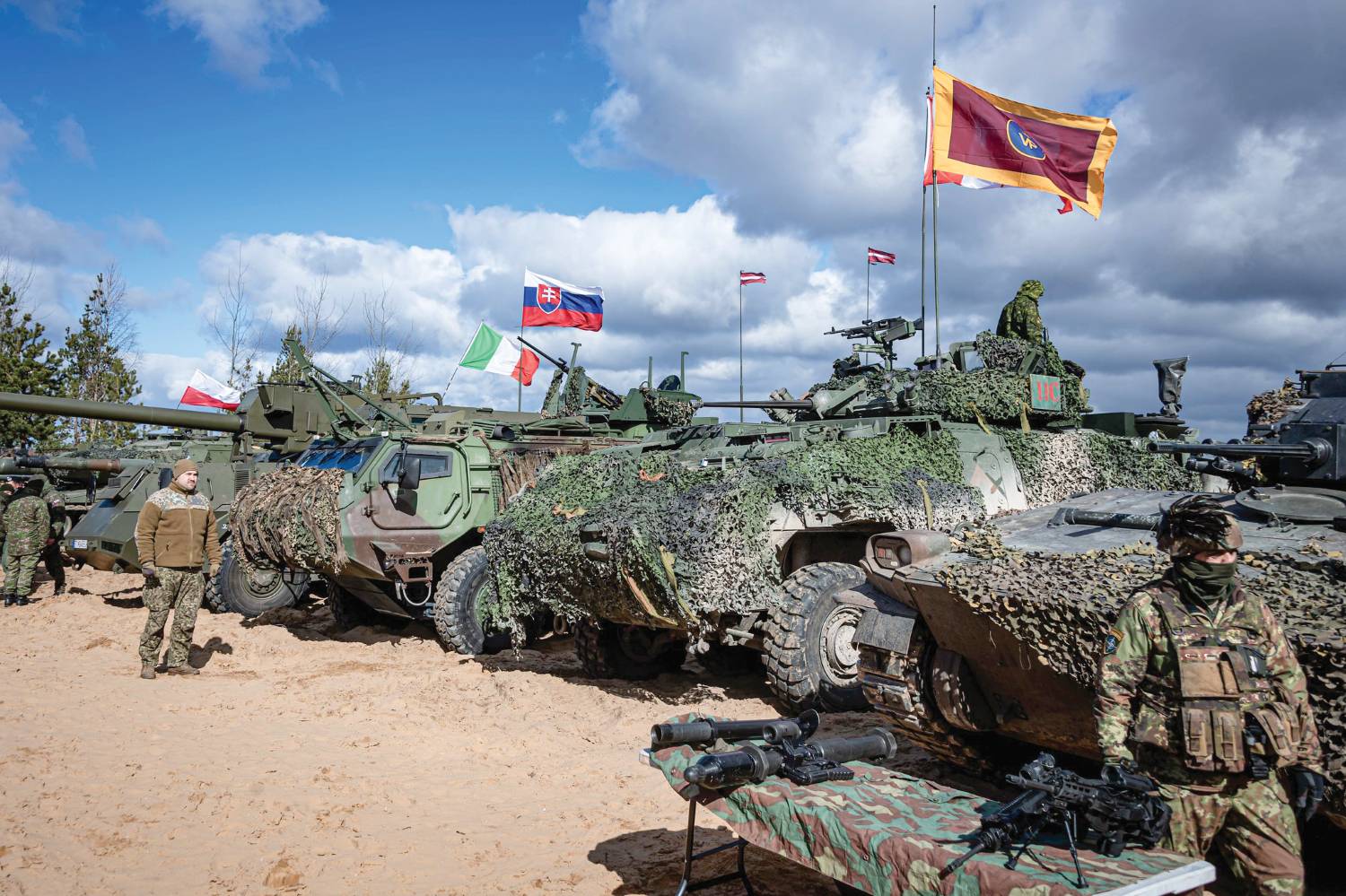
Photo: Canadian Armed Forces
Members of multiple nations conduct a firepower demonstration for media and special guests during Operation REASSURANCE at Camp Adazi, Latvia on March 29, 2023.
Looking ahead, the Italian threat assessment, level of ambition, and objectives across the aforementioned three circles—European, transatlantic, and enlarged Mediterranean—is quite stable. China’s aggressiveness in the Indo-Pacific, in the cyber and space domains, and across trade and technology policies, coupled with its support for the Russian war in Ukraine, has led the US, NATO, and, to a lesser extent, the EU to change their posture vis-à-vis Beijing. This broader geopolitical shift has also had an impact on Italy. In 2023, the Meloni government decided to leave the Chinese-led Belt and Road Initiative in order to fully align with the Western camp. In 2022, Italy, Japan, and the UK launched the Global Combat Air Programme (GCAP), a military, technological, and industrial partnership to develop and produce a next-generation fighter aircraft which will bind the three countries for decades to come. GCAP will connect Rome with the Indo-Pacific via a stronger relationship with Tokyo and will familiarize Italian policy makers with Japanese threat assessment on China.Footnote20 That being said, neither China nor the Indo-Pacific are likely to become as important for Italy as the three aforementioned circles. Other factors, such as climate change, are not going to change the Italian outlook in the short to mid term, although climate change is recognized as a multiplier of instability in Africa.
1.3 Current level of effort
As of 2024, the Italian armed forces consist of approximately 166,000 professional members.Footnote21 Interestingly, in 2011, Italy had planned to reduce the armed forces’ size from 190,000 to 150,000 members, but after the war in Ukraine began in 2022, a new law raised the target to 160,000.Footnote22 Since 2022, in light of the conflict at NATO borders, a debate has unfolded on the proper size of Italy’s armed forces, including the possible establishment of a reserve force. Nowadays the question is how and how much to increase the current level of human resources, as well as how to lower the average age of military personnel with a view to high-intensity combat tasks. In 2024, then Chief of Defence Giuseppe Cavo Dragone argued in a parliamentary hearing that 170,000 members was the minimum threshold to reach.Footnote23
The 2024 defence budget reached 1.51% of GDP,Footnote24 with a slight increase over 2023. In spring 2025, Meloni and Foreign Minister Antonio Tajani announced that Italy had reached 2% of GDP, based on a more accurate accounting of defence expenditures previously not considered in that basket,Footnote25 but since the Ministry of Defence has not yet published its multi-year programming document with the precise budget allocation, at time of writing it is not possible to assess the details and implications of those announcements. Rome matches, and since the late 2010s has exceeded, another allied benchmark: more than 20% of the defence budget allocated to equipment. For example, in 2023 it amounted to 23%.Footnote26 At the same time, too little funding is allocated to operational costs such as training, exercises, and maintenance, repair and overhaul of equipment, because approximately 60% of the defence budget is spent on personnel. Such an imbalance hampers the readiness of military capabilities, particularly with a view to large-scale, high-intensity scenarios.
As of 2025, roughly 7,600 Italian troops are deployed in military operations abroad, and a maximum of 14,500 is envisagedFootnote27 (2,000 more than in 2024), to also take into account the high-readiness forces to be eventually deployed within the new NATO Force Model. Current military deployments abroad encompass peacekeeping operations in Kosovo and Lebanon, defence capacity building in Iraq and Africa, one operation in the Red Sea,Footnote28 NATO air policing in Europe, and forward defence across the Alliance’s eastern flank from Latvia to Bulgaria.
In particular, as mentioned before, Italy is the framework nation of the allied multinational battalion positioned in Bulgaria as part of NATO Enhanced Vigilance Activity on the eastern flank.Footnote29 Italy also commands the NATO Kosovo Force and the EU Training Mission Somalia. In naval operations, Rome holds the strategic command of EUNAVFOR MED Irini in the Mediterranean Sea, as well as the tactical commands of European mission AGENOR in the Straits of Hormuz and of the aforementioned EU operation Aspides in the Red Sea. Major bilateral operations are being conducted in Niger and Libya. In addition, about 5,000 Italian soldiers are regularly employed on national territory for homeland security purposes.
Against this backdrop, from February 2022 to December 2023 Italy donated approximately €2.2 billion worth of military equipment to Ukraine.Footnote30 Although the data on type, quantity, and quality of supplies are classified, it is fair to say that Italian stocks of artillery, armoured vehicles, counter-drones, and missile defence systems, with the related ammunition and spare parts, have been seriously depleted over the last two years, and little money has been invested to replenish them.
2. What does the Atlantic Alliance stand for?
2.1 Expectations for national security
Italian expectations for NATO’s role in national security are focused on Russia, but even more on the enlarged Mediterranean. On the eastern flank, until 2021 the Alliance was seen by Rome as a useful “insurance policy” against Russian military pressure or hybrid aggressions against Europe.Footnote31 After February 2022, the NATO shield against the Russian threat has obviously gained much more political relevance. The 2022 Chief of Defence Strategic Concept clearly confirms that NATO is “the alliance for collective deterrence and defence.”Footnote32 Also, within the allied “dual-track approach” to Russia, Rome emphasized dialogue over defence since the first Russian invasion of Crimea and Donbas in 2014.Footnote33 In this context, the Alliance provides a valued multilateral framework for dialogue with the Russian Federation through transparency and confidence-building measures, even at times of extreme geopolitical confrontation, in order to avoid incidents and unintended escalations beyond the war already going on in Ukraine. Such expectations for NATO’s role as the cornerstone of Europe’s collective defence, security and strategic stability have survived the transatlantic tensions created by the Donald Trump presidency from 2017 to 2020, when Italy supported more intra-EU cooperation and integration in the defence field, but always in synergy with the Atlantic Alliance. During the first half of 2025, Meloni’s government continued to prioritize NATO as the framework to ensure Europe’s collective deterrence and defence in the face of the Russian threat and worked to convince the U.S. to maintain the cohesion of the West also embodied by NATO.Footnote34
In the post-Cold War era, Italy has very strong, high, and deep-rooted expectations of NATO regarding its role on the country’s southern flank and, as previously mentioned, Rome has constantly sought greater Alliance involvement in the area: first, with the establishment of NATO partnerships such as the Mediterranean Dialogue (1994) and the Istanbul Cooperation Initiative (2004), and second, via crisis management and stability operations, from the Western Balkans since the 1990s to Libya in 2011 and Iraq until now, as well as through maritime missions like Ocean Shield or the ongoing Sea Guardian. In the 2010s, Rome was the main supporter of NATO’s 360-degree approach against all security challenges from both NATO’s eastern and southern flanks, the “projecting stability” agenda,Footnote35 and NATO initiatives such as the Framework for the South, the Package for the South, and the Strategic Direction South Hub established in Naples in 2016. Since 2015, Italy has also acted as NATO framework nation for crisis management and stability operations with a view to deployments in the enlarged Mediterranean by leading a group of seven other allies,Footnote36 while Germany did so for collective defence and the UK for high-intensity expeditionary forces. After the 2011 destabilization of several Arab countries, political leaders across the Italian Parliament’s spectrum have repeatedly called for NATO to “do more” in the South. Yet Italy found it hard to transform this political goal into concrete, viable policy recommendations, let alone actions.Footnote37 Since 2022, NATO has de-prioritized the southern flank because of the renewed Russian threat in the east, as epitomized by the current Strategic Concept, which does not even mention the Mediterranean Dialogue or the Istanbul Cooperation Initiative.Footnote38
The Hague communiqué does not even mention the key words “southern flank”, “terrorism” or “partnership” which Italy pushed in previous summits.Footnote39 Yet Italy has continued to try to put the enlarged Mediterranean on the NATO agenda. For instance, it supported the preparation of a report on NATO’s southern neighbourhood by the group of experts appointed by the Secretary General in 2023 and welcomed its results with a view to the appointment of a NATO Special Envoy for the southern flank. At the same time, from 2021 onwards, senior Italian figures, including then Minister of Defence Lorenzo Guerini and then Chief of Defence Staff Enzo Vecciarelli, have explicitly explored other avenues for international cooperation in the enlarged Mediterranean. It is not by chance that Italy has tackled the threat posed by Houthis attacks to the sea line of communication in the Red Sea by promoting the EU’s Operation Aspides. Since 2022, Defence Minister Guido Crosetto has renewed bilateral efforts on defence cooperation in Africa and the Middle East, in line with the Mattei Plan for Africa, while maintaining the commitment on the UNIFIL II mission despite escalation between Hezbollah and Israel in Lebanon.
On the whole, a reflection seems to have begun on the strategic implications of the Russian war in Ukraine for NATO and Italy. Two different views appear to have emerged. On the one hand, the traditional idea, held by the majority, that NATO should adopt a 360° approach and devote more attention and resources to its southern flank was also put forward by Minister of Foreign Affairs Antonio Tajani at the NATO ministerial meeting in April 2024Footnote40 and by Prime Minister Meloni at the subsequent Washington Summit and at The Hague Summit in June 2025.Footnote41 This view is deeply rooted in the Italian establishment, particularly the Ministry of Foreign Affairs, and resonates widely in the public debate. Interestingly, the Meloni government’s official communiqué to celebrate the 75th anniversary of the Washington Treaty, on April 4, 2024, affirms the pride in “Italy’s decisive contribution to [the] Alliance’s missions and operation as well as to its adaptation to new security challenges, including threats on its southern flank and the Mediterranean”:Footnote42 there is no mention at all of Europe’s collective defence. On the other hand, an alternative, minority view takes stock of the watershed represented by the war in Ukraine and the fact that NATO is focusing and will focus almost entirely on the Russian threat. As a result, Italy should pursue its national interest in relation to the NATO agenda as it is—Russia, and to a lesser extent China, space, cyber, etc.—and should deal with the enlarged Mediterranean primarily via bilateral relations and/or other mini-lateral/multilateral frameworks including the EU.Footnote43
2.2 Domestic debate on NATO burden-sharing
The domestic debate on NATO burden-sharing has been centred mainly on military expenditure. To a lesser extent, it also considered the balance between Italian contribution to the alliance and NATO benefits for national security. Another peculiar element is Italy’s participation in the allied nuclear sharing arrangements, which is rather marginal in the public debate. All these elements have been impacted from 2022 onwards by the Russian invasion of Ukraine.
Four background considerations are particularly important concerning the broader debate on defence policy and expenditure. First, the huge public debt—approximately 135% of Italian GDP at the end of 2024—and high taxation heavily constrain the manoeuvre room for increasing the military budget by forcing governments to eventually move funds from other policy areas, thus triggering opposition from the related constituencies.
Second, there is a very vocal minority in Italian society that opposes defence expenditure, an opposition which relies on deep-rooted pacifism in both the left-wing and Catholic electorate and is able to shape public debate. Left-wing pacifism dates back to the Cold War, when a strong Italian communist party was advocating pacifism as an alternative to NATO alignment,Footnote44 and is currently embraced by the Five Star Movement. Catholic pacifism has been revived by the late Pope Francis’s public statements on the war in Ukraine. In addition, a sort of populist, right-wing pacifism has emerged over the last decade, which is somehow cultivated by the Lega. The Israeli war in Gaza, despite not being directly connected with NATO nor with Italian defence policy, has revived anti-military and anti-defence industry groups across Italian universities, which organized a number of rallies in 2024.
Moreover, until 2021, armed forces, institutions, and mainstream political parties were very reluctant to make the case for military expenditure in the public debate.Footnote45 Last but not least, before the 2022 Russian invasion of Ukraine, the Italian debate on defence matters had been rather sporadic, superficial, and limited to a tiny portion of public opinion, which in turn made it more difficult to explain the armed forces’ needs. All these factors have led to a situation whereby until 2024 there was no majority consensus on the increase in defence spending towards the 2% goal pledged by Italy at the 2014 NATO summit.
That situation did not prevent subsequent Italian governments from pursuing a gradual increase of such spending over the last decade, from about 1% of GDP in the aftermath of the 2011 debt crisis to 1.51% of GDP in 2024—a 33.8% increase in 13 years. Yet there was no fundamental shift in 2022–2024, unlike Germany’s Zeitenwende or what happened in France, Poland, and Spain. Policy makers have been balancing national security interests, defence needs and electorate views in a pragmatic way, somehow overcoming a widespread opposition without countering it in the public discourse. One of the few exceptions has been Prime Minister Mario Draghi, who in 2022 stated clearly, “Italy should spend more on defence.”Footnote46 In November 2022, the Italian Parliament passed a motion—not legally binding—which committed the government to reach the 2% threshold by 2028.Footnote47 Italy, unlike France, does not have a multi-year military programming law, and the defence budget is negotiated within the government, together with the state budgetary law, which is discussed and approved by the Parliament on a yearly basis. This makes Italian military spending more dependent on changing political circumstances and less predictable in the mid term. Against this backdrop, the pressure exerted by Trump after his re-election had a significant impact on Italy, leading the Meloni government to announce the achievement of 2% of GDP spending on defence in 2025, as mentioned above. The same US pressure, coupled with growing concerns about the ongoing war in Ukraine and the risk of a future Russian attack against a NATO member, pushed Italy to agree on the 3.5% target for defence expenditure adopted at The Hague, to be reached by 2035. Certainly, the percentage of GDP allocated to the armed forces will remain a key parameter of burden-sharing for Washington, and therefore for Brussels, and thus a challenge to be faced by Rome to implement the commitment undertaken.
Beyond military expenditure, the debate on broader burden-sharing has been even more limited to practitioners, experts, and a very tiny section of academia, civil society, and specialized media. It reflected the aforementioned threat assessment on Russia and the enlarged Mediterranean. Media coverage increased due to the re-election of Donald Trump and the decisions and/or announcements his administration made in 2025. However, concerning threat assessment and the eastern flank, since 2014, the Italian military contribution to reassurance and deterrence measures has not been widely promoted by institutions, in the face of public opinion that was not keen to see Moscow as a real, immediate and significant threat and was more concerned about the risks of escalation. That contributed to preventing a systematic, in-depth debate on transatlantic burden-sharing, despite the fact that Italy’s military contribution in this regard was significant in comparison with the whole of operations abroad and with other major European countries. At the same time, most of the attention in the public debate has been devoted to NATO’s role in the enlarged Mediterranean; the “projecting stability” agenda, including activities such as security force assistance; the partnerships and dialogue with countries in the region; and the potentiality of initiatives such as the NATO Strategic Direction South Hub in Naples.
The Hub has been the only NATO infrastructure in Italy that received some positive attention in the public debate, at least at the time of its establishment and implementation. The same did not apply to the other 12 important NATO bases, centres of excellence, or facilities located in Italy. Most of the public does not know about those bases, but already since the early 2000s there have been protests by local communities and activists against some of those military installations.Footnote48 The protests have been motivated partly by the facilities’ perceived environmental impact, i.e., in terms of radio waves, and partly by a pacifist, anti-American ideological stance within the radical left.
There is a similar pattern for Italian commitment to NATO nuclear sharing, as this element has not been framed as part of burden-sharing in the public debate. The pacifist constituency repeatedly argued against Italy’s participation in the nuclear sharing arrangement, the stationing of U.S. nuclear weapons in Italy and the procurement of dual-capable aircraft such as the F-35, while mainstream media and the national institutions largely avoided the issue. Even the 2015 Italian White Book on International Security and Defence, one of the most outspoken and ambitious documents on Italian defence policy,Footnote49 marginalizes the nuclear dimension.
This situation changed somewhat after February 2022. The Russian invasion of Ukraine generated unprecedented media coverage of the conflict by a range of mainstream media, which usually do not cover international security at all. As a result, a large majority of the Italian public has become more familiar with five major elements: (i) the occurrence of a large-scale, high-intensity, protracted, bloody war in Europe; (ii) the realization of a scenario whereby Russia invades a neighbouring country; (iii) the fact that the invaded country fights back against the Russian Federation for more than three years and calls for help from Western allies; (iv) the large-scale, prolonged provision of military equipment by most NATO members including Italy; and (v) the need to invest more in defence to both support Ukraine and replenish the stocks of the Italian military. In other words, public opinion has been, to a certain extent, informed on the basics of NATO deterrence and Italian defence policy to a level not seen since the end of the Cold War.
This, in turn, has had a significant impact on the debate about transatlantic burden-sharing in three ways. First, it has clarified that the Russian threat is real. Second, it has made more evident the rationale for NATO as a collective defence organization, as further demonstrated by Finland’s and Sweden’s decisions to become members precisely because of the war. Third, it has made more legitimate and understandable the debate on how much money should be allocated to the military and what to do with it —i.e., to commit to NATO and/or to a European defence. However, such an impact should not be overestimated. A minority of Italian public opinion is still somewhat skeptical about the NATO role before and after Russia’s full-fledged invasion of Ukraine. Another strong constituency wishes to have peace at any cost, even if it involves the surrender of Kiev, and believes that once Moscow has occupied the whole of Ukraine it will be satisfied and will not threaten NATO anymore. The latter view has been enhanced by Trump’s promise to end the war in Ukraine by seeking a peace deal with Russia. At the same time, the aforementioned combination of the Trump administration’s pressure, EU defence initiatives, and NATO commitment to increase national defence spending has further polarized the debate in Italy, between those who recognize the new reality and its implications and those who strongly oppose it.
In conclusion, a plurality of views remains in the public debate on the importance of the Atlantic alliance and, thus, of the related burden-sharing, and any Italian government has to deal with the overall orientation of the electorate.
3. Understanding of burden-sharing
Italy has obviously subscribed to the 2014 Defence Pledge, including the goal to reach the 2% of GDP threshold, as well as the subsequent NATO declarations which restated that pledge—up to the 2023 and 2024 summits, where 2% became a floor rather than a ceiling. However, Rome negotiated within NATO to introduce some flexibility in its implementation, because Italy always considered it a political commitment and not a legally binding one. As such, it was and is subject to government decision depending on a number of variables, such as the economic situation, national sovereign debt management, the outcome of elections, or the priority attached to emergencies such as the COVID-19 pandemic. In other words, Italy is not comfortable with the transactional approach put forward by the Trump administration in 2016–2019, whereby the 2% of GDP was considered a fee to be paid in order to benefit from the US security umbrella.
However, Italy and other European countries had to face the same transactional approach from the second Trump administration, taking into account an international security environment much worse than in the 2010s because of the Russian invasion of Ukraine. Therefore, Italy signed up for the 3.5% goal by pushing the deadline for reaching it to 2025, rather than around 2030-2032 as other allies proposed. It also insisted that the other 1.5% commitment on defence-related expenditure should include the budget for critical infrastructure.
Still, Italy thinks defence spending should not be the only parameter used to measure the contribution of a single ally to collective security. NATO, as an alliance of 33 sovereign countries with more than 75 years of positive track records in the political, geopolitical, institutional, military, and diplomatic spheres, is more than such a narrow interpretation of burden-sharing. Until 2021, the Allies’ contribution to NATO activities has been summarized by Secretary General Jens Stoltenberg as the “3C” approach: cash, capabilities, and contribution.Footnote50 “Cash” obviously represents the 2% of GDP parameter of the defence budget. “Capabilities” refer to another element of the 2014 Defence Investment Pledge, which is to allocate at least 20% of the defence budget to the procurement of equipment. Last but not least, “contribution” means whether, how, and to what extent the armed forces of each member state contribute to NATO operations, including both out-of-area ones and activities for collective deterrence and defence.
In this context, Italy displays a record of constant presence in NATO operations, often at a relatively high level, thus presenting itself as a security producer rather than a security consumer. Over the last decade, it has been the second-largest contributor to NATO missions, after the United States. The Italian presence in Afghanistan has been particularly significant, reaching 5,000 troops during the peak of ISAF in 2009, and close to 900 within the Resolute Support Mission in 2021, and included the responsibility for the Regional Command West. Italy has held the command of KFOR 13 times since 1999, including since 2022 onwards, and as of 2024 it deploys more than 850 troops there.Footnote51 Concerning deterrence and defence, the Italian army has deployed about 250 troops and 57 vehicles in Latvia within the Enhanced Forward Presence, while the air force has been repeatedly in charge of the air policing of the Baltic States, Poland, Iceland, and the Balkan countries. Italy also led the NATO Very Rapid Joint Task Force—the spearhead of the NATO Response Force—in 2018. Lastly, Rome deployed SAMP/T missile defence systems in Turkey from 2018 to 2019 within the NATO mission Active Fence,Footnote52 and then in Slovakia in 2023 and 2024. These novel military deployments on the Alliance eastern flank, coupled with the requirements of the NATO New Force Model, are putting the Italian military under pressure in terms of readiness and combat mass,Footnote53 particularly concerning land assets for large-scale, high-intensity, and prolonged war, such as main battle tank, short-range air defence, artillery, ammunition, and all the equipment related to heavy brigades, with the related logistics. Therefore, maintaining Italian commitment to NATO collective deterrence and defence will require robust and long-term investments in those capabilities, more expensive than those related to the previous decades of peacekeeping, counter-insurgency and stability operations. In other words, “contributions” are no longer a substitute for “cash,” but require more “cash” on their own.
| Operation | Maximum Contribution |
|---|---|
| Operation Allied Force, Serbia-Kosovo, 1999 | 22 Tornado; 6 AMX; 6 Tornado IDS; 4 Tornado ECR/IDS, 4 F-104 ASA 6 AV-8B |
| Operation Joint Enterprise (KFOR) | 638 |
| International Security Assistance Force (ISAF), Afghanistan | 4,250 |
| Operation Resolute Support (RS), Afghanistan | 950 |
| Operation Unified Protector, Libya, 2011 | F-16, Eurofighter, AV-8B, Tornado, AMX |
| Operation Active Endeavour (OAE), Mediterranean Sea | 600 |
| Operation Sea Guardian, Mediterranean Sea | 240 |
| Operation Ocean Shield, Gulf of Aden | 497 |
| Operation Active Fence | 130 |
| NATO Mission Iraq (NMI) | 280 |
| Enhanced Forward Presence (eFP), Battle Group Latvia | 238 |
| NATO Air Policing, Baltic States | 260 |
| NATO Maritime Groups, Mediterranean Sea | 235 |
Unfortunately, Italy’s performance on the “cash” parameter is much less favourable than on “contribution” or “capabilities,” in that it exposes the country to criticism regarding burden-sharing. As previously mentioned, in 2024 the Italian defence budget accounted for 1.51% of GDP, ranking 24th out of 31 allies.Footnote55 In contrast, on the NATO parameter concerning the share of the defence budget devoted to equipment, Italy scores 23% in comparison with the 20% NATO target.Footnote56 Interestingly, over the last decade, investments in equipment have risen more steadily than the overall military budget.
Beyond the “3C” parameters, Italy plays a central role—alongside Germany—in terms of NATO military infrastructure as well as the hosting of U.S. troops in Europe. Indeed, 13 allied facilities are located on Italian soil: Joint Force Command (Naples), Rapid Deployable Corps (Solbiate Olona), Deployable Air Command and Control Centre (Poggio Renatico), Airborne Ground Surveillance (Sigonella), space satcom Mobile User Objective System (Caltanissetta), NATO Defence College (Rome), Stability Policing Centre of Excellence (CoE) (Vicenza), Maritime Research Experimentation CoE (La Spezia), Security Forces Assistance CoE (Cesano), Modelling and Simulation centre (Rome), Strategic Direction South Hub (Naples), Civil-Military Cooperation Centre (Treviso), and the newly established Multinational Division South (Florence and Taranto). Accordingly, Italy bears part of the direct and indirect cost for these infrastructures in economic, logistical, and environmental terms. Some of them also represent valuable targets for hybrid or conventional warfare: for instance, Joint Force Command Naples or the Airborne Ground Surveillance installation in Sigonella.
Last but not least, Italy is one of the five Allies hosting US tactical nuclear weapons, procuring dual-capable aircraft since the 1980s like the Tornado, the Eurofighter and the F-35, and participating in the Allies’ nuclear planning group. This is a key part of the sharing of burden, risks, and costs related to collective defence, insofar as the former relies on a continuum of conventional capabilities, missiles, and nuclear capabilities, as re-stated by the 2022 Strategic Concept. In particular, Italy has participated in the development and production of the F35 since the late 1990s, is set to procure more than 90 aircraft, and is the only European country to join forces with the UK to operate F35s as part of a carrier strike group.
Conclusion
In conclusion, the understanding of burden-sharing in Italy encompasses, first and foremost, the 3C parameters, whereby defence spending has to be considered together with the percentage devoted to procurement and the active military contribution to NATO operations, as well as deterrence and defence activities. Moreover, the costs associated with hosting 13 allied military installations on Italian soil should be taken into account. Last but not least, Italy’s role in NATO nuclear sharing is an extremely valuable contribution in terms of investments, capabilities, infrastructure, and risks.
Lastly, concerning the expenditure targets agreed upon by the Allies at The Hague Summit, the 1.5% parameter is important to make it clear that Italy and other European countries already invest in critical infrastructure and civilian resilience, which is an important part of ensuring that Europe can withstand a possible Russian escalation by establishing and maintaining credible deterrence. As a whole, a politico-military alliance like NATO should adopt a more holistic, balanced, and nuanced approach to the sharing of efforts to ensure collective deterrence, defence, and security.
Unfortunately, for a variety of reasons, the Italian debate on defence matters, NATO, and military spending does not contribute to properly shaping the understanding of burden-sharing, neither domestically nor at the international level. But Italy’s level of ambition, effort and commitment in the Atlantic alliance has in fact been quite high in the light of European standards during the post-Cold War period. As recalled by Prime Minister Meloni at the NATO Vilnius summit, “It is not only an issue of how much you spend, it is also an issue of how much you guarantee in terms of the effort you put in with your people, your energy, your professionalism, your centrality, your availability.”Footnote57
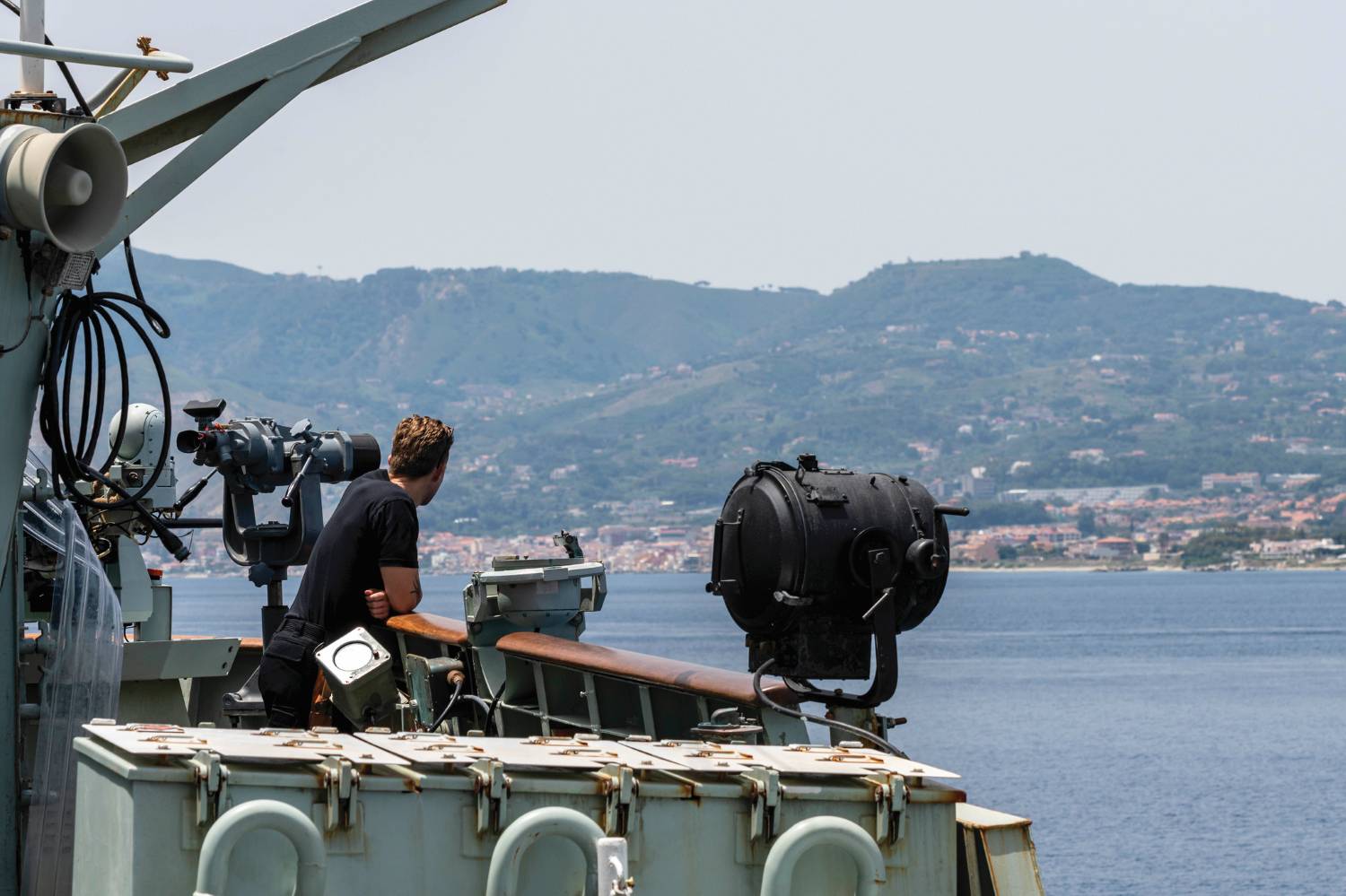
Photo: Cpl Noé Marchon, Canadian Armed Forces Photo
A sailor of HMCS FREDERICTON admires the coastline view of Italy as the ship sails through the Strait of Messina in the Mediterranean Sea during Operation REASSURANCE on June 23, 2023.