

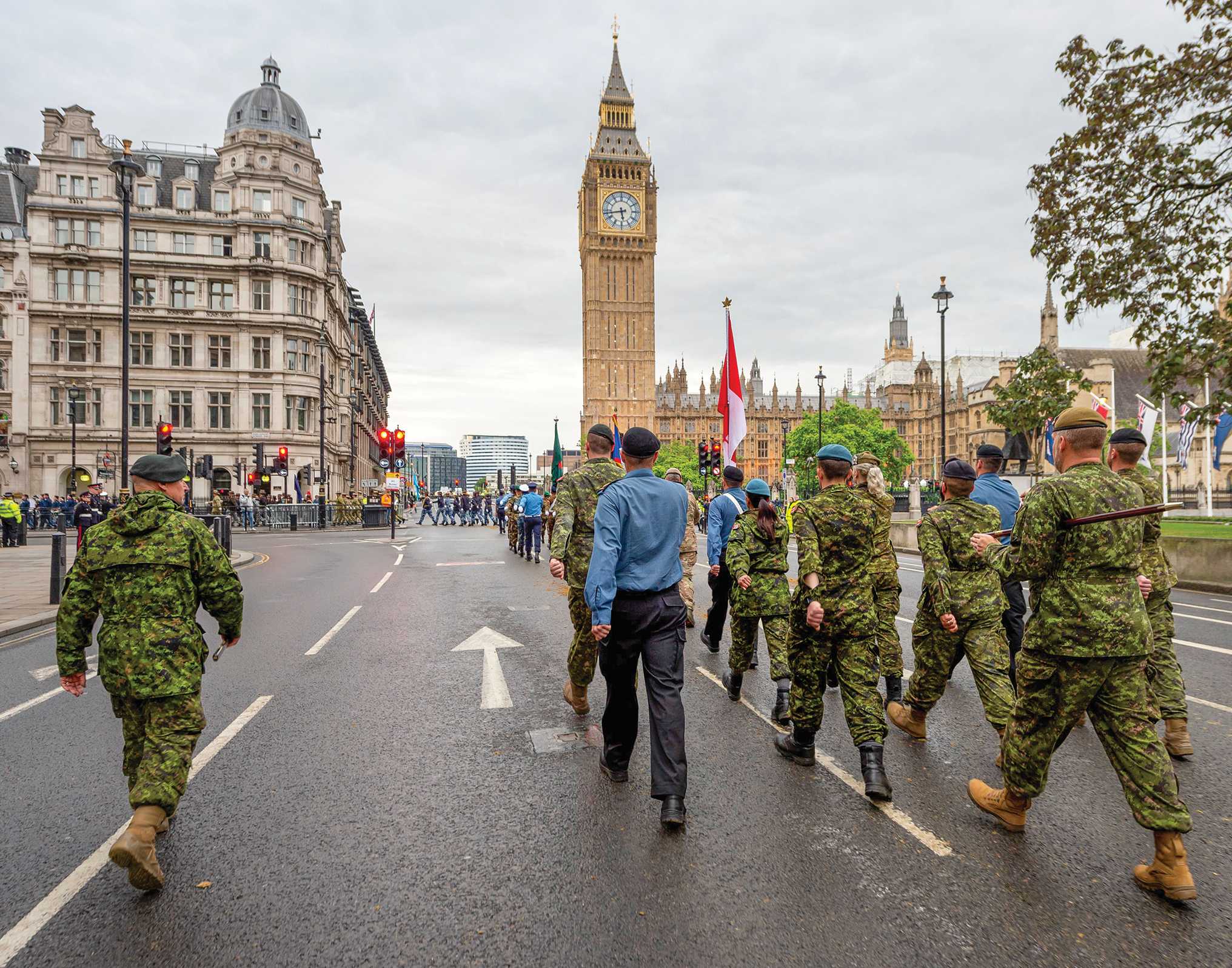
Photo: MCpl Nicolas Alonso, Canadian Forces Combat Camera
Canadian Armed Forces members rehearse a parade in the streets of London with other Commonwealth country contingents for Her Majesty the Queen’s Platinum Jubilee celebrations in London, England on May 31, 2022.
J. William Galbraith was a federal public servant for 30 years in investment review, intelligence and national security policy. He retired as Executive Director of the CSE Commissioner’s Office in 2018. Before his public service career, he spent seven years with the Conference Board of Canada. Mr. Galbraith holds a BA Hon. from Carleton University and a two-year graduate degree, “grande distinction,” from the Université Libre de Bruxelles. He is the author of “John Buchan: Model Governor General.”
“This last year has been a year of great anxiety and unrest throughout the world.” Indeed, it has! This quote, however, was part of the New Year’s Day message of the Governor-General of Canada, Lord Tweedsmuir (1935-40), in 1937. He was better known as the renowned author John Buchan. That pre-Second World War period saw Japan invading and occupying parts of China, civil war in Spain, Fascist Italy conquering Abyssinia (Ethiopia), and Hitler’s troops re-occupying the Rhineland. In this darkening context, Tweedsmuir’s speeches and activities encouraged Canadian unity, emphasizing “loyalty to Canada and to Canada’s King” in free association with the other countries of the Commonwealth. Canada was finding its role in the world post 1931-Statute of Westminster, which formally gave it (and the other Dominions) responsibility for its own foreign policy.
In a world where dictatorial regimes are again challenging democracy, The Enduring Crown Commonwealth: The Past, Present, and Future of the UK-Canada-ANZ Alliance and Why It Matters is an important book and should be read by foreign policy practitioners, academics and parliamentarians. The co-authors, Michael J. Smith and Stephen Klimczuk-Massion provided what historian Andrew Roberts describes as a timely and “inspiring manifesto for the future.” Professor Roberts highlights some urgency in this work’s timing and prescriptive nature, launching his comment from the authors’ statement that the “United States is not predictable anymore.” Roberts never thought he would agree with such a sentiment but adds that “a world where the United States is stumbling and uncertain of her role, her allies need to be as united as possible.”
The basic premise of this treatise is that for countries with “[shared] language, history and governing culture” as well as sharing a Head of State-Canada, Australia, New Zealand, United Kingdom, abbreviated CANZUK-it makes sense they should work closer together in a multi-polar world where democracies are challenged by the axis of China, Russia, Iran and North Korea. The geographically dispersed CANZUK nations have been steadily increasing their relations over the past decades, and, after a period of each finding their way in the post-WWII period, reconverging “in terms of trade, defence, foreign policy coordination, freedom of movement, mutual recognition of professional qualifications and other new and deeper links.”
In the words of Australian academic Peter Boyce in 2008: “The non-revolutionary constitution development in Canada, Australia and New Zealand may be seen as testimony to the genius of British and Westminster-derived political institutions and practice.” In Canada, we find a similar comment by then-professor Michael Ignatieff in a 2004 presentation at the Department of Foreign Affairs: “We have reason to be proud of our loyalty to British institutions, proud of our peaceful achievement of national independence.” The current, hyper-critical “woke” wave of self-loathing in the West does nothing to diminish the accomplishments of countries deeply committed to democracy and that remain magnets to immigrants and refugees from around the world seeking a freer and safer life.
This stimulating book is divided into three major chronological parts, with many sub-titles that are effectively standalone essays. The reader is led through a detailed and analytical progression from the “rise and fall of the Crown Commonwealth” through a re-convergence of the four principal realms-CANZUK-to a hoped-for but not guaranteed “potent international alliance.” The authors are neither nostalgic for the old Empire nor dreamers about the future, but they are perceptive, practical, and thorough in their exploration of this theme.
Queen Elizabeth’s accession to the throne in February 1952 and her Coronation in June 1953 created a euphoric mood in post-war Britain and the Commonwealth. It was the “high-water mark of a common spirit embracing Britons, Canadians, Australians, New Zealanders and many others.” Re-enforcing this were two significant events: the formation of a Commonwealth Division, under the auspices of the United Nations, at the start of the Korean War in 1953 and the very successful six-month tour of the Commonwealth by Queen Elizabeth in the Royal Yacht Britannia in 1953-54. The authors focus on the effects of Her Majesty’s presence in New Zealand and Australia, supporting the idea of the monarch spending time “residing” in the different realms, a theme raised in more detail later in the book.
The Queen’s 1959 Royal Visit to Canada, also in Britannia, to open the St. Lawrence Seaway, twenty years after the first-ever visit of a reigning monarch to Canada in 1939, was successful, but the euphoric mood had been tempered. The authors astutely segregate the then-still “sense of Britishness” in Canadians, Australians and New Zealanders from the point that this “did not automatically equate to unquestioned loyalty to Great Britain.” It was a “twilight” period for CANZUK.
The Suez Canal crisis catalyzed the “twilight” period when Egypt seized control of the Canal in 1956. Britain and France attempted to take back control but failed. The episode split the Commonwealth. Australia and New Zealand supported Britain’s intervention, Canada and South Africa abstained, and the Asian Commonwealth members opposed. It became a defining time for Canada as Lester Pearson, Secretary of State for External Affairs, was instrumental in organizing the first large-scale United Nations Peacekeeping force, for which he was awarded the Nobel Peace Prize in 1957.
The fallout from Suez enveloped the monarchy, leading to public criticism by the media and even a peer from the House of Lords, including “unprecedented personal attacks” on the Queen. It signalled “the end of deference.” Britain’s declining stature prompted it to examine the integration occurring on the continent during the 1950s.
Through the following decades, the Crown was being diminished in the realms. In Canada, the government of Pierre Trudeau introduced the unification of the armed forces in 1968, “a disaster for morale.” As a Sea Cadet on board HMCS Preserver for over two months in early 1971, I heard and saw the impact. “Royal” disappeared from the navy and air force in the unified Canadian Forces. In Australia in 1975, a constitutional crisis erupted with the dismissal of Prime Minister Gough Whitlam by Governor-General Sir John Kerr. This enraged many Australians despite constitutional experts stating the Governor-General could do it with the prerogative reserve powers of the Crown. The incensed Labour Party included an express article in its constitution to rid the country of the monarchy.
The authors examine the geographic and cultural contexts of Australia, New Zealand, and Canada, which acted as catalysts for the republican forces and the sense of distancing from the monarchy. In Australia and New Zealand, there was a growing orientation toward Asia. In Britain, the Commonwealth was overtaken by the growing pull of integration on the Continent; Britain joined the European Common Market in 1973. In Canada, the United States loomed ever more prominent in economic and cultural terms and became a defining element of Canadian identity-not being American.
There is an astute analysis of the rising strength of the republican movement in Australia. After 13 years of Labour Party rule (1983-1996), the authors deftly describe how “the resolute monarchist” John Howard “perceptively turned the tables,” defeating the Labour Party in a general election and beating the republican question in a national referendum in 1999. As the authors incisively comment, “Australia, the world was told, wanted an elected head of state, and now it had one”-the point “where the paradox loses its contradiction”…“that the ultimate guardian of democracy is an unelected figurehead.” The authors acknowledge the referendum result “was not so much that Australians were enamoured with the monarchy in the 1990s but that they were enamoured with the republican option far less.” They also rightly remark later, in the conclusion, that twenty years and more after the referendum, the current political dysfunction in the American republic does nothing to encourage the republican option.
Beyond Australia, there was a restoration of sorts occurring. In 1996, the New Zealand Labour government ended the use of British honours “to better reflect New Zealand identity” and, in 2000, abolished knighthoods, instituting instead a New Zealand Order of Merit. However, a new government (National Party) in 2009 restored knighthoods within a New Zealand-based order. Across the CANZ realms, efforts to retain the most-revered award for bravery, the Victoria Cross, were victorious against the zeal to strengthen national identity and replace the award. In Canada, “Royal” was restored to the Canadian Navy and Air Force in 2011.
Within the same timeframe, in Canada, the appointment of Adrienne Clarkson as governor-general (1999-2005) revived the post after it had been degraded over 25 years by prime ministers submitting names of mostly dull former politicians. Clarkson, a renowned television broadcaster, journalist and agent-general for Ontario in Paris, “elevated both the Crown and her office back to prominence with intelligence, style and panache.” She travelled widely, highlighting Canada’s North and the special relationship between the Crown and Indigenous peoples. Her appointment and approach were reminiscent of one of her predecessors whom she greatly admired, Lord Tweedsmuir. But her time wasn’t without criticism, as her approach is reflected in the authors’ sub-title of “Queen Adrienne,” alluding to her reference as Head-of-State.
The changed, more positive and bipartisan mood toward the monarchy in Canada was reflected in the text of a statement by the Hon. Stéphane Dion, former Liberal Party leader, responding to a motion by the Conservative government, celebrating the 2013 birth of Prince George (now second in line to the throne). Dion explained, “why the institution of the monarchy is more than just a relic of the past and why it remains relevant to Canada in the early 21st century.”
What was at the root of this changed mood toward the Crown? The authors explain, with sarcastic humour in the context of Australia, but which applies more broadly, that “if the unexpected return of the monarchy’s popularity has caused psychological harm to the many nationalists … they at least partly have the millennials to thank for it.” A new generation of royals attracted attention from the younger generation. The authors note that in the case of Australia, the older generation pushing for a republic in the referendum was seen as elitist and out of touch.
However, if the monarchy depends on personality and celebrity for popularity, it is a fickle base. The further I read into the book, the more I expected to find references to, if not a separate, sub-titled essay about, the role that education plays and, in Canada at least, the high level of civic illiteracy. Without a basic understanding of the constitutional role and gaining an appreciation of the institution itself, it is easy in ignorance to criticize an “archaic” and “settler-colonial” symbol (the latter theme is examined in the book’s last chapter under the sub-title “Decolonising the Colonial Past”).
There is a useful history and discussion of British politics in the second decade of the 2000s, culminating in the successful, if close, Brexit referendum, which put “global Britain” in focus. There are essays on: the Anglosphere; on putting the “C” back into the FCO (discussion about whether the Commonwealth will ever be more than a “useful talking shop” is stimulating); on Ireland; on Scotland; and under the amusing sub-title “The empire strikes back” they treat the serious subject of the expanded pool of expertise and experience that the CANZUK realms can represent but which is mainly one-way now with “Aussies, Kiwis and Canucks” being appointed to senior positions in key British institutions.
The third major Part of the book sees the authors weaving between high optimism and “enormous challenges.” “CANZUK Rising: Strategic Cousins in a Multipolar World: From Postimperial Club to Potent International Alliance.” It is an expression hopeful of increasing trade, defence and foreign policy coordination, freedom of movement, and other linkages of longer standing. More recently (2021), a joint letter from CANZUK parliamentary leaders recognized the benefits of their shared traditions, “commitment to the rule of law and a history of working together in defence of democracy.”
The authors present the arguments of CANZUK critics and those questioning its viability or desirability even, given, in part, the existence of other groupings (e.g. AUKUS, the Quad, the Commonwealth Pacific-focussed Five Power Defence Arrangement, G-7) to which one or more of the CANZUK countries belong. But even here, some critics recognize why “middle powers” may band together in an environment of increasingly aggressive dictators. In the defence and intelligence fields, there is a privileged alliance of the Anglosphere and the U.S.-dominated “Five Eyes” intelligence alliance. The discussion continues and leads the authors to reference historian Andrew Roberts’ suggestion that CANZUK could constitute a third pillar of Western Civilization, the USA and the united states of Europe being the other two. The theme is enhanced with geopolitical discussions such as collaboration by Canada, Australia and the UK on a common warship design, the AUKUS arrangement for building Australian nuclear submarines based on UK and US technology, and prospects of UK-Canada cooperation for surveillance and defence in the Far North. The authors suggest, however, that “CANZUK will come about not through a formal grand alliance/summit … but rather through a steady, cumulative buildup of individual agreements and initiatives.”
The death of Queen Elizabeth, the authors astutely observe, created a paradox for critics of monarchy: “Billions mourn the Queen, yet the Monarch is Considered Anachronistic?” It is a provocative question to challenge the doubters. It leads to a discussion of the late Queen’s exemplary life of service, duty and moral orientation, making it impossible for even the most brutal Republicans to cast aspersions on her. However, they may still doubt the future of such an “undemocratic” system of government. The anticipation of Queen Elizabeth’s death had raised questions for monarchists and anti-monarchists alike. Would her death trigger calls in Canada and the other realms to end the monarchical connection? The time since her death has given a preliminary answer with the seamless transition to the reign of King Charles III, who transformed from an advocating Prince of Wales expected to misstep into the constitutional monarch he knew he must become.
The authors argue that “the greatest risk to the monarchy nowadays is not so much that King Charles III will remain a global king but whether he can survive as a British one.” It may seem baffling for the reader to stumble on a point that jars after all that has so far been presented as the enduring Crown Commonwealth. It is, however, a useful provocation to reflection. The point made is that the King is also King in each of the distinct realms, but how, the authors rightly point out in referring to the book Canada’s Deep Crown, do so many elements exist in what they term a “realm of opposites”: “hereditary yet democratic, an individual and an institution, it’s both national and British, it enables and prevents constitutional change, and it’s a symbol of both colonialism as well as independence.” I would argue that these contradictions make it difficult for more literal-minded individuals to see the subtle brilliance of constitutional monarchy, recalling the quotes by Peter Boyce and Michael Ignatieff.
The authors ask if CANZUK relations will “strengthen further over time post-Brexit, or eventually surrender to the modern dictates of anti-colonialism and decolonization? Canadian Prime Minister Trudeau has apologized more often for past sins of his country, rarely speaking about its accomplishments. Canadian journalist Jeffrey Simpson writes that for most English Canadian elites and their institutions, “Canada’s past is a sad litany of sins unleavened by triumphs of the human spirit or generosity.” Simpson adds: “Under Justin Trudeau and the identity politics he has embraced, [patriotism] has almost entirely disappeared.” The consequence is a decline in pride in the country’s population under age thirty. This is likely a contributing factor to recruiting crises in the armed forces of Canada, the U.S. and the U.K.
The authors’ conclusion leads with a provocative question: “The Stone of Destiny: Will the Hereditary Principle Durably Last for Nonresidential Monarchies?” The authors discuss the prospects for republicans and nationalists in the CANZ countries, noting that, apart from the anomaly of Barbados becoming a republic (done without a referendum), the possibility of removing the Crown is more difficult for varying reasons in each country. They note, however, that “the departure of a key realm would almost certainly pose a grave existential threat to the rest,” as Canadian PM Jean Chretien’s relief demonstrated after the defeat of the Australian 1999 referendum.
At the end of the opening discussion, the authors link what they believe is a second, more important question than the first about a non-resident monarch: “Can the King’s senior realms continue to build on their reconverging ties? To both questions, the authors reply with “a very qualified yes.” The “very” is curious. The activities of the CANZUK realms are seeing the practical benefits of closer relations over the past decade, and now, the geopolitical motivation. The authors suggest the future for CANZUK is “not only promising but increasingly unavoidable.” “[T]he reality is that all four of the CANZUK nations need each other.”
As amply demonstrated throughout this book, there are “ups and downs,” but the “extraordinary staying power of the Crown” is evident. “[I]n an age laden with danger,” the authors remark, “the resilience of an ancient institution that has stood the test of time immemorial is likely to live on as against the unprecedented crises and upheavals in our own time.” We hear this as an echo and confirmation from the closing of Lord Tweedsmuir’s 1937 New Year’s message, that “our free and democratic monarchy is a cornerstone … and that whoever occupies the throne, that throne remains the most stable thing in an unstable world.”