

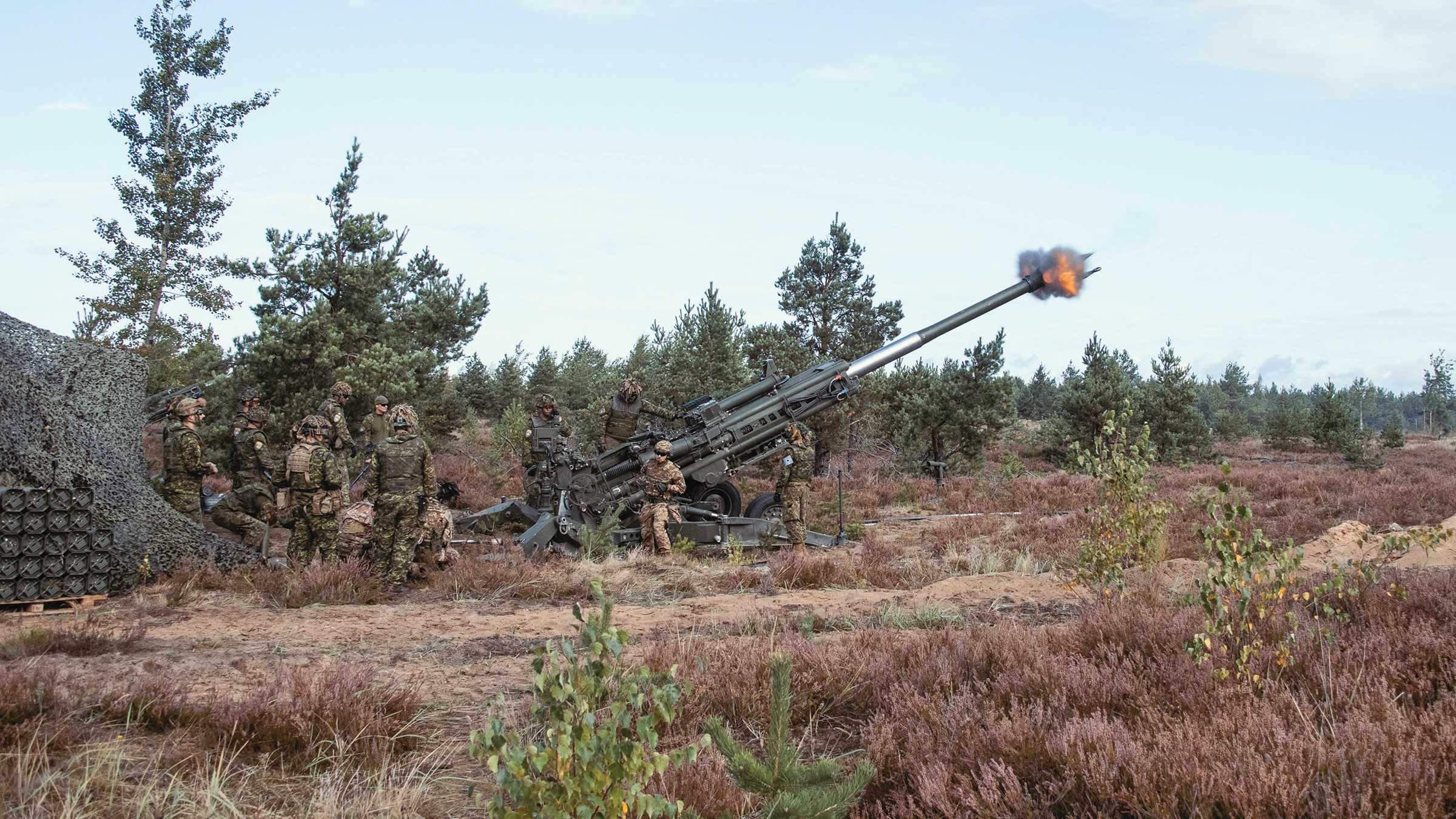
Photo: Corporal Djalma Vuong-De Ramos
The North Atlantic Treaty Organization’s (NATO) enhanced Forward Presence Battle Group-Latvia conducts Exercise GANGSTER PRIME in the Camp Ādaži training area, Latvia as part of Operation REASSURANCE, September 6, 2019.
Major Bryce Simpson, CD, is an armour officer with Lord Strathcona’s Horse (Royal Canadians). As a subaltern, he served as a troop leader in both reconnaissance and tank squadrons and as a Joint Terminal Attack Controller with the 1st Regiment, Royal Canadian Horse Artillery, before returning to his regiment as a tank squadron battle captain, second-in-command, regimental operations officer and officer commanding. He has been deployed on several international operations, including in Latvia in 2020, as the second-in-command of the eFP Battlegroup’s Combat Service Support Company. Major Simpson holds a Bachelor of Arts in History from Nipissing University and a Master of Arts in Military History from Norwich University.
As war rages between one of the great powers and its great power rival-supported enemies in what is considered one of its vital peripheries, the North Atlantic Treaty Organization (NATO) experiences growing concern for the physical security of its member states, all while tensions continue to mount in the Far East. Even casual observers of current events will recognize the international conditions of the Russo-Ukrainian War (2014-present), which led NATO to reinforce member states bordering Russia with rotationally-assigned brigades. One of these is the multinational brigade based in Latvia led by Canada, contributing 2,200 troops to the allied formation.Footnote1 These events, coupled with increasing Sino-American tensions, contribute to a world increasingly characterized by the reemergence of what Canada’s new defence policy-Our North, Strong and Free-refers to as “strategic competition” between Great Powers.Footnote2 However, a keen observer of history will recognize that the introductory set of world circumstances is similar to the early 1950s, where the raging Korean War (1950-1953) created concerns that North Korea’s Soviet allies would use the conflict there to divert alliance nations from an assault by Soviet-led forces on Western Europe. Just as today, NATO has responded with the reinforcement of its conventional deterrence forces along the shared border with its most probable adversary; in 1951, the Canadian government joined its Allies in augmenting Europe through the commitment of a brigade to West Germany.
This article analyzes the Canadian commitment to Latvia by exploring the experience of the Canadian army with establishing a European-based deterrence force in Germany.Footnote3 Ultimately, it will demonstrate significant historical parallels between the two missions, including strategic intent, doctrinal and equipment problems, sustainment challenges, and questions of personnel welfare. Examined in parallel, this article will make the case that today’s army can learn from its experience in Germany.Footnote4 This analysis will be broken into two parts. Part I will provide a chronological summary of the Canadian NATO brigade in Germany from 1951-1993. This summary is heavily indebted to the previous work of other historians, most prominently Sean Maloney’s War Without Battles: Canada’s NATO Brigade in Germany (whose singular work on the subject inspired this article’s title) but also draws on now-declassified historical reports from the early days of the Army’s commitment to Germany. The second part will use a thematic approach to examine specific aspects of the German deployment to shed light on the potential lessons that may apply to Canada’s Latvian commitment. As with the title of Maloney’s book, the present situation the CAF finds itself in Latvia may be characterized as another ‘war without battles.’
Part I: The Canadian Brigade In Germany, 1951-1993
The Genesis Of The Brigade
In May 1951, the Canadian government agreed to commit ground and air forces to Europe. The context for this agreement was the Korean War (1950-1953), then raging in the Far East, and increased tensions between the West and the now-nuclear-armed Soviets in Europe. NATO strategists were concerned about the dissipation of Western military strength in the Korean theatre, and indeed, “many believed that the Far Eastern operations were just a feint orchestrated by the Soviets so that scarce Western military resources would be expended in an inconclusive conflict.”Footnote5 In essence, the Korean War militarized NATO, which, to this point, was effectively a loose alliance of several Western countries. The commitment of a brigade group entailed dispatching 5,807 soldiers and their replacement base to Europe, which was a significant undertaking for the then small, post-Second World War Canadian Army.Footnote6 The Regular Force consisted of a single brigade for the defence of Canada, and the army had had to raise a ‘Special Force,’ made up mainly of new recruits and the large pool of Second World War veterans to fill what would prove to be the first of several rotations of a brigade for Korea.Footnote7 Further, the NATO brigade group, dubbed ‘27th Canadian Infantry Brigade Group’ (27 CIBG), was intended as the vanguard of a much larger Canadian commitment to Europe if the Cold War ‘went hot,’ that on mobilization would provide two infantry divisions in the 30-180 days after the outbreak of war.Footnote8
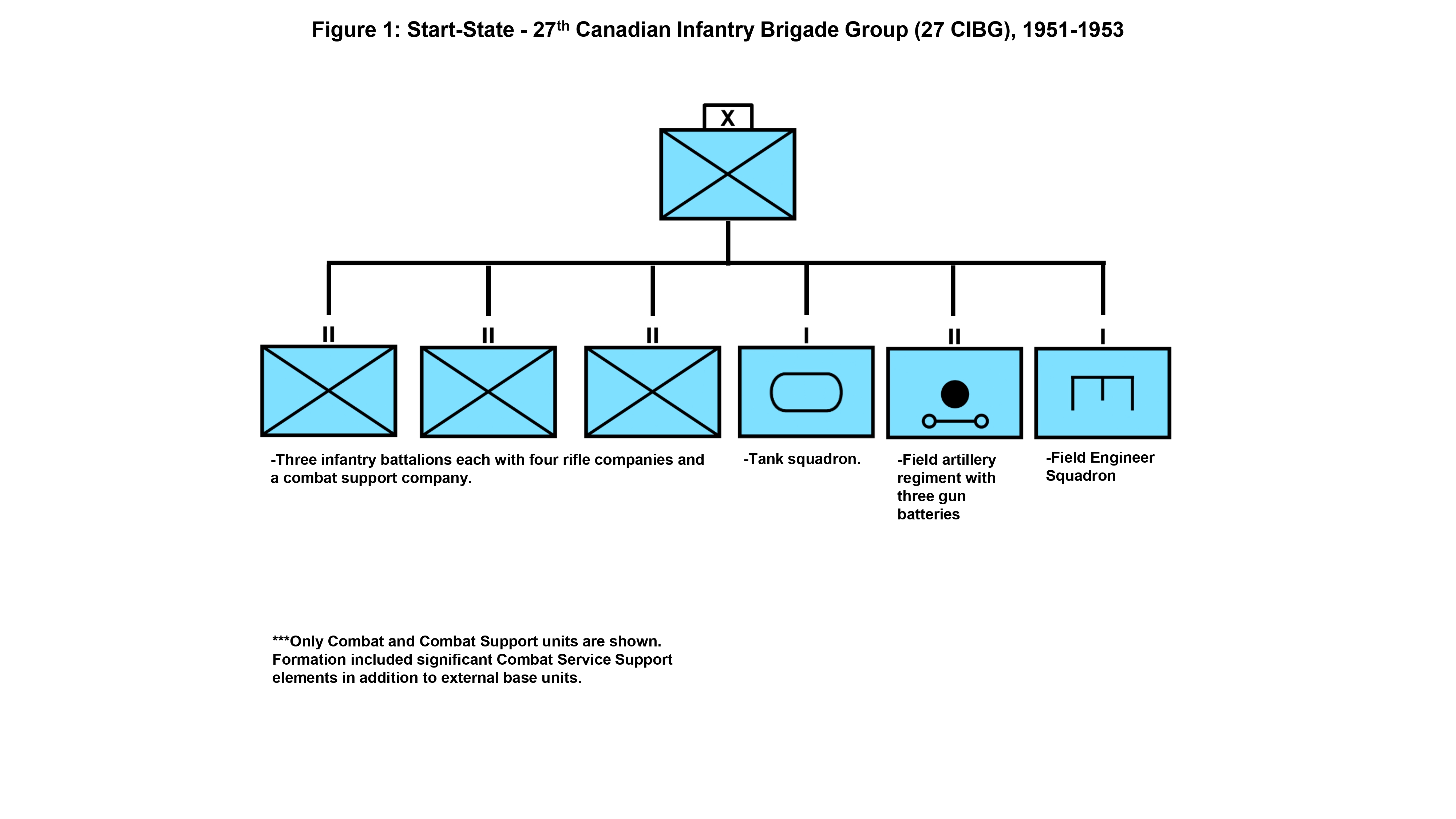
Despite the significant challenges, the Canadian Army managed the herculean task of virtually tripling its active soldiers and dispatching the first elements by 4 October 1951.Footnote9 It consisted of three infantry battalions, a tank squadron, a field artillery regiment, an engineer squadron, and various combat service support and base units.Footnote10
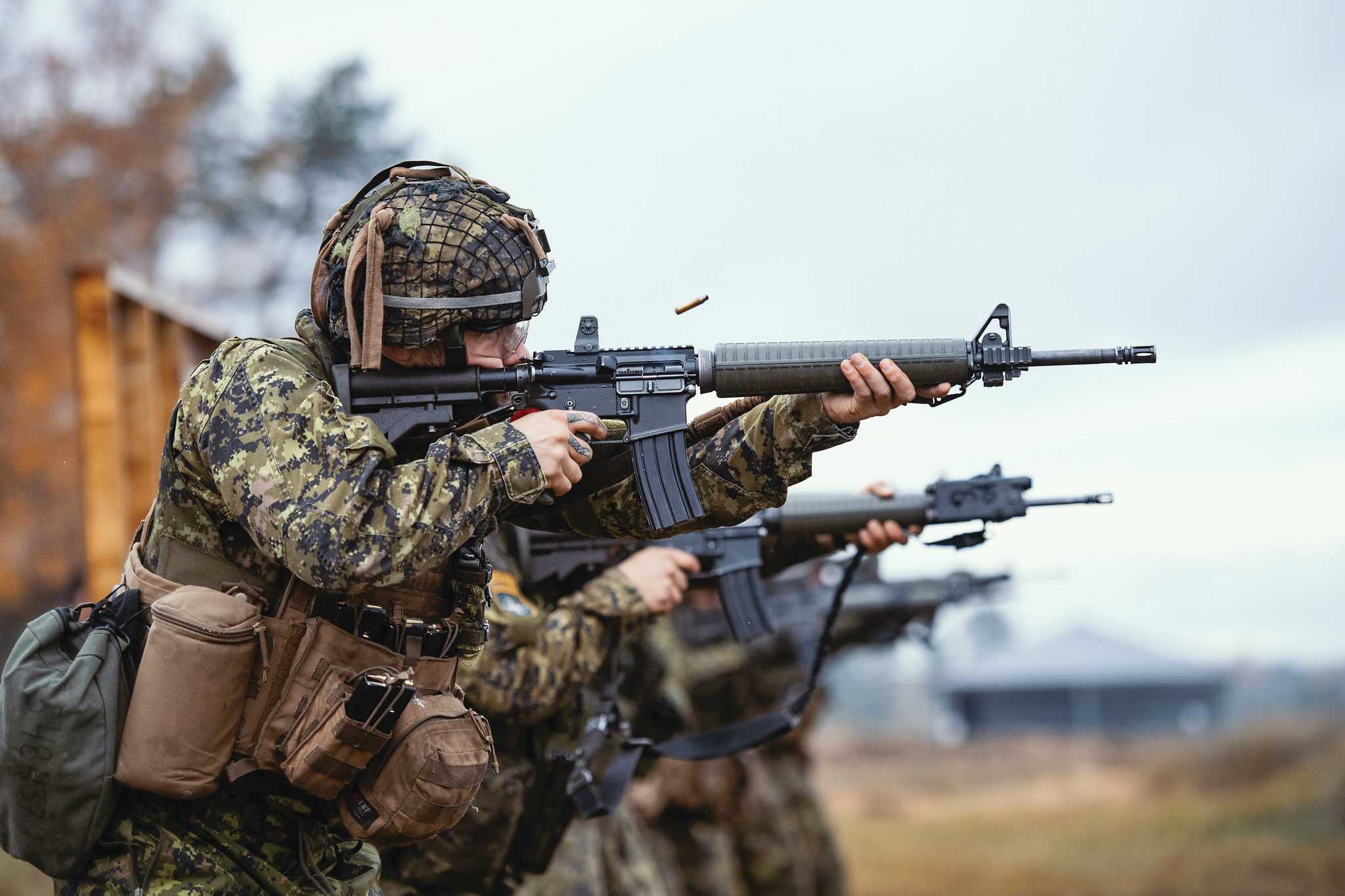
Photo: Corporal Djalma Vuong-De Ramos
Canadian Armed Forces members with enhanced Forward Presence Battle Group Latvia conduct a quick shoot exercise during Exercise URBAN REAPER, in the training area of camp Ādaži, Latvia, as part of Operation REASSURANCE, October 21, 2019.
Figure 1: Start-State — 27th Canadian Infantry Brigade Group (27 CIBG), 1951-1953
Significant debate had occurred over what portion of West Germany the brigade should be stationed in and, therefore, under whose command: British or American. In brief, the Canadian Army favoured its placement under the British Army of the Rhine (BAOR). At the same time, the Royal Canadian Air Force lobbied to have its air division placed in the central region of France and Germany and integrated with American forces. In the pre-unification Canadian military establishment, both services got their way, and 27 CIBG would initially deploy to bases in the Hanover area under BAOR.Footnote11 However, as we shall see, the more significant strategic questions of basing and command arrangements were never entirely closed, and as Maloney warns, “problems which would plague the brigade over the next forty years had their genesis in 1951.”Footnote12
Canada’s Commitment At Its Height, 1951-1969
Initially, 27 CIBG was meant to be a rotational force with personnel rotated out after one or two years.Footnote13 However, with the stabilization of strategic commitments in 1953, due to the end of the Korean War and the decision to maintain the land commitment to Europe, the army, as part of a considerable expansion of all three services, opted for a rotation program using one of the three brigades recently stood up in Canada. Thus, 1 CIBG replaced 27 CIBG, while the three other brigades remained in Canada.Footnote14 Temporary basing arrangements in Hannover were replaced by ten permanent sites further west in the Soest area.Footnote15 Initially, the rotations were conducted by complete brigades as 2 CIBG replaced 1 CIBG in 1955, followed by 4 CIBG in 1957. However, in 1959, the Army replaced this system by rotating individual units on a three-year basis.Footnote16 Thus, after seven short years, the Canadian land commitment to NATO solidified around a permanently assigned 4 CIBG complete with established garrisons and infrastructure to support dependants.
Between 1951 and 1969, the years were characterized by near-constant growth in the brigade’s personnel establishment and fighting capability.
Figure 2: NATO Brigade at its Height — 4 Canadian Mechanized Brigade Group (4 CMBG), 1969
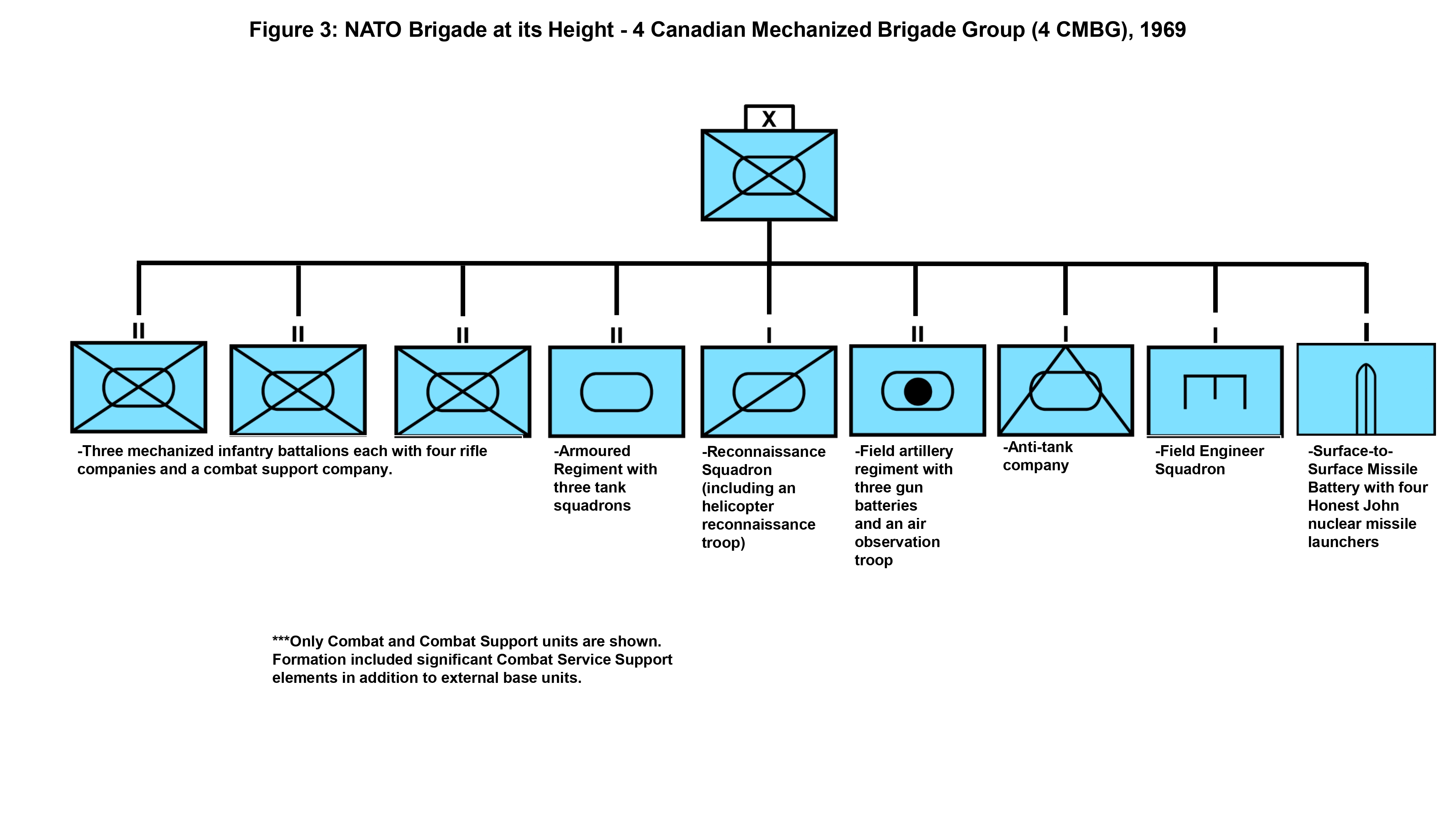
Maloney provides a detailed analysis of each of these changes. Still, a summary is warranted: 1957 saw the addition of a complete armoured regiment and an independent reconnaissance squadron, an air observation troop in 1960, a helicopter reconnaissance troop in 1962, and an anti-tank company stood up in 1965.Footnote17 Two important additions significantly changed the brigade’s capabilities and structure. First, to keep pace with the growing mechanization of armies, between 1965 and 1969, the brigade received armoured personnel carriers and self-propelled howitzers, leading to it being redesignated as “4 Canadian Mechanized Brigade Group” (4 CMBG).Footnote18 More significantly, by 1961, the brigade gained a tactical nuclear delivery capability through four ‘Honest John’ missiles under the 1 Surface-to-Surface Missile Battery, Royal Canadian Artillery.Footnote19 Due to these continual augmentations, by 1969, the Canadian ground commitment to NATO was considered the equivalent of a small or ‘light’ division. It constituted 15% of BAOR’s ground strength and 20% of its nuclear firepower.Footnote20 The outsized significance of this force would create political troubles once it had been decided to reduce and relocate this force.
Reduction, Revitalization And Retirement, 1970-1993
In 1969, the Canadian government made major changes to its military establishment, which included reducing the size of the NATO brigade from close to 6,000 personnel to 2,800.Footnote21
Figure 3: Post-Cuts — 4 Canadian Mechanized Battle Group, 1970
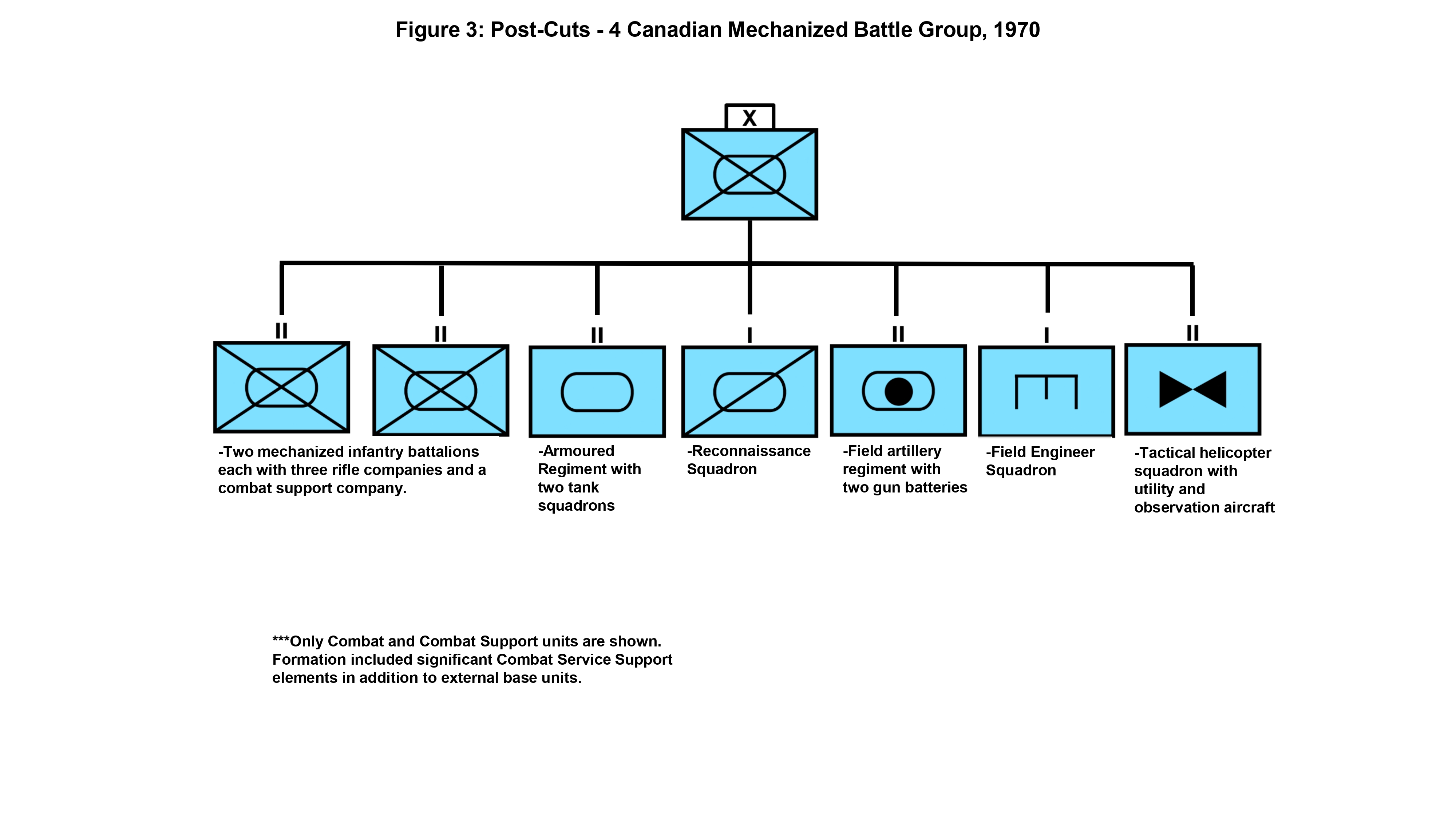
This controversial decision had international repercussions. Further changes were made to the brigade’s role, from a front-line task in NORTHAG, both army and air elements were relocated to the Central Army Group (CENTAG), where the brigade would be assigned as a reserve, as part of an American or German corps in the Lahr area.Footnote22 This change in role and position cut costs and was meant to be followed by a transformation into a light, airmobile-mechanized force at a later date. However, the new role in CENTAG was undeniably lower profile, and this, combined with the fact that the ambitious air-mechanized light force never materialized, leads Maloney to describe the post-reduction brigade as “the nadir of its existence.”Footnote23 To reduce the political fallout from these changes, the government announced its commitment of a brigade to the northern flank of Europe, known as the Canadian Air-Sea Transportable (CAST) Brigade, although, from the very beginning, it was clear the Canadian Forces lacked the strategic resources to move the brigade and its dedicated aircraft to the Northern Flank.
Despite its relocation to Lahr under CENTAG, 4 CMBG continued regular training and soon regained some of its cut strength. By 1979, the personnel permanently based in Europe had increased to 3,268.Footnote24 The 1987 Defence White Paper announced the addition of 935 additional soldiers, which brought brigade units close to their war establishments.Footnote25
Figure 4: Brigade at the End of the Cold War — 4 Canadian Mechanized Brigade Group, 1989
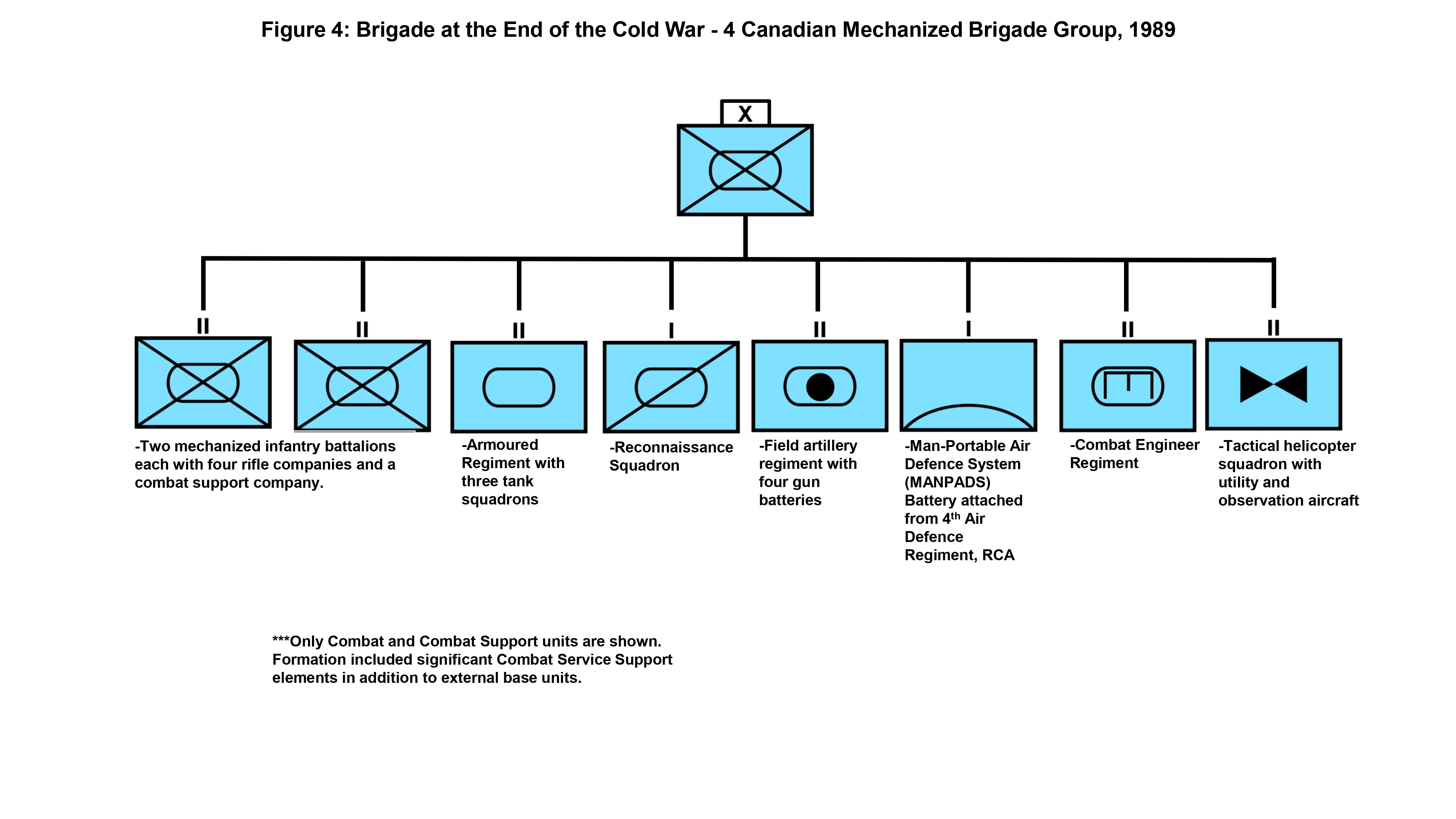
Historian Peter Kasurak asserts that the cancellation of the CAST task, the consolidation of the land commitment to the central front and reactivation of 1st Canadian Division-with one brigade forward-based that in war would be joined by another from Canada and either a German or American brigade-was the result of long-term lobbying by army leadership to create a ‘Big Army’ on NATO’s Central Front rather than a significantly altered strategic situation.Footnote26 Regardless of how realistic the deployment or sustainment of such a division might have been for the army, timing is everything and international events ended any debate on the subject.
With the fall of the Berlin Wall in 1989 and the subsequent collapse of the Soviet Union and the Warsaw Pact, the justification for permanently stationing land and air forces in Europe evaporated. Kasurak calls this period “the end of one era and the beginning of another” for the army, where the expensive European commitment quickly came under government review.Footnote27 In late 1991, the government announced its decision to withdraw 4 CMBG and all brigade units were slated for disbandment or return to Canada by 1993.Footnote28 With the completion of this withdrawal, the Canadian army’s permanently stationed presence in Europe went on a quarter century hiatus until 2017 with the establishment of enhanced Forward Presence Battlegroup (eFP BG) Latvia.
Part II: Historical Parallels With Latvian Commitment
Deterrence And Credibility
The purpose of both the historical commitment to Germany and present-day Latvia was the deterrence of aggression against European territory, which current defence policy considers to be “inextricably linked to Canada’s continued security and economic well-being.”Footnote29 The literature on deterrence theory is vast, much of it devoted to the Cold War. However, it is sufficient here to highlight that deterrence is an effort to dissuade or stop adversary action: either through denial, by demonstrating the capability to defend an area which an adversary might otherwise wish to seize, or threat of punishment, by making clear to an adversary that a local incursion may have broader kinetic consequences or lead to wartime escalation.Footnote30
Of course, in both the German and Latvian commitments, hostile action against the Canadian-defended NATO territories would be met by escalation to general war (a threat of punishment), effectively making both forces a ‘tripwire’: a characterization which official statements on both commitments to Europe have resisted.Footnote31 Conversely, rather than threatening strategic escalation, including the possibility of a nuclear exchange, a denial strategy seeks to frustrate an adversary’s immediate aims by imposing losses or preventing the conquest of a specific region, thus creating the impression that such an action would be too challenging. Therefore, in both these cases, the Canadian commitment is best characterized as a deterrence through a denial strategy. Any success with such a strategy rests on the credibility of the deterring force, as the adversary must believe that the risks and costs of taking the undesired action, that is, warlike actions against a NATO member, are outweighed by the capability of the deterrence force to prevent the action or inflict costs on the aggressor, thus making any warlike moves undesirable.Footnote32
For Canada, the existential problem as a deterring force in Latvia is how much force is a sufficiently credible deterrent. When the German commitment began in 1951, Lieutenant-General Guy Simonds, the Chief of the General Staff, held that the “contribution of the brigade group was militarily insignificant” in the context of a NATO alliance defended primarily by American nuclear firepower.Footnote33 The strategic calculus of this assessment soon changed as the NATO strategy saw conventional forces as a means to avoid automatic recourse to strategic nuclear weapons. During the Cold War, the improvement of the Canadian brigade reflected this strategy. However, the tension between military leadership and successive civilian governments who were “convinced that the brigade group in Europe was no more than a ‘tripwire’ for nuclear retaliation” and resourced it accordingly is a significant theme of Kasurak’s history of the postwar Canadian army. Conversely, uniformed leaders sought the resources for a potentially lengthy conventional war, including reinforcing the brigade to division or corps as part of a denial strategy.Footnote34
These differences in perspectives between military and political leaders were problematic. Maloney’s study of the brigade is replete with examples of how budget cuts hamstrung the fighting capabilities of the formation. While resource constraints reduced the capabilities of the formation, deterrence theory does not require local forces to fight and win in all circumstances. Instead, as RAND analyst Michael J. Mazaar contends, denial strategy “can succeed by deploying sufficient local forces to raise the cost of a potential attack, to make escalation inevitable, and to deny the possibility of a low-risk fait accompli.”Footnote35 Canada’s 1987 defence policy articulated its strategy by noting that “it may not be necessary to match the other side weapon for weapon, but the more effective the conventional forces, the less is the reliance which has to be placed on nuclear weapons.”Footnote36 Just as the Canadian NATO brigade contributed to deterrence by ensuring that any attempt by the Soviets to seize any part of alliance territory would come with severe costs, the commitment to Latvia does not necessarily need to achieve outright tactical victory to succeed in all scenarios. Instead, maintaining a credible level of capability sufficient to inflict significant costs on the adversary and thus deny the possibility of the invasion and rapid collapse of a NATO member can deter a challenge to Baltic sovereignty.Footnote37
Ultimately, it is possible to state that there is no ‘correct’ response to the civilian-military conundrum in the case of the Cold War commitment. However, military professionals and political leaders must ensure the brigade is a credible deterrent in Latvia. Its capability cannot decline to where NATO allies and potential adversaries see it as a “Hong Kong Central” force, alluding to the 1941 disaster where the Japanese wiped out Canadian and Commonwealth forces attempting a hopeless defence of an isolated allied periphery. Some planners sardonically utilized this title for the Cold War era army commitments to NATO, a reflection of the institutional unease around the policy of the day.Footnote38
The remaining themes of this part of the article will explore improving deterrence credibility while balancing resource availability.
Doctrine And Force Structure
During the Cold War, Canada effectively had two armies: one highly mechanized and trained for high-intensity mobile operations in Europe, and another, Canada-based with understrength brigades equipped with a mix of wheeled and tracked combat vehicles. This bifurcation of the field force was a problem that dogged the army throughout this period and is particularly relevant to the present situation in Latvia. The problems encountered during the Cold War were due to two broad means: doctrinal development and equipment.
In his history of the development of doctrine in the Cold War army, Lieutenant-Colonel Andrew Godefroy contends this process became wholly dominated by challenges in reconciling the problems of fighting a conventional war against the Soviets in Europe against the full spectrum of conflict that might occur in other theatres.Footnote39 Maloney presents a similar assessment, concluding that as the “operational centrepiece” of the army, the NATO brigade “drove and influenced all matters of army developments in doctrine, training, organization and equipment.”Footnote40 By 1987, the army was so engrossed by the NATO commitment that its keystone doctrinal publication, Land Formations in Battle, would open with a multi-page description of the Warsaw Pact threat in a conventional war with no discussion of other potential adversaries or types of operations.Footnote41 Contemporaneous subordinate publications included descriptions of Warsaw Pact doctrine and structures in parallel with each functional operation of war related to the unit described, for instance, in Reconnaissance Squadron in Battle.Footnote42 Similarly, Canada’s commitment to Latvia will likely be the locus of most army collective training. Lessons from that theatre will inevitably inform doctrinal development in Canada with the same risk of myopic focus on a single adversary and geography.
Sufficient equipment to support conventional warfare doctrinal structures posed another problem during the commitment to Germany. Historical evidence suggests that heavy mechanized elements are the optimal deterrence forces, but equipping units in this manner was, and is, expensive.Footnote43 Consequently, the temptation to buy lower quantities of equipment solely for the formations most likely to use them was sometimes overwhelming. For example, the first-generation anti-tank guided missiles were initially provided to 4 CIBG in the mid-1960s. The tank was retired in Canada-based units, and new main battle tanks in the 1970s went only to Germany.Footnote44 The decisions to prioritize these systems to Europe were entirely sensible in the light of budgetary limitations but contributed to the divergence between what was increasingly becoming two armies. A similar process has already begun for Latvia, with procurement of anti-tank and anti-aircraft systems as urgent operational requirements for the new Canadian ‘centrepiece’ force.Footnote45
If this experience is any indication, history may bend in a circle, and a situation similar to that of the Cold War may soon be repeated. In the realm of doctrine development, Godefroy believes it is dangerous to allow a single problem-set, like a conventional war in Europe, to dominate doctrinal processes since “training for the moment often trumps investments in long-term knowledge development, even though such activities are akin to letting the brain freeze to keep the hand moving.”Footnote46 Unlike the doctrinal development process during the Cold War, the Canadian Army of today should continue the exploration of the full range of conflict which could occur ‘tomorrow’ rather than focus solely on the problems of ‘today.’
Operational realities and resource limitations forced the Cold War-era Canadian army to generate formations capable of tackling a variety of peace-support and aid-to-civil power tasks. By 1965, the army had divided in two, with 4 CIBG stationed in Europe preparing for conventional war, 3 CIBG stationed in Eastern Canada ready to augment Europe, and 1 and 2 CIBGs assigned as light air-portable brigades for use in lower-intensity environments.Footnote47 Today, the army should investigate the viability of a similar division of its force structure into heavy-medium forces stationed in Latvia or destined to replace it on a rotational basis, and light forces assigned for other contingencies. It must also accept that it is unlikely to procure adequate equipment to identically equip all three Canada-based brigades, plus the forces stationed in Latvia. Thus, this bifurcation of the army will likely occur whether or not force structures are explicitly altered to reflect it. Regardless of the decisions taken, the army must ensure those units slated to replace or augment the Latvia force are equipped to, at a minimum, train in Canada and have sufficient lethality and survivability in the event of deployment.
Host Nation Support
The credibility of Canada’s Germany-based brigade was primarily based on its capability to fight in the high-intensity European theatre; however, as a relatively small formation in a multinational environment, this capability rested partly on the host nation’s (HN) support. Situated on the front lines of any potential conflict, the Federal Republic of Germany created a highly-developed military and civilian support system for the NATO forces stationed on their territory. By the 1980s, the German Territorial Command was explicitly responsible for a wide variety of essential services: rail transport, road and bridge repair requisitioned public utilities and transport, rear area security, refugee movement control, chemical biological radiological nuclear (CBRN) reconnaissance, prisoner of war control, and the provision of hospitals to allied forces.Footnote48 These capabilities, staffed primarily through the ex-conscript German servicemen on a reserve basis following their obligatory service, were vital to the ability of 4 CMBG to be effective in the event of war. While the brigade demanded many Canadian-specific sustainment supports, had it been forced to provide these services in addition to the wide variety of HN remits, its limited personnel strength would have been dissipated into non-combat functions, thus reducing its deterrence value.
The Canadian-led brigade in Latvia will generate a similar demand for most or all of the above-listed functions, which the HN Territorial Command filled through the Cold War. While the roadmap publicly promulgated by the Canadian and Latvian governments highlights the HN’s commitment to developing medium-range air defence, rocket artillery, and coastal defence capabilities, which will provide combat support to allied forces in the country, work is required to develop many service support capacities.Footnote49 With conscription implemented in Latvia,Footnote50 Canada should strongly encourage and assist Latvia in developing territorial forces focused primarily on the essential support tasks the German Territorial Command provided to 4 CMBG during the Cold War. As conscripts complete their terms of service, territorial units with specific HN support responsibilities should be formed, thus allowing the multinational brigade in Latvia to be comprised primarily of combat troops from contributing nations. Such a utilization of reserve personnel would dovetail nicely with the concept of “Comprehensive Defence” being explored by many of the smaller nations in the region, as outlined by Latvian researcher Ieva Berzina.Footnote51 Other Latvian commentators, including Tom Rostocks, have noted that the costs of increased HN supports will inevitably compete with the improvement of Latvian combat capability, but concludes that the presence of NATO troops constitutes such a high priority that further investments are justified “despite the opportunity costs.”Footnote52
Sustainment Challenges
The discussion of HN support raises the issue of sustainment, which ranks among the most serious challenges for both the German- and Latvian-based forces. In the realm of supply, the Cold War brigade initially required the creation of a Canada-specific communications zone generating a chain from Canadian ports, through Antwerp to Canadian third-line sustainment organizations, to its bases in northern Germany.Footnote53 However, much of the realism of the sustainment apparatus was allowed to decay and by 1978 the situation was such that rather than the NATO-mandated 30 days of supply stockpiled in theatre, Canada had less than seven days of key anti-tank and tank ammunition on hand.Footnote54 Perhaps worse from a professional perspective, Maloney argues that the brigade of that period engaged in much “illusory” war sustainment planning until a 1983 logistics exercise exposed the flaws in these assumptions.Footnote55 Consequently, considerable efforts were made through the rest of the decade to re-create a more viable Canadian sustainment chain including third-line logistical, medical and personnel sustainment chains.Footnote56
Given this historical precedent, Canada’s Latvia-based formation must guard against magical thinking concerning sustainment. Unlike an exercise in Canada, where some logistical realities can be sidelined for the sake of meeting specific training objectives, operational plans in Latvia must remain grounded in the realities of the situation. For instance, it would be unwise to train and plan for the doctrinally called-for expenditures of artillery ammunition if stockpiles in theatre would not support them, supply lines do not exist to move more ammunition forward if necessary, and new ammunition is not even being produced.Footnote57
Unlike 4 CMBG, the supply situation of the Canadian-led brigade in Latvia is further complicated by its extremely diverse composition: at least 10 NATO countries currently contribute to the mission. This level of multinationalism at the unit level was unheard of during the Cold War, with many contemporary commentators arguing that intermingling national formations at even the division or corps levels would create an ineffective “tactical stew,” and that consequently “the level at which interoperability should be practiced cannot be high enough.”Footnote58 As a former member of the eFP BG Latvia’s combat service support company, the author can personally attest to the complexities of sustaining a multinational unit of this type on a relatively small scale: each nation brings bespoke equipment, ammunition, and rations which must be sustained along individual supply lines utilizing occasionally conflicting national sustainment doctrines.Footnote59 However, the “most multinational battlegroup ever put together in the NATO context” has made significant strides towards alleviating the challenges posed by multinationalism, which the Canadian-led brigade will undoubtedly carry forward.Footnote60 Still, as the framework nation, Canada should take the lead in encouraging interchangeability within the brigade by taking steps to limit ammunition and equipment diversity, including pushing for more homogenous units where possible. Such efforts are vital to the sustainment credibility of the brigade to avoid becoming the “Frankenstein” formation warned against by some eFP commentators.Footnote61
The brigade staff in Germany devoted significant effort to planning for personnel sustainment in wartime. Two primary planning forms were involved: planning for augmentation and planning for casualty replacements. The former came to be addressed by Operation Plan (OPLAN) PENDANT, which by 1979 involved the use of civilian airlift to bring 2,347 augmentees to Germany to add two rifle companies, a third tank squadron, and a fourth artillery battery.Footnote62 The accompanying casualty replacement OPLAN BARBET was designed to bring 938 replacement soldiers over the first 30 days of any conflict.Footnote63 These plans were exercised occasionally throughout the Cold War. In 1964, the brigade utilized BARBET to locate 77 replacements for critical specialists in Canada, who were then flown into theatre. In 1987, PENDANT was implemented to bring 653 augmentees to Germany for a significant exercise.Footnote64 More importantly, augmentation plans were a way for the Canadian government to signal strategic resolve during increased tensions. During the 1961 Berlin Crisis, 1,100 troops were flown to Germany to augment 4 CIBG’s fighting strength.Footnote65
Current army planners should take note of the above augmentation and casualty replacement plans as a key aspect of the overall deterrence through denial strategy. Specifically, an individual replacement pool should be created in the Canadian Forces Tasking, Plans and Operations system with sufficient personnel to replace moderate casualties within a reasonable planning window. This system should be exercised periodically, and all contributing nations should require a similar one. Regarding augmentation, the brigade roadmap issued by the HN and Canadian governments commits Canada to providing “Canada-based reinforcements.”Footnote66 Similarly to PENDANT, these forces should include formed elements to add key capabilities or augment existing ones. However, to ensure the credibility of these augmentation plans, identified elements should be an enduring task rather than an ad hoc arrangement so that appropriate equipment and stores can be stockpiled in the theatre.
Maintaining 2,200 soldiers stationed in Latvia, plus the bona fide requirement for replacements and augmentation elements, may divert a significant portion of CAF personnel to operational tasks. An honest appraisal within the Canadian Army and Canadian Joint Operations Command (CJOC) may reveal an uncomfortable truth: the CAF is facing operational strain that the Latvia brigade task has compounded, perhaps beyond the point where it can be maintained indefinitely in the absence of significant reform or resource injection. Some commentators, including among Canada’s Latvian hosts, have already questioned the feasibility of the existing personnel commitment, noting that this “may compromise the quality of Canada’s contribution.”Footnote67 The failure to establish such plans may inadvertently signal to allies and adversaries alike that the Canadian-led brigade in Latvia is simply a token tripwire force rather than a part of a comprehensive Allied denial strategy.
Recruitment And Retention
Even without taking the militarily responsible steps of constituting augmentation and replacement pools, the 2,200 soldiers committed permanently to Latvia are likely to impose a significant strain on the CAF’s personnel, whose strength the Minister of National Defence has already referred to as being in a “death spiral.”Footnote68 Assuring an adequate flow of personnel through theatre and their Canadian bases will be vital to the deterrence’s credibility; therefore, recruitment and retention must remain high priorities. Though the commitment to Germany took place in a very different societal context for Canada, experience from that period in both efforts can be instructive.
As we have seen, the initial commitment to Germany in 1951 strained the existing personnel resources in the army in a way that is far more serious than the problem faced today: staffing the brigade for Germany required a near-tripling overall army strength. Though the brigade was supposed to be based on the Reserves, only a disappointing 1,681 enlistees came from the reserve units themselves. New enrolment methods were employed to attract civilian recruits to fill the balance of the initial 6,525 positions.Footnote69 Most of these recruits were attracted by what General Charles Foulkes, the Chairman of the Chiefs of Staff Committee, called a “Soldier of Fortune” enlistment path, in which individuals were enrolled for a short (two-year) term of service with the explicit understanding that a year of their enlistment would be spent overseas with the German-based brigade.Footnote70 This unique enrolment option was accompanied by an aggressive nationwide print and radio advertising campaign explicitly targeting civilians interested in overseas service.Footnote71
Figure 5: Full-page advertisement announcing the establishment of Canada’s NATO Brigade in the Edmonton Journal, a division of Postmedia Network Inc., May 5, 1951. (Edmonton Journal Archives provided by the Edmonton Public Library).
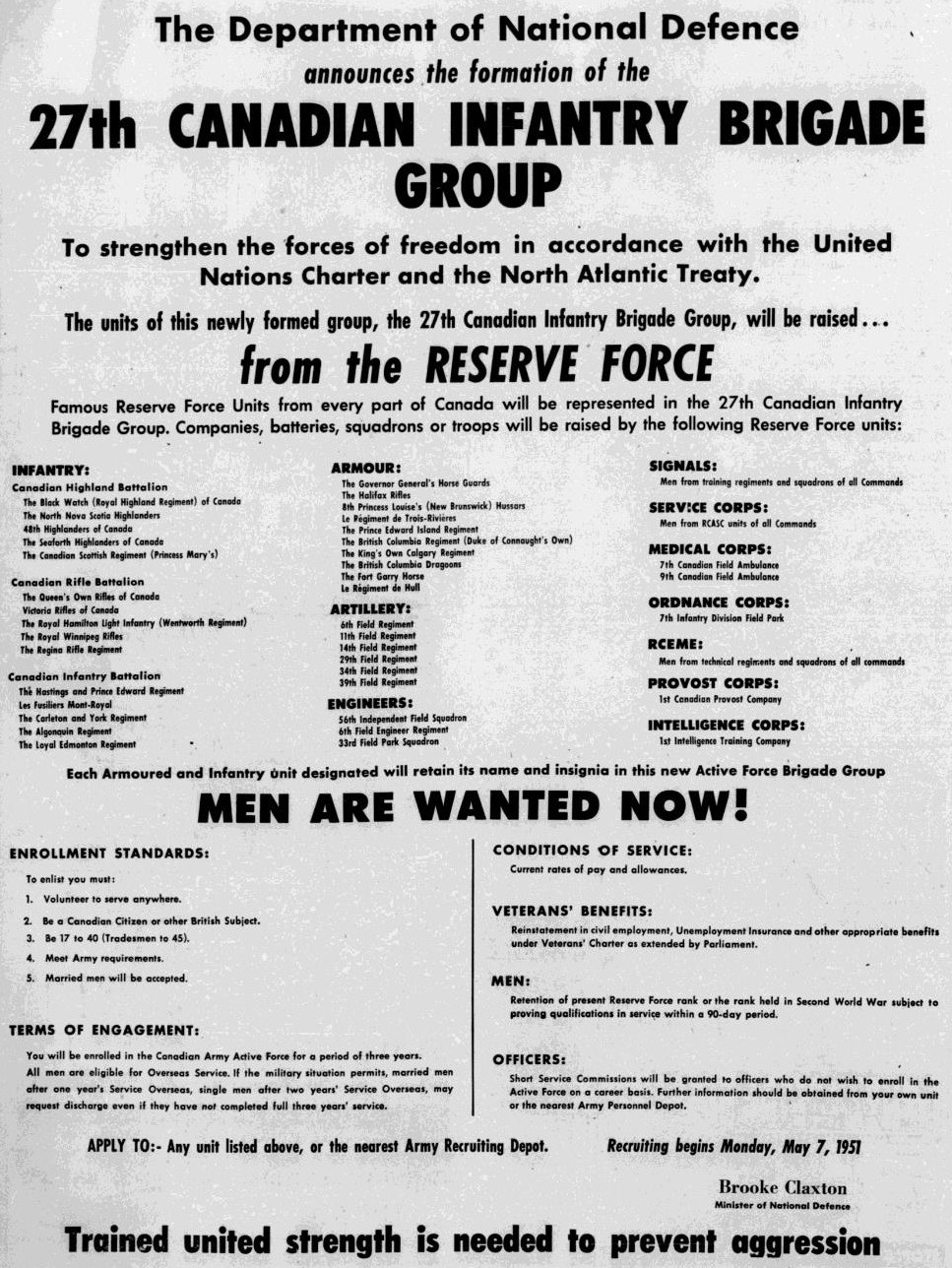
This short-term campaign was largely successful, and in just a few months, the army achieved a net increase of 14,292 personnel by the fiscal year 1951-1952.Footnote72
Despite the separation of 70 years, the concerns and motivations of today’s soldiers (and potential soldiers) share some commonalities with those who initially filled 27 CIBG. With a similarly attractive overseas experience available in Latvia, the army should consider prominently placing service in that theatre in future recruitment efforts. Further, just as Germany-specific enrollment methods were used to fill the ranks of 27 CIBG, the army should consider creating a Latvia-specific short term of service in which recruits could join, be trained, and be guaranteed a position in the NATO brigade for a set period. However, a short-service program should be approached with caution, as was done in the 1950s: short-service personnel impose additional training costs on the institution if a sufficient number of them are not convinced to stay in the force following their initial enlistment period. That said, Latvia’s increase in personnel demand may be worth the necessary resource expenditures. The scale of the Latvia commitment should, at a minimum, cause the Canadian Army and Military Personnel Command to examine whether existing intake plans are sufficient to meet operational demand.
Maintaining the enthusiasm for the overseas mission in Germany was a challenging prospect for the army, and it quickly had to adapt to accommodate the wishes of its peacetime recruits who, though dedicated, required improved living conditions if any personnel were to be retained. As indicated in Part I, the NATO brigade was intended to be deployed on a rotational basis, and dependents were not initially authorized. This prospect of repeated deployments without their families made long-term service in the Army unattractive to many. In less than a year, morale problems in 27 CIBG were noted both within the army and in the national press, with one scathing Maclean’s article describing morale issues as part of the “Failure of the 27th.”Footnote73 Frustrated soldiers took matters into their own hands, and Maloney notes that some simply ignored the Army’s regulations and moved their families to Europe at their own expense.Footnote74 By 1953, the Army gave in to the now-public demands of its soldiers and authorized the movement of dependents to Germany with the accompanying commitment to quarters and base facilities. Dependents would come to build a Canadian community in Germany as the mission became more and more a permanent fixture in the strategic landscape.Footnote75
Since 2017, the commitment to Lativa has been based on a six-month rotational model, and except for permanently posted Task Force Latvia headquarters personnel, dependents are not authorized. Given its experience in Germany, the army can anticipate that the current policy of what amounts to repeated unaccompanied foreign postings will become a source of dissatisfaction for its personnel. Consequently, the army should seriously examine options to progressively turn the bulk of the 2,200 soldier positions into permanent postings with dependents authorized. The increased costs involved would not be insignificant: funded moves, quarters, schooling and other base services would all be required, to say nothing of what one 4 CIBG commander called the “moral obligation” to maintain a realistic dependent-evacuation plan in the event of war.Footnote76 Despite these challenges, the historical disadvantages of retaining a rotational model will likely be resurrected without action.
Additionally, from an operational-output perspective, maintaining two six-month 2,200 soldier rotations under the current model will require an annual commitment of 4,400 personnel, which a permanently stationed force would cut by half. These savings in personnel outlay contributed to the recent Centre for Strategic and International Studies report recommendation to transition rotational U.S. Army brigades in Europe into permanently posted formations.Footnote77 The hidden costs of locking the army into a high personnel tempo rotational model may have consequences beyond retention: a recent Army Times investigation revealed that American soldiers assigned to repeated rotational tours to Europe were three times more likely to commit suicide than the general U.S. Army population with one battalion that was repeatedly deployed losing six soldiers in just 14 months.Footnote78 This study identified particular risks associated with the armour personnel community. Their lower density in the Army force structure did not reflect the high demand for their units in international rotational deployments. The mission in Latvia is similarly likely to draw disproportionately on specific units and specialist trades with potentially similar consequences. The risk to the mental health of our soldiers alone should be enough to justify an investigation into the benefits of postings over a rotational model.
Conclusion
One aspect of the Canadian experience in Germany that was not considered here was Canada’s difficulty in extracting itself from the European commitment. Even after the end of the crisis of the early 1950s, which had sparked the brigade’s establishment, the many efforts to reduce, reformulate or remove its land forces were strongly resisted by other members of the Alliance. Even the government’s relatively modest 1969 decision to move its forces from northern to central Germany and the accompanying force reduction led one NATO ambassador to “burst into tears” and reduced NATO military leadership to “near-apoplexy.” One official referred to the decision as a “national disaster.”Footnote79 Only the earth-shattering events leading to the welcome collapse of European communism allowed Canada to remove its forces from Europe. The Latvian commitment faces a similar situation, and it may continue far longer than imagined when the eFP BG was established in 2017. The Canadian Armed Forces must remain aware that a seemingly short-term commitment could quickly become a generational one, and plan accordingly.
The prior Canadian experience with a similar deterrence task in Germany was the foundation of this examination of some of the challenges posed by Latvia. However, the recommendations offered here are not fully developed courses of action. One must remember that the historical contexts of both commitments differ and that the direct extrapolation of a ‘Germany-solution’ may not apply to Latvia. That said, any or all of the sections covered in the second part of this article are worthy of detailed examination by individuals or military decision-makers. The lengthy deployment of a brigade in Europe during the Cold War involved more than 100,000 service members and their dependents, and can, in the wake of hindsight, be considered a positive contribution to Alliance efforts to deter an aggressive adversary and prevent the ultimate escalation to war.Footnote80 A similar level of perseverance by the present-day CAF, perhaps benefitted by historical experience, can increase our optimism that the basing of a Canadian-led brigade in Latvia will positively contribute to the successful conclusion of a second war without battles.