


Photo: MCpl Robert Mitchell, 3rd Canadian Division Imagery Technician
A convoy of Light Tactical Vehicle and ATVs conducting a patrol in Kananaskis, Alberta in support of Op CADENCE on June 8, 2025.
Lieutenant-Colonel Kevin Davis has served for 20 years as a Logistics Officer in the Canadian Army and is currently the G4-Logistics for the 4th Canadian Division, based from Toronto, Ontario. He is a graduate of the Royal Military College of Canada (RMCC) and holds Master’s degrees in Conflict Studies (Saint Paul University, Ottawa) and Defence Studies (RMC, Kingston). Initially introduced to Design Thinking while attending the Joint Command and Staff Programme (JCSP), LCol Davis is now a keen advocate of design methodologies and their use in fostering innovation within teams and institutions.
Announced in 2017, the Government of Canada’s Innovation and Skills Plan articulated a clear national-strategic goal to “establish Canada as one of the most innovative countries in the world and to foster a culture of innovation.”Footnote1 Likewise, Canada’s recently renewed defence policy, Our North Strong and Free, states that “the speed of technological change requires a shift in organizational mindset—a willingness to embrace innovation and experimentation, and to continuously adopt emerging technologies.”Footnote2 Consequently, two key initiatives, namely the Innovation for Defence Excellence and Security (IDEaS) and the Mobilising Insights in Defence and Security (MINDS) programmes have been established in recent years to achieve these goals. The IDEaS program seeks to develop novel solutions by providing funding to researchers and innovators as well as outsourcing defence-related challenges to private industry.Footnote3 Whereas, the MINDS initiative seeks to strengthen collaboration with academia to improve evidence-based policy development.Footnote4 Both of these programs aim to increase collaboration between public and private sectors and to draw innovation into the Canadian Armed Forces (CAF) from external sources, an approach commonly referred to as “open innovation.”Footnote5
What these funded research and development programs largely overlook, however, is the internal capacity of the CAF to innovate through the leveraging of skills, experience, and creative potential nascent within its existing workforce. While much needed, these “outside-in” initiatives do not directly contribute to educating and training CAF members to solve problems more creatively nor do they seek to address existing barriers to innovation vis-à-vis a holistic review of the CAF’s current structures, policies, and processes. Despite the attention given to digitization and equipment upgrades, bolt-on technologies will not be enough to address the more systemic barriers to innovation that reside at the level of organisational culture. For the CAF to truly embrace innovation, greater strategic focus (and investment) must be given to evolving current structures, policies, and processes to grow innovative capacity and to enable idea-generation and experimentation to thrive at all levels of the organisation.
Design Thinking (DT) practice holds promise for enabling the kind of organisational transformation in view here. As a highly collaborative, human-centred approach, DT provides the mindset, processes and methods required to better harness the creative potential of CAF’s greatest resource—its people—in developing solutions to overcome the most pressing obstacles to the accomplishment of their missions. This article aims to visualize the path towards this broad objective, applying DT concepts and drawing support from existing models and research findings. Finally, these concepts are underscored through a case study review of Plan Qulliq —a trailblazing innovation initiative of the Royal Canadian Air Force (RCAF).
Designing An Innovative Organisation
Militaries ought to be amongst the most adaptive and agile organisations in existence given the life-and-death imperative to achieve competitive advantage and to operate in highly volatile environments. While it may hold true that the CAF demonstrates adaptability and agility at the tactical and operational levels, these attributes are arguably less a reality at the institutional-strategic level. It is at this level that the CAF operates more in keeping with traditional bureaucracies—hemmed in tightly by the slow-changing regulatory and policy constraints of the broader Department.
Important lessons can be learned from private industry in this regard. Jay Galbraith studied the phenomenon of large, successful businesses failing to innovate and, consequently, being overtaken by more agile start-ups. In Designing the Innovating Organization, Galbraith states:
It is my contention that innovation requires an organization specifically designed for that purpose—that is, such an organization’s structure, processes, rewards, and people must be combined in a special way to create an innovating organization, one that is designed to do something for the first time… An organization that is designed to do something well for the millionth time is not good at doing something for the first time.Footnote6
Radical innovation often requires organisations to pivot from the very business models, structures, and processes that were responsible for their initial success. Akin to re-building a plane mid-flight, this is an obvious challenge for more established companies and, as a result, smaller start-ups often win the innovation race.
As illustrated in figure 1, Galbraith’s model proposes that organisations are comprised of five distinct components: strategy, structure, processes, rewards, and people. Strategy “concerns the long-range goals and objectives (‘what we do’) as well as the courses of action necessary to achieve them (‘how we win’).”Footnote7 It provides direction to the system. Structure is the internal configuration of the organisation that determines how roles and activities are divided and allocated to teams, departments and divisions. It organises power within the system through the attribution of various authorities. Reward systems are the mechanisms that aim to align team efforts and individual performance with the organisation’s goals as well as the metrics used to measure these performances. Such systems shape motivations for action within the system. People Practices refers to hiring, developing, and promoting the right talent to successfully implement and manage the organisational model. These practices influence the skills and mindsets available within the organisation. Processes refers to the broad range of procedures that direct how work is performed and how entities coordinate, encompassing both vertical processes like planning, budgeting, reporting and lateral processes like coordinating, aligning, liaising, integrating. These processes determine how information flows within the system. Altogether, the configuration of these internal components produces specific patterns of behaviour that, in turn, become characteristic of what can be called the “performance” and “culture” of the organisation.
Galbraith particularly advocated for creating structural separation between what he termed the “operating organization”—responsible for ongoing product and service delivery—and the “innovating organization”—responsible for exploring new product and service development. Galbraith proposed that by carefully managing the separation of these structures and roles, companies could reap the benefits of each while ensuring that the operations of one were not inhibiting the operations of the other.
Figure 1: Galbraith’s Five-Star Model
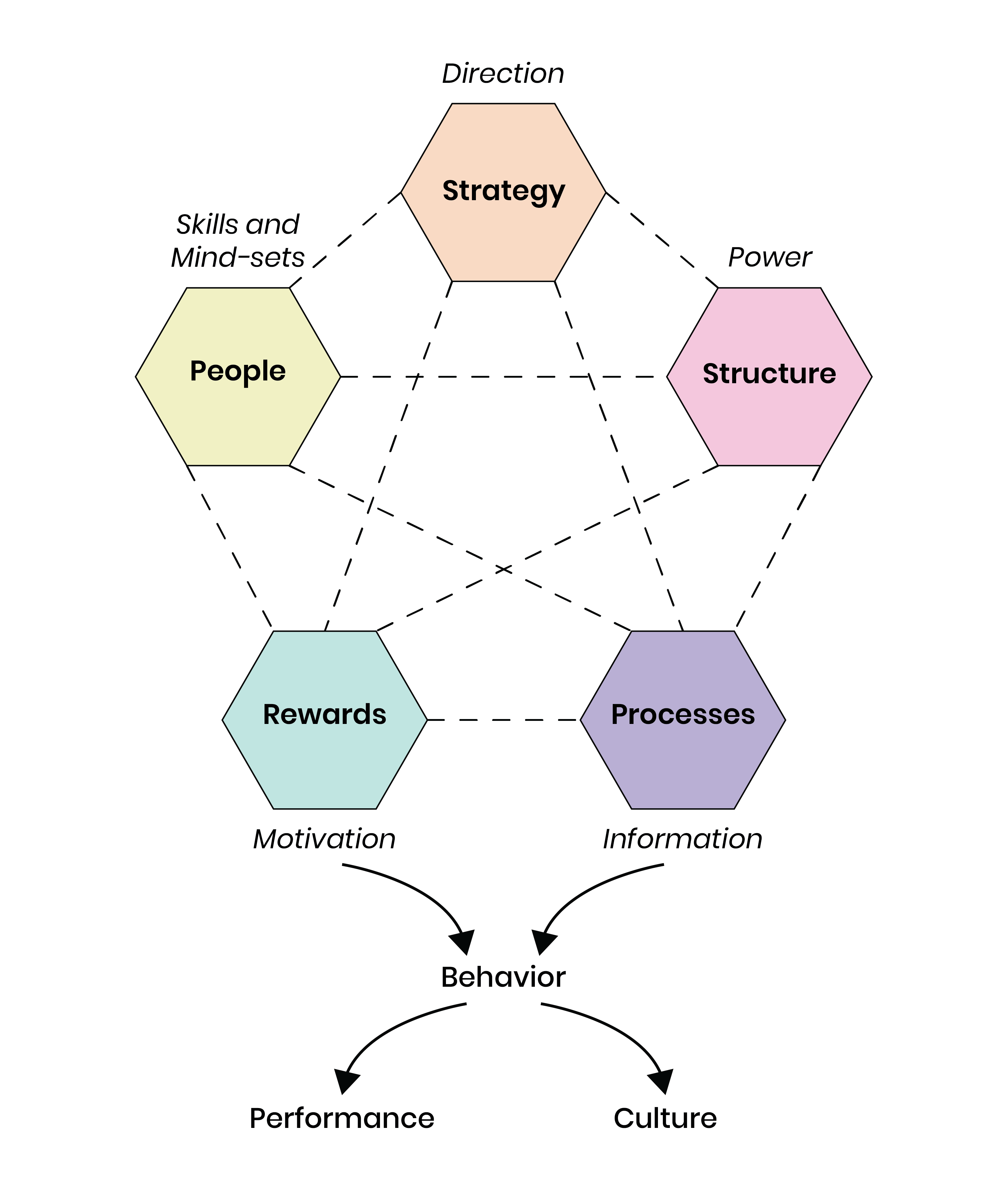
Source: Figure reproduced from illustration in Ronald Jean Degen, “Designing Matrix Organizations that Work: Lessons from the P&G Case,” Revista Eletrônica De Estratégia & Negócios 2, no 1 (August 2009): 36.Footnote8
Galbraith further emphasised that innovation required that the constituent components of the organisational design be aligned under a common strategy (see figure 1). Echoing this need for strategy and noting a similar void in the United States, Lieutenant-Colonel Cassem states that because air forces are designed with specific purposes in mind, innovation often clashes or conflicts with the routine fulfilment of those purposes. To foster innovation within the US Air Force (USAF), Cassem suggested separating innovation from “day-to-day mission execution (or the ‘performance engine’)”.Footnote9 Arguing that innovation is fundamentally human-centred, Cassem further posited that military organisations needed to “create the conditions necessary for innovators to thrive by reforming three specific areas: organisational empowerment, formal education, and effective evaluation.”Footnote10 Cassem’s recommendations largely track with Galbraith’s model, addressing issues of structures, people, and reward systems.
In summary, from Galbraith we gather a useful model for understanding the role of strategy in directing innovative activity within an organisation, wherein performance and culture are expressed as the byproducts of an organisation’s strategic alignment of structures, processes, people, and reward systems. In other words, organisations are not innovative by accident—their ability to adapt themselves in response to the changing demands of their environment is largely a function of how they are organized. This raises several questions concerning how the CAF is currently organized to enable innovation. How central is innovation in its directing strategies and is this reflected in how resources are allocated? Is the organisation structured in such a way as to enable both stable operations and disruptive innovation to occur in parallel? Are its reward systems conceived in such a way as to motivate innovation or to stifle it? Are the people who comprise the CAF trained and skilled in the right ways to support innovation? Are the processes that govern the flow of information within the organisation conducive to the free exchange of ideas and playful collaboration? These are complex, interrelated questions that are not easily interrogated. Nevertheless, they serve as a starting point for describing how the CAF could frame “innovation” as a design problem to be explored and interrogated. We turn then to discussing how a Design Thinking (DT) approach could be applied in this exploration.
Design-Thinking For The CAF
Created in 1944 under Winston Churchill’s wartime government, the Council of Industrial Design was stood up to tackle Britain’s looming challenge of post-war economic recovery.Footnote11 Now branded as the Design Council, the group has evolved to become the United Kingdom’s national strategic advisor for design writ large, with an expanded vision to helping their “government, businesses and communities better understand what design is and the economic, social and environmental benefits it brings.”Footnote12
The “Framework for Innovation” advanced by the Design Council centres on the application of a “Double Diamond” design process which is now widely referenced (see figure 2). Each diamond represents a process of exploring issues in depth (aiming for divergence of thought) and then narrowing collective understanding (aiming for convergence of thought) to take focused actions. The process is applied first in discovering and defining the “problem” (the first diamond) and then subsequently in developing and delivering “solutions” (the second diamond). Though sequential, the process involves numerous feedback loops, underscoring the need to iterate frequently at each stage of the process to achieve clarity and consensus.
The framework is further characterized by four design principles (see figure 2): “put people first” (striving to understand the needs and aspirations of stakeholders); “communicate visually and inclusively” (working to develop a shared understanding of core problems); “collaborate and co-create” (working together to expose a broad range of potential solutions); and “iterate, iterate, iterate” (detecting errors early and to build confidence in the viability of potential solutions). A “methods bank” is depicted alongside the process, acknowledging the vast array of design methods and tools available to guide these efforts. Finally, the framework emphasizes the role of leadership and engagement in creating a culture of success.Footnote13 The Council states that “as important as the process and principles… we adopt, is the culture of an organisation and how it connects with citizens and partners.”Footnote14
Underlying the Design Council’s framework are three varied conceptualizations of DT as reflected in the literature: DT as mindset, DT as process and DT as method. Mirroring this, the following definition of DT has been proposed: “Design Thinking is an iterative problem-solving and innovation process in organisations, which is based on specific principles (such as a focus on user needs, multidisciplinarity, etc.) and uses specific methods (such as creative thinking, visualization, experimentation, etc.).”Footnote15 Given this plurality of elements, many describe DT more generally as an “approach”Footnote16—suffice it to say, it is all of the above. Describing DT as the de facto “language of innovation,” Hernandez et al. observe that “design practices, design visualizations, and design methods—not to mention the push toward integrating design thinking—often form the common ground upon which conversations can be built in the complex context of innovation process.”Footnote17
Figure 2: The Design Council's Innovation Framework, 2019
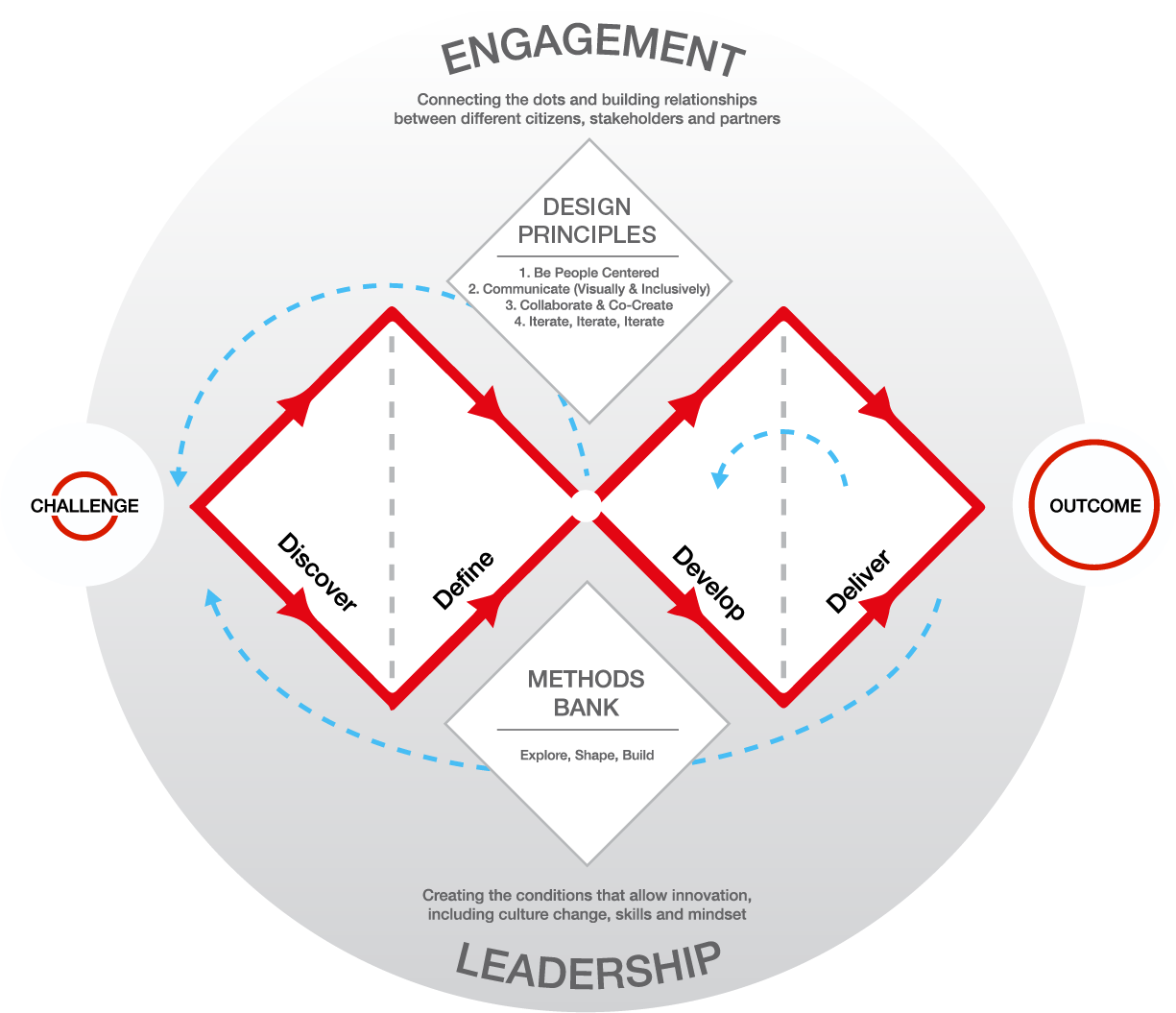
Source: Design Council, "Framework for Innovation," Accessed 23 September 2024.
Moving from the theoretical to the more practical, the question arises: what is the value proposition for applying DT within the CAF specifically? Acknowledging that other authors have given this question a longer treatment,Footnote18 let us simply consider how DT aligns with the aspirations of CAF leadership. In the updated Canadian Armed Forces Ethos: Trusted to Serve, we read:
Inclusion is a force multiplier because it increases our operational effectiveness by integrating various perspectives and insights to improve decision-making… It encourages creativity, fosters group motivation, speeds up problem-solving, improves risk management, and increases productivity and performance… It also engenders trust and creates a sense of belonging which enhances group cohesion. Embracing diversity produces stronger teams, with leaders capable of making better-informed decisions and with team members contributing their unique knowledge, skills, experience and perspectives to the team.Footnote19
With its emphasis on user-focus, stakeholder engagement and collaborative problem-solving, the DT approach aligns exceptionally well with the expressed aim of promoting inclusivity. Similar language is reflected in the outcomes of DT application. For example, studies have shown DT to increase individuals’ creativity,Footnote20 motivation and empowerment,Footnote21 self-confidenceFootnote22 and skill-development leading to improved performance.Footnote23 At the group level, DT practice has been shown to increase creativity,Footnote24 to reduce hierarchies,Footnote25 and to reduce cognitive biases leading to improved decision-making and innovation outcomes.Footnote26 As such, the DT approach has potential for improving the level of engagement of CAF members of all ranks, trades, and backgrounds in innovation processes (and, by extension, the culture-change effort).Footnote27
Applying DT also comes with certain challenges. Rosch et al. state that for DT practice to be successful “non-designers need to learn the design skills and principles of dealing with ambiguity and uncertainty, developing a holistic view, and collaborating in teams among divergent thinking and convergent thinking.”Footnote28 Given the low likelihood that DT approaches will be perfectly compatible with the established culture, it is further stressed that “the organisation should have a strategic vision and clear goals known among employees”Footnote29 and that facilitators should be employed to teach design processes and mediate, where necessary, between the design process and barriers within the organisation.”Footnote30 In short, successful implementation of DT within organisations requires leadership vision, long-term commitment and deliberate investments in design education.
Re-Designing The CAF For Innovation
Transforming the CAF into a truly innovative organisation, with a culture that embraces innovation, is a worthy aspiration that demands a holistic review of the organisations strategies, structures, processes, people policies, and reward systems. It is an endeavour that would require both top-down leadership and bottom-up engagement. It would require risk-taking, trial and error, collaboration, and a willingness to experiment. It would require a clearer understanding of the current impediments to innovation (i.e. the problem space) and potential means to eliminate them (i.e. solution space). Moreover, it would require pioneering investment in exploration activities that are not all guaranteed to produce immediate results. Considering these realities, the goal of fostering a culture of innovation in the CAF is best approached as a continuous design-challenge to be tackled through continuous, structured design interventions and guided by a DT methodology.
The design challenge. How might the CAF evolve its organisational design to optimise its capacity for innovation?
The design framework. By integrating concepts from both Galbriath’s Five-Star Model (figure 1) and the Design Council’s Innovation Framework (Figure 2), an initial design challenge framework is proposed that seeks to provoke inquiry across multiple domains in a quasi-sequential manner. The framework presumes that multiple, interrelated design problems need to be explored to address the full scope of the organisation’s design, including its strategies, structures, reward systems, people, and processes. An example of a potential design problem could be: “How might the CAF adjust its organisational structures to enhance innovation?” Another design problem might focus on rewards: “How might the CAF better incentivise its members to contribute innovative solutions to well-known and lesser-known problems?” Yet another may focus on the people dimension: “How might the CAF improve the skills and abilities of its members to think and solve problems creatively?” Following the design-thinking process and conducting multiple iterations of framing and re-framing problems would refine thinking towards a more holistic and unified view of larger design challenge.

Photo: Master Corporal Robert Mitchell, 3rd Canadian Division Imagery Technician
A 1 Canadian Mechanized Brigade Group Headquarters and Signal Squadron telecommunications dish set up during Op CADENCE at Mount Kidd RV Park, Kananaskis, Alberta, on May 24, 2025.
Figure 3: Innovation as an Organisational Design Challenge
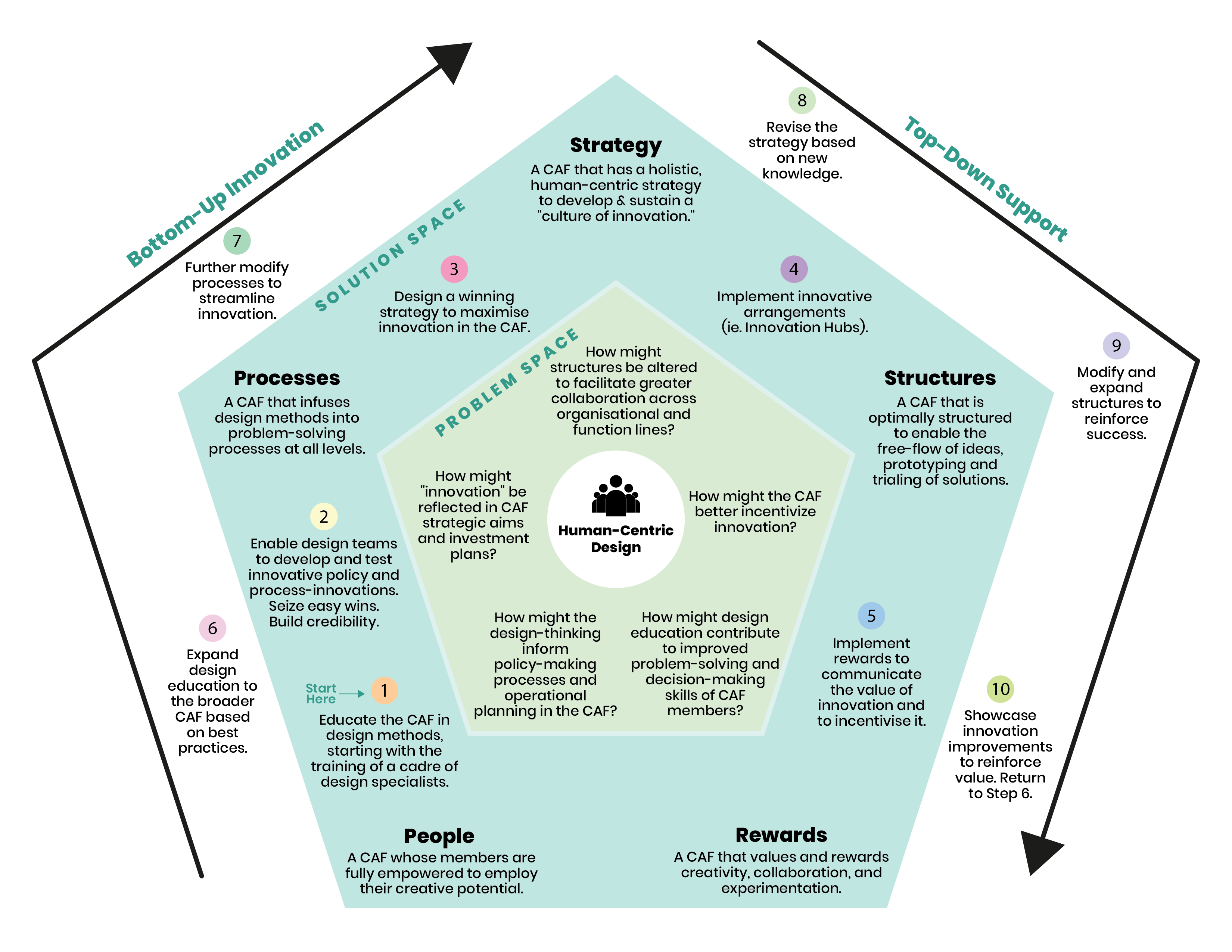
Source: Original (created with Miro)
Ultimately, the design team would need to validate the five-part framing of the problem through extensive stakeholder engagement. Moreover, design inquiry would need to expand beyond the current framing to consider external stakeholders and environmental factors. Of note, using the model would be intended to guide inquiry rather than constraining it. The solution space is left intentionally blank and undefined, though desired outcomes are proposed in the absence of a defined strategy.
The design roadmap. As described previously, the design exercise is intended to foreground real-world conditions and to serve, simultaneously, as a roadmap for advancing design-thinking education in the CAF. Acknowledging design-thinking’s current, peripheral status in the CAF, a conservative approach that builds on existing capacity and knowledge is the most realistic path forward. Thus, the proposed experiment leverages extant design education programs as its start-point and builds outwards. The experiment envisions a progression of activities starting with continued efforts to reinforce the “people” component of the CAF’s internal capacity. This people-centred approach intends to expand design education beyond the introductory-level familiarisation that is afforded to members on JCSP and NSP. For instance, specific design courses and workshops could be developed or curated for members of all ranks to facilitate broader participation in CFC-led design activities.Footnote31
Next, the design experiment proposes to focus initial efforts on improving processes related to innovation to include those mechanisms which facilitate or impede the flow of information and collaboration within the CAF. This is purely a pragmatic suggestion, as the longevity of the experiment itself would depend upon its ability to generate results and processes (to include policies). It is unlikely that the structures and reward-systems of the CAF would see any adjustment unless driven by the implementation of top-down strategic direction. Yet, no such strategic direction and “championing” of design efforts will emerge in the absence of more concrete evidence of its utility to the CAF. To that end, the experiment is proposed as an iterative series of discrete design sprints that are bounded in such a way as to ensure that proposed solutions are viable to be prototyped, tested, and implemented.
Next, design efforts can work towards framing an appropriate strategy for the CAF to improve innovation in the long run. This effort would be informed by an increasingly broad design community and would be legitimised by a lengthening résumé of successful design interventions. A design-informed strategy would also provide the required direction to implement proposed changes to various structures and reward-systems.
In summary, the proposed design experiment envisions a sustained bottom-up effort to demonstrate the utility of design thinking for applications in the context of the CAF while simultaneously addressing the broader and more complex (perhaps ‘wicked’) problem of improving the CAF’s capacity for innovation. In time, it is posited that this approach will generate the momentum necessary to justify the more formal adoption of design thinking methodology into professional military education streams. Moreover, guiding design inquiries along a consistent theme, instead of applying them in an ad hoc manner, is more likely to generate cumulative effects and broader-level solutions. Until such design work is done, the CAF will likely remain ignorant of its own potential.
Plan Qulliq: Leading The Way
Plan Qulliq is an innovation initiative of the Royal Canadian Air Force (RCAF) that targets bottom-up idea generation and facilitates the development, testing, and resourcing of solutions to problems identified by individual members. It serves as an ongoing case study against which to evaluate the proposed design experiment and its value-proposition for the CAF. Most notably, it serves to highlight the role that an innovation strategy has played in establishing the requisite structures, processes, people policies, and reward systems within the context of the RCAF to foster innovation.Footnote32
Strategy. Plan Qulliq was issued a formal mandate letter from the Commander of the RCAF in July of 2020, which lays out the vision, mission, and key tasks of the initiative.Footnote33 The initial vision for the team was “to provide the RCAF with relevant and holistic focus points to evolve our capabilities of today, so as to ensure the RCAF is postured as an integrated and interoperable leader amongst its allies tomorrow.”Footnote34 Recently updated, the vision now reads: “to inspire people through agile, integrated & inclusive innovation.”Footnote35 Its mission remain unchanged: “to analyze and identify gaps, deficiencies and opportunities in connectivity, interoperability and processes and then champion solutions that allow the RCAF to optimize its weapon systems, exploit emerging and disruptive technologies, and empower RCAF personnel to continue to thrive in the modern battle space.”Footnote36 Additionally, an Innovation Charter was issued that provides a governance framework and “innovation management strategy” for the RCAF.Footnote37 Together, these strategic documents clearly communicate a firm commitment from leadership and lay down a common framework and orientation for all members of the RCAF.
Structure. Plan Qulliq saw the establishment of a distinct “Innovation Team” which has the role of guiding the innovation process and helping idea-owners further develop their solutions through the application of DT methods. The team was established as a direct report to the RCAF Deputy Commander which is, in and of itself, an innovative structure. The separation of the team from other force development elements within the RCAF is reminiscent of what Galbraith proposed when advocating for the establishment of an innovating organisation to operate alongside the operating organisation. Also, the strategic positioning of the Innovation Team within the hierarchy translates into unusual access to senior leadership, enhanced credibility when collaborating with parallel organisations, and flattened approval processes.
Processes. Largely reflecting DT approaches, the RCAF Innovation Charter lays out an innovation process, commencing with ideation, through evaluation, development, and approval, and ending in implementation. With the aim of fast-tracking ideas through to approval (and resource investment), Plan Qulliq employs a uniquely agile process-flow that runs in parallel with traditional governance processes within the RCAF. Central to the innovation process is the convening of bi-annual “Vector Check” events, whereby innovators are given a platform to pitch their ideas directly to the RCAF Commander. Beyond facilitating a few good ideas through to execution, this unique and highly-visible exercise serves also to raise awareness of innovation efforts across the RCAF and is another means for leadership to reinforce and celebrate innovation efforts.Footnote38
People. The earliest initiatives of Plan Qulliq saw the development of digital tools to enable and improve communication within the RCAF. A notable example has been the development of “Hangar,” a cloud-based digital ecosystem that currently houses eight distinct applications that facilitate collaboration in executing a range of tasks including flight administration, flight safety, cargo operations, financial claims processing, internal communications, and ideas management. Designed by the RCAF for the RCAF, these digital tools directly enable its members to do their work more effectively, thus contributing to job satisfaction. In addition, an “Innovation Network” was established to link innovation reps from across all Wings and Bases and to increase connectivity and information-sharing about innovation activities between units, formations and command. Furthermore, Plan Qulliq delivers educational opportunities to RCAF members as a means of fostering a “culture of innovation.” Online courses are currently being offered on Design Thinking, Data Analytics, Power BI, and Generative Artificial Intelligence. Finally, the RCAF Innovation Team benefits from uniquely flexible remote-work arrangements, removing geographic barriers and enabling the selection of diversely-talented and motivated candidates from across the organization to lead the initiative.
Reward Systems. With the formal designation of innovation roles, Plan Qulliq has established a means for recognizing and rewarding members for formally contributing to innovation efforts in either a full or part-time capacity. Through the Vector Check process, idea-owners remain involved to see their innovative solutions carried through to formal endorsement by the RCAF Commander, which is a form of public recognition. In addition, resources have been, in some cases, awarded to the Base or Wing that presents the best innovation idea, which adds playful and competitive energy to the process.
Only a short number of years into its existence, Plan Qulliq has come a long way in formalizing a bespoke innovation strategy for the RCAF. While it does not seek to supplant the research and development work occurring elsewhere across the Department, it does provide a unique conduit for RCAF members to directly engage in the innovation effort and to tackle issues that may otherwise go unaddressed in the larger system. As an evolving initiative, it is ever adapting. Plan Qulliq has already revised its innovation planning cycle to a “version 2.0” and is working to revise and reissue the Innovation Charter as an Innovation Handbook. It has achieved notable success in standing up a centre of excellence for innovation within the RCAF and in facilitating a unique, bottom-up innovation process that drastically enhances member engagement in innovation activities. Altogether, Plan Qulliq represents a model example of an innovation strategy that accounts for structure, processes, people, and reward systems. While these bold strides are being taken to foster innovation within the RCAF, there is opportunity to expand these lessons and initiatives to the broader CAF.
Conclusions
Canada’s defence policy makes it exceptionally clear that the rate of technological and geo-political change is accelerating and that this context demands that the CAF fully embrace a more innovative mindset.Footnote39 Yet such pronouncements are slow to translate into true organisational change. Efforts to partner with industry, to upgrade technologies and to procure more modern equipment are necessary but near-sighted. They fall short of addressing the institutional barriers that currently prevent units and individual members from pursuing innovation at all levels of the organisation. As discussed herein, the strategic goal of promoting a more inclusive and innovative culture in the CAF is a design challenge in its own right: a complex set of problems that demand innovative solutions.
This article represents an initial effort to frame the problem space around innovation in the CAF. It raises, rather than answers, questions regarding how components of the CAF as an organisation—its strategies, structures, reward systems, people, and processes—might be adjusted to improve its innovative capacity. It proposes that these questions be treated as design problems to be explored through a human-centred design lens, leveraging DT methodologies to engage CAF members more directly in co-creating the CAF of the future. The CAF would benefit from an innovation strategy to guide this continuous effort. In the meantime, bold ventures like Plan Qulliq are leading the way.
Disclaimers
Other noteworthy CAF initiatives targeting digitization, modernization and grass-roots innovation have likely been overlooked and more will be undertaken by the time of this article’s publication. How these disparate initiatives are contributing to the evolution of CAF culture should be a focus of future research.
Acknowledgements
The author thanks the team at Archipelago (https://aodnetwork.ca/about-archipelago/team/) for their editorial and graphic-design support in preparing this article for publication.