

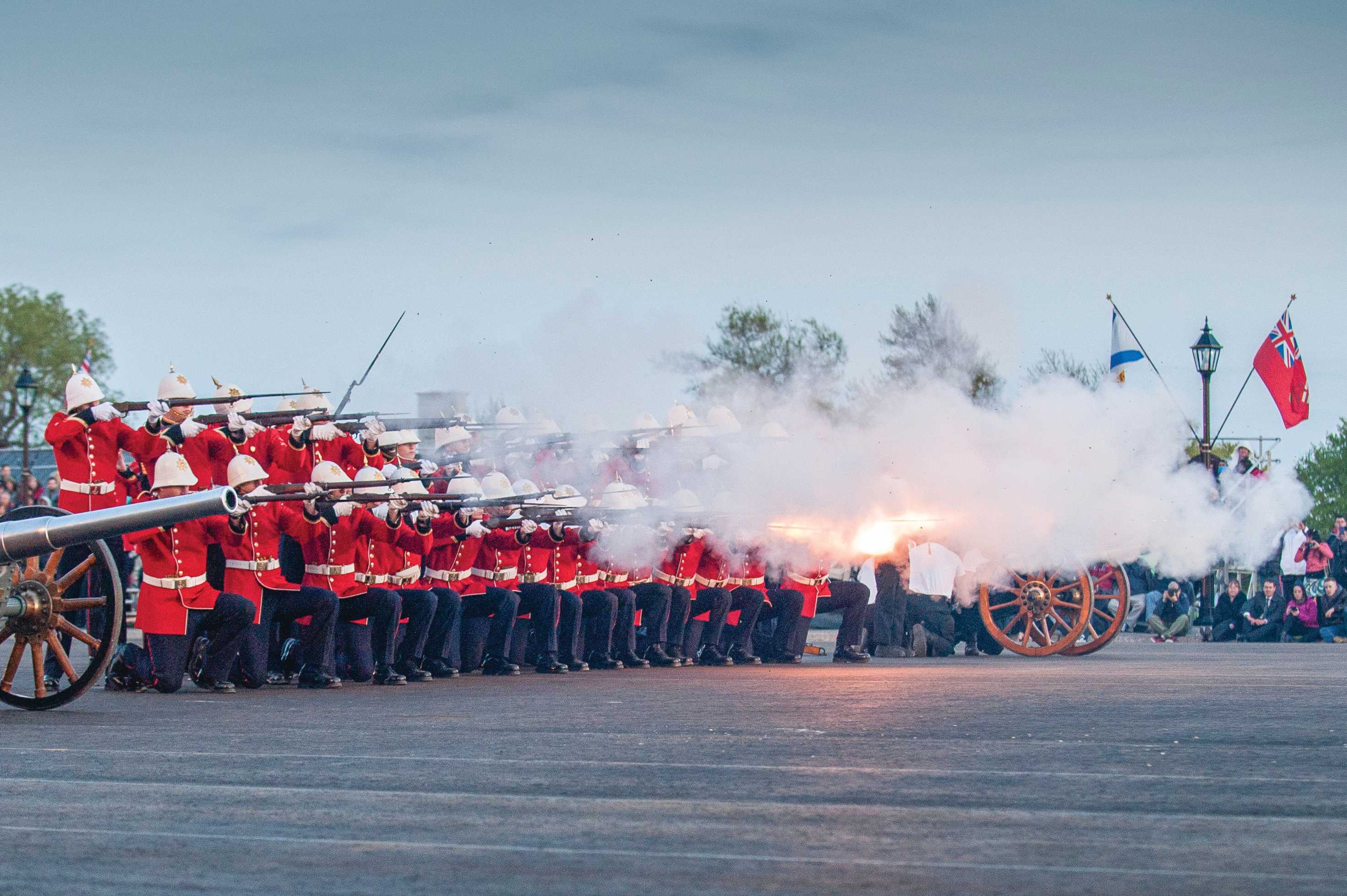
Photo: Mary White, DND
Cadets demonstrate firing skills during the Sunset Ceremony held at Royal Military College of Canada, Kingston ON, on May 14, 2015.
Mike G. Fejes is an Assistant Professor at The Royal Military College of Canada in Kingston, Ontario. He holds a BA (Hons) and an MA from the University of Manitoba and a Ph.D. from the Norman Paterson School of International Affairs at Carleton University. An infantry officer with almost 30 years of military service in both the regular and reserve force (including five international deployments and one domestic response operation), his research interests include civ-mil relations, foreign policy analysis, comparative defence policy, and the contemporary use of armed force.
“I hope to make a few officers think.”
The Royal Military Colleges of Canada (RMC) are once again at a crossroads regarding their purpose.Footnote1 Over the past several decades, a series of reports and decisions have impacted Professional Military Education (PME) in the Canadian military. Different approaches to PME, defined as the provision of “training, education, and development in the profession of arms including teamwork, leadership, ethics, and military ethos,”Footnote2 have directly influenced the two Canadian Military Colleges (CMC) in Kingston and St. Jean. First, the 1969 Report of the Officer Development Board (or Rowley Report), which called for an established set of learning programs, including an undergraduate degree to provide a basis of critical thinking.Footnote3 Then the 1998 Report of the RMC Board of Governors (or Withers Report) which called for Cadets to receive both a liberal education and the technical knowledge to effectively apply military force.Footnote4 Two decades later, while recognizing a core curriculum designed to provide a balanced liberal arts, science, and military education, the 2017 Special Staff Assistance Visit (or Maddison Report), made an opposite recommendation. Mandated to assess the overall climate, environment, and culture of the Regular Officer Training Plan (ROTP), the report concluded that the Colleges emphasized academic education over military training and were “falling short of providing meaningful and relevant training.”Footnote5 The authors argued that a return to training would instill practical meaning to the Colleges and would “address perceptions … regarding the value of graduates.”Footnote6 This was subsequently affirmed by the 2017 Auditor General’s Report which recommended that the Colleges “clearly define and strengthen military training [to be] relevant, practical, and provide value to operational units … with a view to concentrating effort into longer, and more meaningful, training and education sessions.”Footnote7 As of 2018, recognizing the comprehensive skill set required to become an commissioned officer in the CAF, Cadets must now successfully complete four equal “interlocking” pillars: academics, bilingualism, military leadership, and physical fitnessFootnote8 to graduate and receive a commission.
More recently, in May 2022, the Report of the Independent External Comprehensive Review (or Arbour Report ), provided 48 recommendations to prevent and/or eradicate sexual harassment and misconduct within the Department of National Defence (DND) and the CAF.
Of particular relevance, recommendation 29 advocated for a detailed review of continuing to educate ROTP cadets at the military colleges.Footnote9 In response the Minister of National Defence established the Canadian Military Colleges Review Board (CMCRB), to study culture change through an examination of the quality of education, military training, and socialization.Footnote10
While perhaps unintentional, these diverging recommendations between training and education have resulted (once again) in an inherent tension for the CMCs—what Barrett has referred to as “the gulf that divides the military and academic worlds” within RMC,Footnote11 generating an important question for the CAF. As an institution, the military needs to (once again) examine the PME experienceFootnote12 and re-ask one of Wither’s original questions; “what kind of junior officer does the CAF want at the competition of their first Developmental Period (DP1).”Footnote13 Specifically, how much education and how much training does the institution want junior officers to have, and what organisations within the CAF should be responsible (recognizing that the CMCs only addresses a portion of DP1)?
Using a descriptive research methodology to observe and describe a particular phenomenon, I argue that junior officers become “experts” in the profession of arms though the proper balance of obtaining both knowledge and experience, and that the role of the Colleges is to focus on imparting knowledge-based education vice training. This paper will take place in six sections. Following the introduction, the second section will discuss the place of education in the current Professional Development (PD) system. The third section will address the question of how can junior officers best gain knowledge, with a focus on explaining the requirement for knowledge-based expertise and the role of the CMCs. The fourth section will then address the subsequent question of how can junior officers best gain experience with a focus on identifying the existing branch schools and centres within the CAF. The fifth section will address the question what is the best way to combine knowledge and experience in the Profession of Arms, asserting that an institutional balance of the two approaches is required. Last, I conclude that to truly develop professional officers, through a division of labour the CAF must be encouraged to seek a proper balance between education and training within the total PME system.
Continued reflection on this debate is important to the future of the CAF. While RMC is currently responsible for training between 25-30% of the officers who receive commissions and join the CAF, RMC graduates comprise 55–57 percent of the General and Flag Officers, demonstrating that the CMCs and their approach to PME have a disproportional impact on the senior intellectual capacity of the CAF.Footnote14 As such, this paper aims to identify important characteristics and trends within PME at the Colleges and focus additional light on the debate. Ideally, to help guide deliberations on what kind of expertise, defined as “the existence of a military-specific body of knowledge, and the development, dissemination, and application of that knowledge,”Footnote15 is required for junior officers?
While there is nothing in Canadian Officership in the 21st CenturyFootnote16 which suggests this tension, I contend that junior officers at the CMCs are now expected to be something akin to Schrödinger’s Soldiers —based on Schrödinger’s proverbial cat—where there is a paradoxical expectation of achieving two opposing “professional” conceptions at the same time and place. Junior officers are expected first, to be well trained, to quickly follow (lawful) orders and become highly proficient in carrying out specified (often violent) drills and tasks. Second, through completion of a 40 credit undergraduate degree that generally mirrors equivalent disciplinary degrees at civilian universities, cadets are also expected to demonstrate fundamental leadership qualities such as thinking critically, problem-solving, and understanding nuances to make timely decisions under challenging conditions. Two conceptions of professionalism which, while there can be overlap, come with an inherent tension.Footnote17
Setting the Stage:
“To lead men in battle is a profession demanding careful education and thorough training”
Within the Canadian Defence Academy (CDA), there are two major actors engaged in developing the junior officer; RMC (Kingston) and the Collège Militaire Royal de Saint-Jean (known as CMR). Each CMC is both a military unit that is governed by the National Defence Act, and a post-secondary university with its own academic governance. According to its 2003 charter, CDA has a mandate to “uphold distinction in the Profession of Arms” and is tasked “to champion lifelong learning, and to promote the professional development of CAF members.”Footnote18 However, its worth noting that within the Colleges, “military education” is the responsibility of Training Wing and the Cadets themselves are part of the Training Wing, which is commanded by the Director of Cadets, who is responsible for training, career progression, administration, and overall welfare, while under the President “academic education” is the responsibility of the Academic Wing.Footnote19 Externally to the Colleges, the three branches—the Canadian Army, the Royal Canadian Navy (RCN), and the Royal Canadian Air Force (RCAF)—through their Schools and Centres, provide training (ideally in the summer months) for officers and non-commissioned members (NCMs) to learn their assigned trades.Footnote20 I will now briefly discuss academic education.
Theoretically, it is education that sets the professional officer (and soldier) apart from the warrior, recognizing that in addition to bravery and courage, the management of state-sanctioned violence is considered both an art and science. Ideally, education helps militaries to invest in, shape, and build future leaders, and the knowledge gained through education helps to ensure that officers are exposed to models and concepts across the range of Bloom’s Taxonomy of Learning,Footnote21 which in turn provides the basis for mastering and applying the complex lessons of the Profession of Arms.Footnote22 Practically, the military, for various reasons such as discipline, immediate applicability, standardization, comfort zones, decreasing military budgets, and above all a desire to retain what Huntington first called objective professionalismFootnote23 (where the military professional is relieved of external/civilian supervision or intrusion), will regularly try to either shirk, meet the minimum educational requirement or allow training methods to predominate over education.Footnote24
While the notion of professionalism, synthesized here as a “social institution that brings value to broader society through its expert application,”Footnote25 includes both concepts of knowledge and experience as a method for gaining expertise, I maintain that it is time for a more recognized division of labour in the junior PME system, with the Colleges primarily focusing on education and the branch schools and centres focusing on training so that the end result, described as a pillar of the CAF’s PD system, is a more balanced expert junior officer. In principle, this division already exists. Notionally, the branch schools are focused on training and the CMCs are attempting to focus on education—but in practice the CMCs and in turn the Cadets are being oriented towards training by the institutional forces discussed above.
Becoming an expert takes time, usually requiring a level of dedication measured in years. Being an expert generally requires the integration of three different skills: you a). have acquired the technical skills to conduct professional activities (usually through lengthy hands-on practice), b). understand the theory that underpins professional knowledge (you have gained proficiency through study, research, and analysis and know a lot about a subject that you have not experienced personally), and c) have internalized the values and professional ethics that informs independent judgement (socialization within the profession).Footnote26
The truth of the matter is that the Profession of Arms requires balanced dedication to each one. Gladwell talks about needing 10,000 hours of experience to truly master any skill,Footnote27 and Gallo talks about reading 100 books a year to truly become knowledgeable in a field of study.Footnote28 This is not to assume that an expert in the Profession of Arms will always make correct decisions, but rather acknowledge that there is a requirement to invest in the balance between education and training that junior officers receive early in their careers to maximize the conceptual tools required to perform their jobs.
Unfortunately, as Last notes, Canada doesn’t appreciate big personalities in its General Officers.Footnote29 Subsequently while there is much discussion regarding training and readiness across CAF academic publications and doctrine manuals, there are few Canadian Generals publicly touting the advantages of knowledge-based expertise. As such, quotes from American Generals are used to complete this passage. It was McMaster who wrote that “reading and thinking is a sacred duty … and leaders who choose to learn solely from personal experience are irresponsible.”Footnote30 And as Mattis distinctively stated; “if you haven’t read hundreds of books … you will be incompetent because your personal experiences alone aren’t broad enough to sustain you.”Footnote31 The dilemma faced by the CAF today is how to balance technical and theoretical expertise, and where to bring these two demanding and diverse practices—knowledge and experience—together to create junior experts in the Profession of Arms?
How do Junior Officers best gain Knowledge?
“I have read somewhere the remarks of Frederick the Great when speaking about officers who relied solely on their practical experience and who neglected to study; he is supposed to have said that he had in his Army two mules who had been through forty campaigns, but they were still mules”
The debate over how to develop expertise in the Profession of Arms has long roots. It was Clausewitz who rejected von Bülow’s dynamic system approach and the claim that warfare could be reduced to any system that relied solely on experiences.Footnote32 Instead Clausewitz stressed that the purpose of educating the officers was to ensure they had the “total contingency” and creative ability to correctly evaluate unfamiliar “fog of war” environments.Footnote33 Much like the demands placed on the CAF today, “a young officer may be called upon to be a skilled leader, a technical expert, a diplomat, a warrior, an interpreter, and an aid expert—all at once.”Footnote34
More so than ever, to meet these demands there are two essential factors—experience and education—which are required to build the officers of the future. Education is defined as “the provision of a body of knowledge and intellectual skill sets, upon which competing facts, information, and ideas can be critically examined, assessed, and interpreted.”Footnote35 Within the CMCs, cadets are presented with concepts and information that cannot be learned firsthand—not only for learning about facts, science, technology, and math—but for effecting lasting perspectives, social attitudes, and values that training cannot achieve. Within the current CAF system, the four-year degree (ideally intermixed with scheduled time at the branch Schools and Centres) was originally indented to provide the opportunity and time for junior officers to invest in and develop their knowledge-based expertise.
What is knowledge? As Grotzer points out, there are three ways to think about knowledge.Footnote36 First, there is procedural knowledge asking; how we do things such as algorithms, recipes, and methods. Then there is conceptual knowledge, such as the framing of ideas and models, or how we construct information in our head. Last there is structural knowledge inquiring how we reason and determine basic assumptions. She argues that there is a need to teach critical thinking skills at an early stage to evaluate each type of knowledge, to ask questions, and to be skeptical—and that this process will produce the next generation of information generators.”Footnote37 To provide an empirical example, applying procedural knowledge and possessing the ability to follow the Army’s 16-step battle procedure, the operational planning process, or even to jointly campaign plan demonstrates procedural knowledge, but applying conceptual knowledge to find, analyze, and refine the information that goes into the processes demonstrates expertise and helps avoid what Donato has called “misconstrued analogues, erroneous presumptions, and insufficient knowledge.”Footnote38
To successfully gain knowledge, a junior officer requires access to a variety of information sources, an acknowledgement of bias, critical interpretation, and the ability to generalize both positive and negative variables. Evans has observed that being knowledgeable demands the aptitude to develop good data, critically assess demanding scenarios, and implement change based on second-hand knowledge, which is almost the opposite of the current training system which relies on processes including repetition, memorization, and routine.Footnote39 As Erdmann highlights:
It’s particularly important for military officers to read, think, discuss, and write about the problem of war and warfare so they can understand not just the continuities in the character of warfare but also the changes.Footnote40
While there remains no clear standard for leadership qualities and ethical military behaviour that Cadets are required to demonstrate before receiving their commissions, an affirmation of academic education over military training at the Colleges will help to achieve these objectives. As Rosenstock points out, education is about the providing an opportunity for developing the quality of individual analysis.”Footnote41 Nonetheless, when advertising campus life at the College, there is an acknowledgement that the demands of an education go beyond academic achievement, and that the military side of a cadet’s life is designed to engage cadets in a wide variety of training activities including drill competitions, range practices, and preparation for periods of summer training.Footnote42
To clarify, this is not to suggest that the CMC’s four pillars be abandoned, but perhaps that they should no longer be considered equal, and there should be a clear acknowledgement in terms of which pillar is a priority when and where during DP1. An example would see Orientation and Integration for 1st Years (OI1) de-conflicted from the academic term where Cadets are required to function under extreme mental and physical stress in August/September each year—an essential training opportunity—but also one where faculty members have pointed out that the CMC’s end up losing a large part of the term to training objectives because professors are not expected to assign the cadets any academic work in the first several weeks of the year.
Although it takes time and effort to obtain knowledge, many proficiencies such as intelligence, problem-solving, confidence, and open mindedness have been quantified by the amount of general knowledge students can obtain and apply early in their careers.Footnote43 This education is done at RMC presently, but at best it currently exists in competition with the other three equal pillars, undermining the balance required to produce an “expert” junior officer.
How do Junior Officers best gain experience?
“Experts often possess more data than judgement.”
What is experience? Experience is defined as “proficiency that is obtained through practical involvement in, or exposure to, an activity or event.”Footnote44 Experience can also be described as “familiarity, skill, or practice in a particular activity” and is generally considered to be different from the intangible theoretical knowledge.”Footnote45 Training refers to the process of learning specific skills or knowledge through structured instruction (requiring constructive feedback from experts), while experience refers to the knowledge and skills acquired through practical involvement in activities, tasks, or situations (requiring reflection and self insight on the part of the practitioner). By extension, individual training, which is the principal focus of DP1, can be defined as “the provision of specific skills and attitudes required to perform assigned tasks and duties,”Footnote46 Training and experience, while different, are related concepts that have significant overlap within the comprehensive Professional Development system which includes senior officers, senior NCMs, doctrine, and other aspects.
Before joining their units where Cadets can receive on-the-job training and mentorship, the CAF recognizes that the best way to provide junior officers with initial experience is through the opportunity to have intense formative practices in specific training locations. Within DP1 (and beyond), there is an understanding that placing junior officers in a range of training scenarios will confirm their aptitude, test their character and actions under pressure, and will help foster a culture of proficiency in environments characterized by stress, deprivation, and limited resources.Footnote47 This military training often encompasses physical and mental components, with an emphasis on readiness for operational effectiveness, both at the individual and unit level. To perform their duties effectively, junior officers must attain levels of competencies commensurate with their rank,Footnote48 and to confirm the process, there is a planned progression of skill-based learning from individual training to collective exercises. Throughout this progression, the Lessons Learned process provides “constant learning, routine correction of mistakes, and the reinforcement of best practices and correct activities.”Footnote49
Minus the CMCs, and not taking into consideration the thousands of military exercises held across the country and internationally each year, the CAF has almost 50 training establishments instructing junior officers (and NCMs).Footnote50 Within the Canadian Army, the Combat Training Center and its ten lodger units support the CAF’s overall readiness and modernization in terms of individual and collective training.Footnote51 Additionally, Naval Warfare Officers attend the Naval Fleet School Pacific for 12 months training to obtain hands-on experience where the RCN has several training and auxiliary ships, submarines and other vessels.Footnote52 The RCN has also just opened a new naval facility at Canadian Forces Base Halifax to provide additional training opportunities to all ranks while ashore.Footnote53 In the RCAF, responsibility for training is assigned to 2 Canadian Air Division, which encompasses training formations such as 15 Wing Moose Jaw, 16 Wing Borden, and 17 Wing Winnipeg (and the Canadian Forces Aircrew Selection Centre), as well as individual Squadrons.Footnote54 Currently, there are seven Squadrons that have the designation training added to their title, endorsing a well-established system.Footnote55 At the time of writing, the RCAF is also currently negotiating the construction of a new training center in Winnipeg with an announcement anticipated this year.Footnote56 After the specific branches, and available after completion of military occupation qualifications, the Canadian Special Operations Forces Command also maintains the Canadian Special Operations Training Centre which focuses on critical thinking, innovation, adaptation, and problem-solving within the context of a broad spectrum of conflict.Footnote57
In terms of joint training (activities in which two or more branches collaborate), since 2014, the Canadian Joint Operations Command has been providing joint individual training through the Canadian Joint Warfare Centre in Ottawa. As an aside, there is also the Canadian Forces Training Development Centre, focused on the delivery of applied training to the Personnel Support Program training cadre, personnel selection officers, training development officers, imagery technicians, and recruitment personnel.Footnote58
Suffice to say that externally to the CMCs, the CAF has dedicated a multitude of Schools and Centres to provide experience through training, instructing, and exercising junior officers through their DP1 with well-established standards and Training Qualifications—where once completed, junior officers are considered to be occupationally employable. As Jeffery notes, “there is no doubt that Canada has a professional force that is highly capable of providing effective military training.”Footnote59
What Is the Best Way to Combine Knowledge and Experience in the Profession of Arms?
“Be a doer and a self-starter—aggressiveness and initiative are two most admitted qualities in a leader—but you must also put your feet up and THINK.”
As Ricks points out, “training tends to prepare one for known problems, while education better prepares one for the unknown.”Footnote60 Training tends to be more specific and focused, while education can be broader and covers a wider range of topics. While scholars are often more concerned with understanding and explaining theoretical and empirical events; practitioners are often more concerned with planning and problem solving. As such, a successful PME program requires a level of in-depth knowledge to assess and analyse both current events and future threats—and subsequently the training to plan and act. While critics may point out that intellectual knowledge and practical experience can be acquired at the same time and that the synergies between the two experiences can enhance both, I contend that the CAF’s PME system would be better off identifying the tensions that currently exist and seeking to minimize them, identifying synergies through a selective prioritization of academic efforts in specific times within the CMCs rather than concurrently. While the 2017 Maddison Report does call for concentrating efforts and optimize the learning opportunities for Cadets, the report specifically calls for “the training syllabus to be reviewed to determine the best way to schedule it within the restraints of the RMC programme,” proposing to “create hands-on training through a multi-day field exercise environment,” as opposed to an additional focus on academics.Footnote61 Another example, much like OI1, sees almost all members of the Cadet Wing dedicate a substantial number of hours to compete in the annual RMC Drill Competition during a duty weekend in November that has no relation to their educational obligations.Footnote62
To help validate my thesis, and drawing on existing experiential vs traditional learning methods,Footnote63 I have created the table below which considers some of the ideal traits, often contradictory, that Schrödinger’s junior officers are exposed to as they start to develop their expertise in the profession of arms:
| Expert (skill) | |
|---|---|
| Training | Education |
| Experience based (empirical) | Knowledge based (theoretical) |
| Objective (i.e.: drill, marksmanship, tactical manoeuvres, SOPs, thinking in concrete terms) |
Subjective (i.e.: critical thinking, problem solving, creativity, thinking in abstract and conceptual terms) |
| Vertical Instruction (discipline based ensuring mastery of foundational skills over time) |
Horizontal Instruction (fostering broad logic-based learning) |
| Thinking Inside the Box (procedural) |
Thinking Outside the Box (improvise)Footnote64 |
| Specific Problem Solving | Ability To Understand and Explain Correlated Problems |
| Intuitive (instinctive) |
Perceptive (insightful and discerning) |
| Certainty (confidence) |
Skepticism (doubt) |
For junior officers, while individual training is about reaching a uniform standard, critical thinking is about considering the all the different inputs into potential action before committing to a plan of action. While entry-level development does have to include teaching new officers how to do their job, as Mitchell stated, the role of the Colleges is not and should not be to teach officers how to do their jobs.Footnote65 That is the role of the training institutions covered in the previous section. Nor is it the responsibility of the Colleges to make academics out of the Cadets. However, the mission of the Colleges should remain educating junior officers to reflect on their profession in a knowledge-based manner.
To de-conflict these tensions, the CMCs should be provided with a clearer mandate focused on education. As an institution, the CAF should be asking whether or not all of the required competencies in Table 1 can be obtained through the process of earning a degree, or if they can be acquired through training-based experiences? The Chief of Military Personnel has developed a Competency Dictionary which seeks to convert the Leader Development Framework into practical items and measurable outcomes; including expertise, cognitive capacities, social capacities, change capacities, and professional ideology for each rank.Footnote66 To move forward, the CAF should take the time to fully integrate the Dictionary into the PME system (it currently has limited implementation) and confirm where each attribute can be best learned—in the Branch Schools or in the Colleges.
The CAF Officer Professional Development System, an integrated and sequential development program intended to provide a comprehensive and continuous learning framework for both officers and NCMs, acknowledges that officers are well trained because they have learned to perform an act by doing it well themselves. At the same time, there is a requirement to acknowledge that junior officers become well educated by asking questions, by thinking, by experimenting with questions, and proposing resolutions to problems, noting that;
The CAF must prepare its members intellectually … to meet the anticipated challenges in the ambiguous, chaotic and complex security environment. What practical experience has shown over and over is that warfighting skills alone are not enough.Footnote67
There is a need to acknowledge that in addition to having become the de facto standard for professional employment in Canada,Footnote68 completion of a bachelor’s degree signifies attaining the elementary critical thinking skills necessary to function as a junior officer. In other words, helping junior officers to think critically by introducing them to new forms of knowledge that cannot be learned at the Schools/Units remains the responsibility of the Colleges, just as it remains the responsibility of the Schools/Centres to help junior officers learn the tools and best practices of their trade. Instead of both sets of institutions competing and seeking to focus on training, there needs to be a realization that the two approaches are balanced and complimentary, and that it is the end result—an emerging expert junior officer, ready to undertake a career in the profession of arms—which is significant. The branch schools must ensure that officers (and NCMs) are trained to lead through rigorous preparation, and the Colleges must ensure that officers (and NCMs) are also educated and prepared to lead in ambiguity. This approach will ensure that the CAF continues to be able to develop highly skilled, articulate, and critically expressive officers who can assume their role in the profession of arms.Footnote69 In essence, there needs to be an aspiration for junior officers to avoid competing DP1 as “tactically proficient yet strategically inept.”Footnote70
Conclusion:
“Modern leadership demands officers who can accept challenge with initiative, originality, fidelity, understanding, and, above all, the willingness to fully assume the responsibilities of command.”
Almost three decades after the release of the Morton Report, the Withers Report, and Duty with Honour, the situation has not changed. The CAF continues to introduce junior officers into “a future which remains characterised by uncertainty, ambiguous threats, and rapid technological change.”Footnote71 I will concede that modern militaries do not need junior officers that can discuss the Punic or Peloponnesian Wars in minute detail, but to develop senior officers, the CAF needs junior officers that have been taught to think critically, to research, and to apply intangible data. It was Santayana who infamously stated that, “those who cannot remember the past are condemned to repeat it.”Footnote72
The Colleges would be well served to remember the goals of today’s PME—to provide officers who can “function in an age of strategic competition with a range of actors, including near-peer adversaries, rogue states, and non-state actors,”Footnote73 fostering an “intellectual agility”Footnote74 that may not be attainable solely through modern training systems. As such, there is a necessity for the CMCs to acknowledge the tension that what the military wants junior officers “to do” and what the military wants them “to know” are different but essential [italics added] approaches to PD. The contradiction regarding Schrödinger’s Soldiers, between what should take place at the Colleges and the Schools/Centres emphasizes that while knowledge and experience are very different undertakings, they are nonetheless both inextricably linked. The Training Wing’s military pillar, whose purpose is to “identify, develop, and consolidate the moral qualities and ethical values which are essential for a military officer,”Footnote75 should be maintained at all costs, but its experience and training-based activities balanced within the overall framework of DP1, allowing graduates to focus on and complete their knowledge-based education at the Colleges.
While Canada deliberates the future of the CMCs, it’s important to acknowledge that in the US, West Point is also transforming to address future challenges. Ensuring that graduates can design and implement solutions to complex problems on the modern battlefield, West Point recently established the Department of English and World Languages and the Department of Law and Philosophy, preparing graduates with an additional focus on the constitution, the law, and their ethical obligations when faced with unanticipated challenges.Footnote76
On a positive note, and distinct from the CMCRB, CDA recently announced an intent to reinvigorate ROTP’s Individual Training & Education System Quality Control Process. Importantly, among several changes to the four pillars, CDA’s new model for the CMCs acknowledges the need for a “whole-of-college” approach to ensure that achieving balance between the pillars becomes the new “measure of excellence” for Cadets to succeed as junior officers in the CAF.Footnote77 At the time of writing, implementation has just started.
In the conflicts of the future, the state’s military needs to guard against preparing its officers based solely on experience, giving credence to the old adage that a nation’s military is “always prepared to fight the last war”—an example of which is the critique that NATO was recently accused of training Ukrainian forces for counterinsurgency operations in Afghanistan.Footnote78 It was Howard who concluded that, one of the foremost attributes of military effectiveness lies in the ability to recognize and adapt to new challenges that conflict inevitably presents,Footnote79 and not as Schadlow notes, “act as a regular soldier whose only duty is obey orders without possessing the resources and grasp of mind suited to the responsibilities of the position.”Footnote80 In the CAF, there is a need to ensure that the Profession of Arms contains the necessary breadth and depth of expertise to complete all assigned missions, ranging from peer-on-peer combat to domestic response operations. A role for the CMC’s, the Schools/Centres, and junior officers to take seriously. As Cowen concludes, “complexity of thought and maturity of judgement are the product of strong education, and its application to the interpretation of experience.”Footnote81
While there are several limitations that are associated with using a descriptive research methodology (limited scope, no primary statistics, and a lack of generalizability), nonetheless this paper adds to the intellectual discussion on PME in Canada, helping to identify and understand current trends, emphasizing how important the current education vs. training debate is, and stressing more accurately where education and training for junior officers belong within PME. In terms of policy recommendations, just as CAF branches have rightly assigned individual General/Flag officers to champion specific positions including, visible minorities, indigenous causes, and even volleyball, CDA may wish to consider assigning individual CAF champions for both education and training at the CMCs and elsewhere within the CAF to ensure an equilibrium between the two approaches—they are currently shared within CDA often making efforts to professionalize junior officers difficult to distinguish.
Recognizing that today’s officers must “augment their existing qualities and competencies” to meet future operational challenges, Officership 2020 establishes first, that comprehensive knowledge and intellectual capability are the hallmark of the military profession, and second, the need for a better balance between education, self-development, training and experience to anticipates future requirements.Footnote82 The task at hand is to ensure that both the Colleges and the Schools/Centres are in synch and working together with the directive, with one focused on a knowledge-based education, and the other focused on experience-based training. While it may appear counter-intuitive, for the CAF to become more professional, the institution may have to train less during certain developmental periods and in certain places like the CMCs.
Last is correct when he concludes that the CAF must be on guard for the status of military education in the CMCs.Footnote83 Like other modern militaries, the next generation of officers must ensure that military capabilities are maintained to a high standard, but unlike the Maddison Report, the institution must also ensure that investment in education is also developed to innovate and create opportunities.Footnote84 This approach will allow the CMCs to address important future research questions such as how the military can harness innovation and artificial intelligence, and how can those receiving pre-commissioning learning (of any type) reflect on a profession they don’t yet understand?
The Arbour Report acknowledges that the raison-d’être of the military colleges has to rest on the assumption that the CMCs remain the best way to form and educate military leaders, and that in conjunction with the academic program similar to other universities, the institutions value-added must also come from the other three pillars.Footnote85 That said, both types of learning organizations—educational and training—must embrace the opportunity for improvement and acknowledge that achieving distinction in the Profession of Arms will be that much more difficult if one is repeatedly prioritized over the other. According to Statistics Canada’s 2016 Census data, Canadians are among the most educated people in the world,Footnote86 and if the CAF is to continue to reflect the society that it serves, then there is every reason to balance education with training-based expertise at the CMC so that junior officers may continue to serve in the capacity their profession deserves.
“Discipline is the very life and soul of an army; and that army can never rise at the summit of perfection which have not intelligent officers to direct it.”