

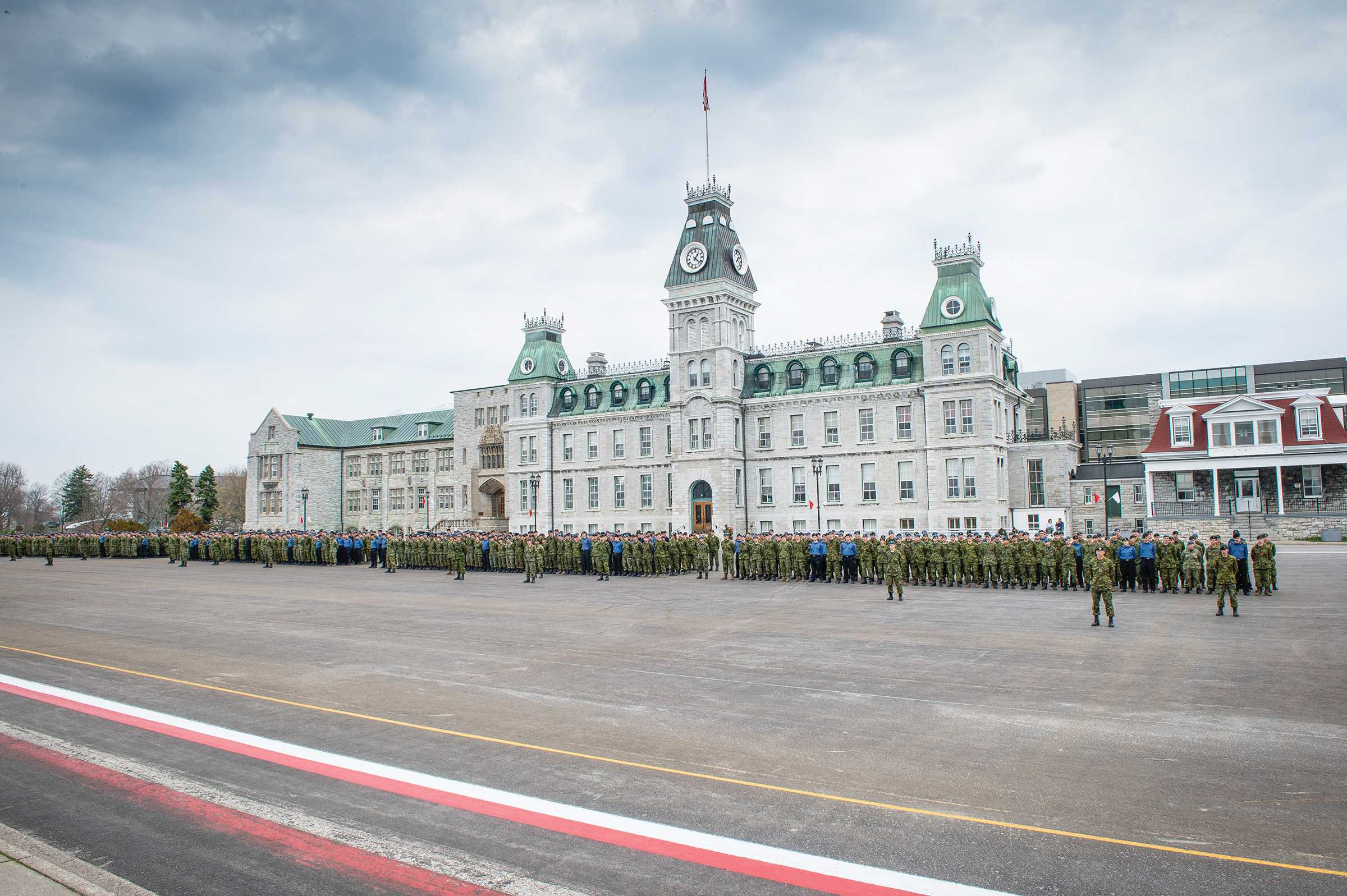
Photo: Steven McQuaid, CFB Kingston
Royal Military College of Canada (RMCC) cadets form up on the RMCC Parade Square during the National Day of Honour on May 9, 2014 at Kingston, Ontario.
Lobna Chérif, Ph.D., CAPP, CRT, PPCC, MBSP is the Founder and Director of the Resilience Plus program at the Royal Military College where she is a Professor at the Department of Military Psychology and Leadership and where she also holds the Chair in Resilience. Dr. Chérif’s current research focuses on character strengths, mindfulness, resilience, and accomplishment—and how to apply this understanding to improving well-being and performance.
Meaghan M. Wilkin, Ph.D. is an Assistant Professor in the Department of Military Psychology and Leadership at the Royal Military College of Canada. Meaghan is a senior team member with Resilience Plus focusing on research and education. In 2021, under Meaghan’s guidance, the Resilience Plus program launched The Resilience Plus Podcast. Her research focuses primarily on the long-term effects of stress, how stress affects the brain, and how social bonds can prevent or alleviate these effects and lead to resilient outcomes.
OCdt Courtney Townson is a Logistics Officer in the Royal Canadian Air Force. She is a 4th-year honours student studying English, Culture, and Communication and is an ambassador for the Resilience Plus Program at the Royal Military College of Canada. She has been a member of the Resilience Plus team since 2021 and is the lead on a variety of initiatives, including creativity-based activities, and has experience as a facilitator for the International Forum on Peace, Security, and Prosperity.
“I am not what happened to me, I am what I choose to become.”
Despite widespread interest in the study of resilience since the 1970s, there has never been a universally accepted definition of the concept. It is generally accepted, however, that resilience encapsulates a mental, physical, emotional, and behavioural ability to face, cope, overcome, grow from adversity, and adapt.Footnote1 Adversities, or stressful life moments, can range from situations that disrupt an individual’s equilibrium to trauma or serious injury.Footnote2 While some research treats resilience as a trait that is relatively stable within individuals, other research indicates that resilience can be learned.Footnote3Footnote4 The research on resilience shows that individuals with strong resilience skills fare better in a variety of domains than those with weaker ones. Accordingly, two decades of research shows resilience can predict a lower risk for depressionFootnote5Footnote6 and greater success in academics.Footnote7Footnote8 Numerous studies highlight the importance of enhancing mental fitness and resilience in healthy populations by improving performance and reducing maladaptive behaviours.Footnote9Footnote10
Resilience-focused programs are now offered in many civilian universities as part of their transition support or as part of their overall wellness program offerings (for a list of resilience courses/programs currently offered in Canadian universities, see Wood and Chérif 2022Footnote11). For instance, 7 out of 21 civilian universities in Ontario (Canada) offer resilience-based courses or programs to their student body. These resilience-based programs are primarily course-based (53.3%), and of these course-based programs, 25% are academic in nature. However, it is not mandatory for students to take these courses (i.e., they are considered electives; Wood and Chérif 2022Footnote12). Resilience is also recognized as a strategic priority for most post-secondary institutions.Footnote13 Similarly, the Canadian Armed Forces (CAF) and military organizations in other countries (i.e., the British Army and the Australian Defence Force) have successfully adopted resilience-based programs in their training curricula (i.e., Canada: Road to Mental Readiness; British Army: Mental Resilience Training; and Australian Defense Force: BattleSMART). The U.S. Army’s Comprehensive Soldier and Family Fitness Program (CSF2) serves as a scientifically validated example of a successful military resilience program with positive results.Footnote14 Effective resiliency training can result in improved self-efficacy, cognitive control, self-awareness, academic achievement, goal attainment, overall academic and workplace productivity, as well as decreased stress levels and stress perception.Footnote15Footnote16Footnote17 Furthermore, being resilient also predicts decreased risk for the development of mental illness, such as depression,Footnote18Footnote19 and greater academic success.Footnote20Footnote21 Not surprisingly, Canada’s military colleges have also started designing and integrating resilience-based programs into their educational resources.
The Canadian Military Colleges (CMCs) are highly selective institutions that have high standards for applicant acceptance. That is, applicants must be in excellent physical health, have obtained a high school diploma (or equivalent), have acceptable results on standardized tests, and have a clean criminal record. Compared to their civilian counterparts, Naval and Officer Cadets (N/OCdts) face additional challenges once they attend the CMCs. When this article was submitted, during their undergraduate studies, students were required to maintain the “four pillars” of excellence. They must adhere to a strict code of conduct and pass their military training (the military pillar); maintain high physical fitness standards, and complete not only yearly CAF testing, but a specialized physical performance test unique to the CMCs (the fitness pillar); become bilingual and proficient in the two official languages of Canada (the language pillar); while maintaining a high academic standard by passing all their classes every semester (the academic pillar).
Military and academic programs at the CMCs are designed to prepare N/OCdts for future military operations. With that objective in mind, N/OCdts are given opportunities to learn and practise “thinking-outside-the-box” skills within a controlled environment. The goal is for cadets to be able to draw on their training and well-developed skills when they face unpredictable and more significant challenges in the future. Aside from the mandatory classes in a cadet’s field(s) of study/degree progression, the CMCs provide mandatory classes for all cadets to attend, including, a variety of military history and military psychology courses. In addition to their combat training, the CMCs also recognize the importance of providing N/OCdts with the necessary training to be successful in life. The aim is not simply to churn out soldiers with tactical and technical skills, but to produce well-balanced individuals capable of handling stress and new challenges with both mental and physical acuity. The CMC programs promote the overall welfare of cadets through a variety of programs. For example, at RMC, N/OCdts can access the Sentinel program, which focuses on a peer-led support system that works in conjunction with the Padres and mental health services. Additionally, there are several student support centres such as the Success Centre, a safe space for students to seek guidance for work, access to financial services, tutors, and a quiet space to study; and the Writing Centre, where students can receive guidance for various academic activities that involve writing skills, presenting, and preparation.
The Resilience Plus Program
The Resilience Plus programme was originally developed based on the core values of the RMCs. It has recently been updated to support the cultural evolution of RMC and, more broadly, the CAF. In particular, the five main components of the program (research, education, training, mentoring and coaching) respond to Justice Arbour’sFootnote22 call for the development of the soft skills of N/OCdts. At Justice Arbour’s call to strengthen the “soft skills” of the N/OCdts:Footnote23
“Members need communication skills, interpersonal skills, problem-solving and conflict management skills, creativity, flexibility, work ethic, mutual respect and empathy. This includes learning to speak up and communicate effectively around difficult issues (like sexual assault and misconduct), to resolve conflicts respectfully, and to help team members understand how to treat others fairly.” (p. 216)
To help address this, the Resilience Plus program aims to strengthen N/OCdts capacities to thrive while at the CMCs and to prepare them for future responsibilities as CAF leaders who will contribute to ongoing culture change initiatives. The program builds on the science of positive psychology and is based on the PERMA model of well-being. The PERMA model emphasizes five core elements of well-being: Positive emotion, Engagement, Relationships, Meaning, and Accomplishment.Footnote24Footnote25 Additionally, the Resilience Plus program’s five core components are designed to help N/OCdts build their leadership and antifragility not only during their time on campus, but also to go forward in their careers within the CAF. Antifragility, originally coined by Taleb,Footnote26 refers to the concept of coming back from adversity stronger and better before being confronted with it. TalebFootnote27 introduced the concept of “antifragile” systems, which “thrive and grow when exposed to volatility, randomness, disorder, and stressors.” In other words, when pressure is applied to a system, it grows stronger. Just like these systems, antifragile people do more than withstand or overcome adversity. They turn closed doors into open ones. They turn existential threats into lessons. They turn personal tragedies into movements. After going broke, Walt Disney sold his favourite character, only to come back with “everyone’s” favourite character, Mickey Mouse. Nelson Mandela endured political imprisonment and then became a revolutionary leader. In recent memory, Malala Youssoufai showed the world the face of antifragility, literally and figuratively, by turning her scarred face into a symbol for bravery, antiviolence, and peace.
Resilience Plus is not a treatment program intended to improve compromised mental health. In addition, it is not targeted at people with moderate or severe mental health symptoms or concerns. It bears repeating that N/OCdts are not being asked to engage in this program because they are lacking resilience or are viewed as deficient in any way. Instead, the program intends to 1) teach resilience fundamentals, concepts, and skills that individuals can use to enhance their current abilities to thrive through disruption and challenges, and 2) conduct research in the field of positive psychology and apply the findings to increase resilience, leadership, and well-being in N/OCdts at the CMCs.
This review will summarize the main characteristics of the content offered by the Resilience Plus program’s different components.
Research
Resilience Plus conducts ongoing research to assess its program offerings both quantitatively and qualitatively. For example, the program was internally evaluated by measuring key indicators of resilience and well-being before and after participation in training sessions and initiatives. N/OCdts also provided informal feedback following voluntary and/or mandatory training sessions and program’s activities. An internal preliminary program evaluation was conducted in the 2022–2023 academic year to provide insight into what resilience-based information is offered to the N/OCdts at the CMCs. This was achieved by evaluating the program’s description, goals, learning outcomes, content, target audience, research, potential benefits, theoretical foundations, and overall characteristics. Preliminary results demonstrate that Resilience Plus is a conscientious program that is well suited for the target audience at the CMCs. Not only is it tailored to the demographic of young leaders attending the CMCs who have unique priorities, challenges, and stressors, but it is also very well received by the N/OCdts due to its support in maintaining optimal levels of performance and well-being through a variety of student-led initiatives. Outside of this type of program evaluation, Resilience Plus has a variety of ongoing research projects that examine topics such as curriculum development, resilience and mental health, and character-based interventions.Footnote28Footnote29Footnote30 Moreover, N/OCdts at the CMCs are invited to participate in a variety of research activities that provide them with the opportunity to learn about the research process. This includes being involved in the writing process, data collection and analysis, exercising their investigative skills, presenting at international forums and conferences, and diving deeper into academic fields of interest, thereby enriching their learning experience and preparing them for higher levels of education and research that they may undertake in the future.
Education
Resilience Plus offers N/OCdts a comprehensive, theoretical overview of resilience which translates into teaching resilience-based strategies to help them identify personal and professional moments in which they can use/demonstrate their resilience. Overall, the program aims to develop resilience skills in N/OCdts as a way of buffering against and/or overcoming personal challenges (e.g., stress, personal conflict, work/life balance). The program offers a plethora of tailored programs for first-year N/OCdts and students involved in the Indigenous Leadership Opportunity Year, Supplemental Physical Training Program, Sentinels program, and Graduate Studies Program to focus on specific emotional, behavioural, and cognitive skills that these unique populations might need to use at some point in their academic and professional progression. Resilience Plus also presents a variety of engaging and participatory webinars and workshops where evidence-based cognitive, emotional, interpersonal, and behavioural strategies that are shaped by positive psychology, clinical psychology, cognitive psychology, and social psychology are explored. For example, Resilience Plus recently offered a VIA Institute on Character Mindfulness-Based Strengths Practice 8-week programFootnote31 that teaches individuals how to apply research-based mindfulness and character strengths practice.
The Resilience Plus Program also has a variety of student-centred activities on campus to encourage them to participate in the program’s activities and positive interventions based on the VIA character strengths. These offerings align with the interests of N/OCdts and CMC cultural values. They are intended to build resilience and empower the cadets. For example, the program offers a monthly newsletter that provides readers with a light introduction to the science of positive psychology and a variety of useful, science-based tools and strategies. This is also where “Narratives of Resilience Plus” from the CMC communities are shared. The narratives celebrate the character strengths of the CMC communities and can inspire others to share their stories of overcoming challenges in their day-to-day lives. The narratives create a positive space to practise journaling, storytelling, and mindfulness. Studies on the benefits of these practices show that narratives create meaning and provide perspective on our reconstructed past, perceived present, and imagined future.Footnote32Footnote33 They are written accounts of lived, past experiences and offer an outlet for courage, reassurance, and hope for others who are currently facing difficult times. The narratives initiative can be beneficial to both the author and the reader. The author can reflect on their own resilience, acknowledge it, and take pride in the fact that they have fostered it. In doing so, many authors report that the process is encouraging and reinforces their resilience. For the readers, it provides them with examples of resilience and character strengths in action with the hope that they are better able to identify and explore their own stories. The “Wall of Paragons of Strengths of Characters” is also present at RMC and members of the CMC communities can nominate N/OCdts, faculty members, and staff members as paragons of the various character strengths.Footnote34 The nominations include a brief description of how these individuals demonstrate a specific character strength. This wall encourages individuals to spot and explain character strengths in others and to empower them. Research has shown that strength spotting can effectively improve engagement and positive affect in youth.Footnote35 Strength spotting practices also support the participants in developing and enhancing practices of love, forgiveness, and kindness, which is helpful in cultivating a sense of community and supportive friendships.Footnote36 The “Team Mosaic with Strengths of Character” initiative is designed to boost awareness of a particular team’s top character strengths and to increase their Character Strengths fluency. Team members are invited to take the Values in Action (VIA) Inventory of StrengthsFootnote37 where the results are then compiled into a “mosaic” of strengths for the team. The mosaic shows the top five character strengths of each member according to a colour-coded scheme. This allows everyone to see each member’s top character strengths immediately and to see the strengths most represented in their team. The mosaic can then be used as a team-building activity, as a point of personal reflection, and/or for group discussion. A variety of creativity-based events are also hosted regularly by the Resilience Plus “Creativity Club.” Creativity is a character strength that enhances one’s ability to connect abstract ideas and come up with novel solutions. In accordance with Seligman’sFootnote38 PERMA model, creativity fosters positive emotions that can broaden our mindset by encouraging us to try new things and to look at situations from a different perspective. The Resilience Plus “365 Days of Character-Based Challenges” initiative provides social media subscribers with daily prompts and challenges to practise using their character strengths in a new way every day for a set period (e.g., daily, monthly, and yearly challenges). Research has shown that even “minimalist” interventions (e.g., receipt of emails encouraging character-strength development) can be effective for promoting well-being, even shortly after the intervention.Footnote39 The program also coordinates a “Letters Project,” which passes on CMC alumni letters to graduating students and fourth-year student letters to incoming first-year students. The goal of these letters is to provide N/OCdts with a direct connection to a person who has successfully navigated their time at the CMCs and beyond. CMC alumni and graduating fourth-year N/OCdts are invited to write a (short) letter to their graduating self or first-year self respectfully. The letter provides the recipient with first-hand knowledge about what the author wishes they had known, thereby offering their younger self some advice and a different perspective on life at the CMCs or in the CAF. The “Resilience Plus Podcast” offers monthly, bilingual podcasts that feature an interview with an invited guest, conducted by an N/OCdt of the “Ambassadors of the Resilience Plus Program.” Each interview is followed by the application of an empirically based tool to facilitate resilience building. The “Ambassadors of the Resilience Plus Program” are N/OCdts who are interested in learning more about resilience and passing this information on to their CMC peers. They volunteer to organize, promote, and participate in campus-wide Resilience Plus activities and initiatives.
Training
The Advanced Leadership and Resilience Training (ALRT) is an internationally recognized, evidence-informed program designed to strengthen leadership effectiveness and psychological resilience under operational pressure. Grounded in the science of positive psychology and leadership development, ALRT enhances combat readiness, fosters adaptive leadership, and supports ethical decision-making in volatile, uncertain, complex, and ambiguous (VUCA) military environments.
The curriculum explores specific evidence-based cognitive, emotional, interpersonal, and behavioural strategies from the subfields of psychology (positive, clinical, cognitive, and social) as well as mindfulness-based strengths practices, known to improve well-being and promote flourishing after adversity.Footnote40Footnote41Footnote42Footnote43 It also recognizes alternative ways of knowing (e.g., Indigenous practices) and has parameters in place to be trauma-informed and responsive (e.g., creating safe, accountable learning spaces, recognizing triggering content, and having a support response framework and resources on hand should students express that they are in distress or are triggered by course content). Learners discuss key concepts such as, but not limited to, mindfulness, character strengthsFootnote44Footnote45 leader character,Footnote46 mindsets,Footnote47 emotional intelligence,Footnote48 and explanatory styles.Footnote49 (see Table 1) With the completion of this certification, learners have the tools and practised skills to nurture their resilience, to be able to “bounce back,” and to overcome adversity that they might face in life. They will be able to apply their knowledge of resilience and its strategies, factors, and tools in their personal and professional lives. They will be able to describe the concept of resilience and its theoretical underpinnings/driving mechanisms, outline and evaluate various resilience-based strategies that will help individuals overcome challenges and be able to identify how their cognitions (mindset) and behaviours (lifestyle) may affect their ability to cope. By raising awareness of the factors and tools of resilience, learners obtain skills that they can foster and use to thrive in challenging environments. They learn how to regulate their emotions and influence superior decision-making, thereby improving team dynamics and increasing their overall awareness of themselves and the people around them.
Building on the foundational insights and early outcomes of ALRT implementation across Canadian Military Colleges, ALRT — Level II was introduced in 2025 as an advanced train-the-trainer certification. Designed for researchers, educators, and leadership professionals in both military and civilian settings, ALRT — Level II expands the program’s reach and impact through structured knowledge transfer and capacity building. The inaugural international cohort included participants from South Africa, Portugal, France, and Canada. A second cohort is currently being prepared, with confirmed or pending participation from Tunisia, Denmark, Norway, Qatar, Ukraine, and Italy—contingent on institutional support.
| Number of Modules | 7 |
| Module Topics & Overview |
Module 1: Antifragility: Resilience 2.0
This module equips participants with the theoretical foundation and applied tools to teach resilience and antifragility within military leadership contexts. While resilience is commonly understood as the capacity to recover from adversity, antifragility describes systems that grow stronger through stress, volatiliSty, and disruption—an essential capability for military leaders operating in uncertain and high-stakes environments.
Module 2: Mindfulness
The purpose of this module is to understand the benefits of mindfulness, describe the relationship between mastery of thoughts, resilience, and leadership, and to practise and experience mindfulness strategies.
Module 3: Character Strengths
This module explores the foundational role of character strengths in fostering effective, values-based, and antifragile leadership. Drawing on the VIA Classification of Character Strengths, participants examine how cultivating and applying one’s character strengths can enhance personal resilience, improve team cohesion, and promote ethical leadership in military contexts.
Module 4: Emotional Proficiency
This module examines the critical role of emotional intelligence in strengthening leadership effectiveness and cultivating antifragility. In high-stakes military environments, unmanaged emotions can undermine decision-making, performance, and cohesion. Leaders who develop emotional intelligence are better equipped to regulate their own emotions, understand the emotions of others, and foster psychologically safe, high-performing teams.
Module 5: Behavioral Mastery
This module provides participants with a deep understanding of the psychological foundations of behavior, habit formation, and behavioral change. Drawing on contemporary behavioral science and habit theory, participants examine how automatic and intentional behaviors influence leadership performance and personal growth.
Module 6: Cognitive Clarity
This module equips leaders with a foundational understanding of cognitive processes that shape perception, judgment, and behavior under stress. Participants explore how cognitive distortions and biases undermine decision-making and leadership effectiveness in complex environments. By cultivating awareness of these mental traps and learning evidence-based cognitive strategies, leaders can enhance psychological flexibility, build resilience, and foster antifragility.
Module 7: Empowered Leadership
This module explores empowered leadership as a strengths-based, purpose-driven approach grounded in psychological well-being and optimal functioning. Drawing from the PERMA Model—Positive Emotion, Engagement, Relationships, Meaning, and Accomplishment—participants examine how flourishing leaders cultivate inner clarity, relational authenticity, and sustainable high performance. |
|---|---|
| Learning Outcomes |
|
| Module Format | Webinar/workshop; mini-lectures, videos, military scenarios, role-playing, quizzes, and homework assignments. |
Mentoring
“No matter what the situation or context, mentoring is a human endeavour that, like a butterfly, develops over time and maintains and transforms individuals, organizations, and cultures bringing hope and beauty to them all.”Footnote50
The importance of mentoring has increased at the CMCs over the last few years and a growing number of N/OCdts are seeking mentors to help them guide their personal and professional journeys. Research on mentoring demonstrates significant benefits to mentors, mentees, and organizations alike.Footnote51 Creating learning environments which ensure N/OCdts are developed personally and professionally is paramount for both the CMCs and the CAF. Currently, senior team members of the Resilience Plus program offer mentoring for the Ambassadors of the Resilience Plus Program where they share their knowledge, insights, and wisdom with their mentees who wish to benefit from mentoring. The program also offers training activities that can assist CMC staff or faculty members who are interested in mentoring. The goal of these activities is to increase understanding of the fundamental principles associated with effective mentorship and to help CMC staff and faculty acquire these essential skills to guide, support, and motivate their respective mentees.
Coaching
Currently, Resilience Plus offers one-on-one coaching sessions with certified coaches to CMC communities. Coaching sessions are aimed at individuals who are interested in developing strategies to maximize their personal and professional potential while empowering them to build their resilience and thrive.
Several studies have demonstrated the value, efficacy, and impact of coaching in several contexts.Footnote52 Coaching has become a long-term human resource development strategyFootnote53 and has recently attracted a lot of organizational attention. Effective coaching is described as one of the best practices for achieving successful management, leadership, and learning in organizations.Footnote54Footnote55Footnote56 Additionally, effective coaching can significantly impact both employees’ experience at work and organization-level performance; for example, increasing their morale, self-confidence, knowledge abilities, work attitudes, and behaviour through coaching contributes to the organization’s overall performance.Footnote57 Specifically, coaching facilitates increased psychological capital. This is a positive psychological resource that coaches can help individuals apply to their day-to-day work experiences. It thereby acts as the linking mechanism between coaching interventions and a host of beneficial outcomes, including job satisfaction, organizational commitment, and job performance. More specifically, research shows that 80% of people who receive coaching report increased self-confidence, and over 70% benefit from improved work performance, relationships, and more effective communication skills.Footnote58 Similarly, 86% of companies report that they recouped their investment in coaching through increased employee commitment and job performance.Footnote59 These findings are transferrable to N/OCdt engagement at the CMCs. The Resilience Plus coaching initiative is thereby laying the foundation for positive culture change at the CMCs and is helping to improve the CAF ethos in the future careers of N/OCdts.
Discussion
The Resilience Plus program at the CMCs is an important outlet of support offered to the N/OCdts and aligns with many of the efforts of the CMCs to develop and maintain optimal levels of performance and well-being. The program is holistic and has various opportunities for CMC N/OCdts, staff, and faculty to be involved in research, education, training, mentoring, and coaching. But the adaptation of how resilience programs are implemented within the CAF is growing more vital as the world continues to become digitalized.Footnote60 Thus, an area of consideration to extend the reach of the Resilience Program at the CMCs, especially given the generally younger demographic of students, is to use the integration of digital applications (apps) on cellular phones to deliver quick-access information, tools, and services to the users. Additionally, the program itself would benefit from continuous feedback via Intervention Mapping (IM). Intervention Mapping consists of a needs assessment, an identification of the outcomes and objectives of a program, the design elements of a program, production, an implementation plan, as well as the development of an evaluation framework.Footnote61 Resources such as these would allow Resilience Plus to provide step-by-step, continuous development of the program to better suit the needs of the CMCs in an ever-changing world. Finally, devoting resources to examining the impact of the Resilience Plus program on fostering antifragile leaders will elucidate the changes and improvements needed to create a specifically tailored program that addresses the unique needs of N/OCdts.
Conclusion
The Resilience Plus program teaches N/OCdts the necessary skills and tools needed to foster resilience during their time on campus and to thrive in a challenging environment when faced with adversity in the future. The program is thorough and well suited for N/OCdts. N/OCdts report having positive experiences when interacting with the Resilience Plus components presented earlier. This holistic program, which includes student-led initiatives and outreach, gives N/OCdts several opportunities to practise “thinking outside the box,” contributes to a positive working and living environment, and ultimately, fosters a network for them to draw upon in their future careers, personal lives, and challenges. Resilience Plus is a well-received program that offers various levels of connection in the general CMC population and establishes an opportunity for the CMCs to “lead by example” when it comes to culture change in the CAF. Ultimately, Resilience Plus supports and serve those who serve us.