

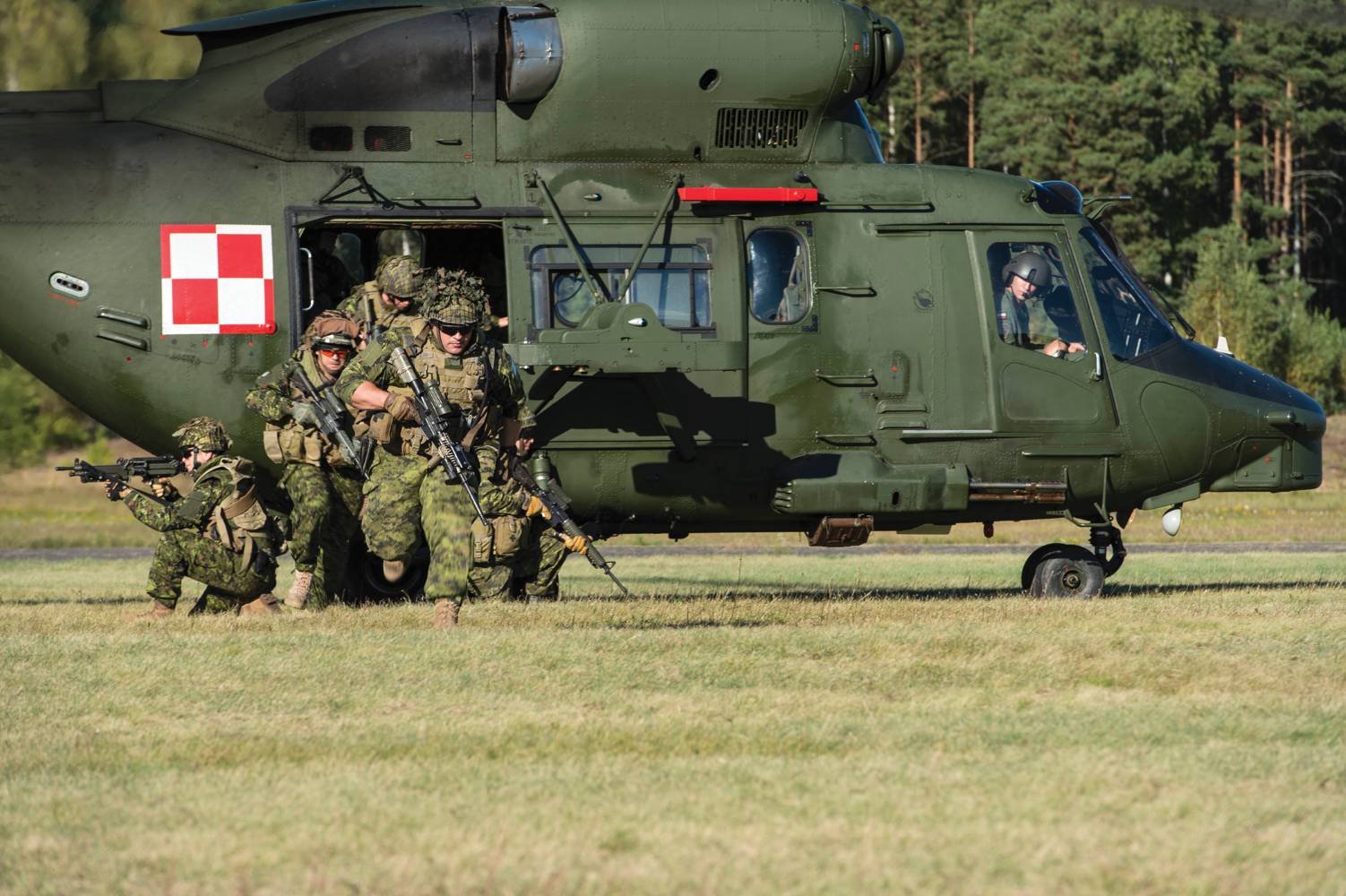
Photo: CCpl Jay Ekin, Operation REASSURANCE Land Task Force Imagery Technician
Members from 1 Princess Patricia Canadian Light Infantry (1 PPCLI) dismount a W3W Falcon helicopter in Drawsko Pomorskie Training Area, during Operation REASSURANCE on September 14, 2016.
Andrzej Grzyb, Ph.D., is a Polish politician, economist, and local government official, a member of the Sejm (the Polish Parliament), and Chair of the National Defence Committee of the Sejm. He served as a deputy to the European Parliament in the 5th, 7th, and 8th terms.
The process of political and political system change in Poland, which began with the formation of Solidarity in 1980, led to the formation of the Coalition Government of Poland on August 24, 1989, with the first non-communist Prime Minister, Tadeusz Mazowiecki, who was designated by Solidarity. Solidarity, a large trade union movement of 10 million people, initiated a historic process of peaceful political system change in Poland, the first in Central and Eastern Europe.
Prime Minister Tadeusz Mazowiecki made a clear declaration that Poland wanted to join the European Communities (now the European Union). Prime Minister Mazowiecki could not announce Poland’s desire for NATO membership in 1989, because the Warsaw Pact was still in effect, and the last troops of the former USSR did not leave Poland until September 17, 1993.
At the time, there was strong public support in Poland for Polish NATO membership. On November 2, 1992, Prime Minister Hanna Suchocka stated in a government exposé that Poland’s strategic goal was to become a member of NATO. There were also voices of support in the US administration and the German government. However, there was reticence on the part of some NATO countries regarding Poland’s aspirations.
Polish efforts for NATO membership also involved a change in Russia’s position, as raised by President Lech Wałęsa during a visit to Moscow in August 1993. Russian President Boris Yeltsin stated at the time that Russia would not announce a veto on the issue. However, a few weeks later, Russia changed its position and announced its opposition to plans for NATO enlargement, and President Yeltsin sent letters to the presidents of the US, France, the UK, and Germany stating that enlargement would be contrary to the provisions of the 2+4 conference on the terms of German reunification.
A particular impetus to intensify efforts to join NATO was provided by the visit of NATO Secretary General Manfred Wörner, who said in Warsaw on March 12, 1992, “the door to NATO is open.” President Wałęsa wrote in a letter to the NATO Secretary General on September 1, 1993, that NATO membership was one of the top priorities of Polish foreign policy. In October 1993, US Secretary of Defense Les Aspin, at a conference of defence ministers of NATO member states in Travemünde, Germany, proposed a “Partnership for Peace” defence cooperation agreement with Central and Eastern European countries. A mechanism for cooperation among NATO aspirant countries on order, security, and stability in Europe was introduced. An invitation to participate in the Partnership for Peace was extended to all European countries interested in cooperation with NATO. In 1995, 25 countries participated in the program. The signing of the agreement took place on January 10, 1994, in Brussels.
The document defined the objectives of cooperation within the framework of the Partnership for Peace, which included the following:
- developing security cooperation,
- ensuring stability on the continent by increasing transparency in defence budgets,
- resuming civilian control over the military, joint exercises and defence planning, and
- enabling partners to interact with NATO in the area of peacekeeping operations and humanitarian operations.
Within the framework of the Partnership for Peace, Poland was the first to sign an individual program of cooperation with NATO, which was the basis for, among other things, joint military exercises. The first joint NATO exercises on Polish territory within the framework of the Partnership for Peace took place on September 12, 1994, at the training ground in Biedrusk near Poznan, less than a year after the last Russian troops had left Poland. Poland, in order to join NATO, was specifically required to introduce civilian control of the army and its complete reconstruction.
US President Bill Clinton, in a conversation with Prime Minister Waldemar Pawlak during a visit to Poland in July 1994, stated that NATO enlargement was no longer a question of “if,” but of “when and how.” Two years later, President Clinton confirmed that adoption would take place by the 50th anniversary of the NATO alliance, at the latest. Negotiations with NATO alliance authorities lasted three years and had the full support of all political parties. The consensus also included a process of changes and reforms in the army.
At the NATO summit in Madrid in July 1997, NATO member states decided to invite Poland, the Czech Republic, and Hungary to join the structures of the North Atlantic Treaty Organization, and the official invitation to join came in January 1999. Poland’s efforts to become a member of NATO were the subject of full consensus among all political forces in Poland. That consensus was evidenced by the efforts to gain support for Poland’s NATO membership from all member states, with particular emphasis on the US, both at the government level and in the parliaments of NATO member states. Four rounds of negotiations on Poland’s membership took place in 1997, and on October 14, 1997, Foreign Minister Bronislaw Geremek handed over to the NATO Secretary General a letter expressing Poland’s will to join the North Atlantic Treaty. The letter also confirmed its readiness to accept the obligations associated with membership. The accession protocols of Poland, Hungary, and the Czech Republic were signed by the foreign ministers of NATO countries on December 16, 1997, and the process of ratification of the Accession Protocols by NATO member states began.
Lobbying for Poland’s NATO membership
Was lobbying for NATO enlargement to include Poland in NATO member states, especially in the US Congress and Senate, necessary? In Washington, it was stated unequivocally that lobbying efforts were necessary because there were many questions and doubts: for example, how Russia would react to NATO enlargement to include Poland; whether Poland’s democracy was mature; and what Poland’s relations with Ukraine and the Baltic states were. Precise and professional information about Poland’s efforts to join NATO achieved the expected result: in the US Senate, 82 out of 100 senators voted in favour of NATO membership for Poland. That was 15 more than the required two thirds of the Senate (67 votes). A major factor in swaying the decision was the presentation of Polish efforts to the US administration, influential think-tanks, and university centres.
An important role in promoting Polish membership in NATO was played by, among others, Professor Zbigniew Brzezinski, former National Security Advisor to US President Jimmy Carter; US Congress members of Polish descent; and the Polonia (the Polish diaspora), which collected 9 million signatures in support of Poland’s membership in NATO. Lobbying groups in the United States kept accurate maps that showed growing support from senators starting in 1994. Poland, the Polish government and parliament, and Polish diplomats knew that the most important thing in the process of promoting Poland’s membership was to prove that enlarging NATO to include Poland, the Czech Republic and Hungary—former Warsaw Pact countries—was not contrary to the interests of the United States and the other members of the North Atlantic Alliance.
I have described at some length the efforts made to expand NATO to include Poland, as well as Hungary and the Czech Republic. It was not enough to change the political system, make democratic changes, introduce civilian control of the armed forces, and declare a desire to join the alliance. In addition, it was particularly important to build alliance members’ confidence in the candidate states: that we were ready to subject the army to civilian control, to finance and carry out modernization of the armed forces in accordance with NATO standards, and to demonstrate the ability to integrate fully into NATO.
Participation of the Polish Armed Forces in international exercises and missions
A good example demonstrating the ability to fully integrate with NATO is Poland’s involvement in the exercises of NATO units since joining the Partnership for Peace. The Polish Armed Forces have participated in international missions since 1953 (UN peacekeeping missions in Indochina, Lebanon, and the Golan Heights). They have participated in difficult missions in Iraq and Afghanistan. The Polish Military Contingent participated in the international operation in Iraq in 2003–2008, which was the most serious challenge the Polish army has faced since the end of World War II. Although Poland had acquired considerable experience while operating around the world under the UN and NATO flags, the operation in Iraq required a completely new approach: 15,000 soldiers were involved and 22 were killed. In the Iraqi mission, Poland commanded, for the first time, an international structure in the strength of a division. It was a very demanding test of soldiers’ training, service in an international environment, command skills, and the quality of equipment and supplies. In 2007, there was a shift in the nature of the tasks Polish soldiers performed.
Poland joined “Enduring Freedom,” the US-led international coalition against global terrorism, in 2002. In 2007, participation in Operation Enduring Freedom ended and the first rotation of the Polish Military Contingent under the International Security Assistance Force (ISAF) in Afghanistan began. A major challenge was the assumption of responsibility for Ghazni province by the Polish Task Force. Polish soldiers were present in Afghanistan for almost 20 years, and more than 33,000 soldiers and Ministry of Defence personnel took part in the operation. Forty-three Polish soldiers were killed and 200 wounded in Afghanistan. Currently, the Polish Armed Forces participate in international operations conducted under the auspices of NATO, the European Union, and the United Nations. The Polish Armed Forces have taken part in 89 operations since 1953. Soldiers of the Polish Armed Forces are currently present in these locations:
- the Balkans: in Kosovo as part of the NATO-led KFOR mission and in Bosnia and Herzegovina as part of the EU’s EUFOR mission,
- the Middle East and Africa (UN missions), and
- Turkey (NATO mission and EUNAVFOR MED IRINI mission in the Mediterranean Sea).
Increasing the size of the Polish army
Poland has decided to increase the size of its army. In 1999, the year Poland joined NATO, the Polish armed forces numbered 226,000 soldiers, including 95,000 professional soldiers. The remainder were conscripted soldiers under compulsory military service.
At the time, we, like the rest of Europe and partly the US, were entering a decade of disarmament due to the belief that there was no likelihood of a global conflict. That was also the result of a reset in relations with Russia, which was established not in Poland, but throughout NATO with the hope of a new peace order in Europe. Significant savings in defence spending were allocated to necessary infrastructure investments and social spending.
On January 1, 2010, Poland abandoned military conscription and began building a professional army. The size of the army in 2010 was 95,500 professional soldiers, and by 2020 that number had increased to 110,100.
Beginning in 2021, there has been a surge in the size of the Polish army, following a hybrid attack involving immigrants from Belarus on the Polish border. Since then, the military has been and continues to be used to reinforce the Border Guard forces and protect the border with Belarus. Another impetus was Russia’s aggression against Ukraine, which began on February 24, 2022.
In 2017, the Territorial Defence Forces were created, the size of the army was systematically increased, and the formation of new units began. Based on the Homeland Defence Act of 2022, voluntary basic military service was introduced for those interested. Some soldiers, after training under voluntary basic military service, continue to serve in the professional army. A new idea of an active reserve has also been introduced, based on American models. Under these arrangements, specialized cadres for the military are being built for the future. The program begins with high schools, through the creation of uniformed classes as part of military preparation. A volunteer military training program has been introduced within the framework of the Academic Legion program, aimed at university students and graduates. The program aims to connect students and graduates with the Polish Armed Forces, while supporting their career development. Personnel training for the Polish Armed Forces also takes place at five military colleges and non-commissioned officer schools. For a number of years, we have noted in Poland the creation of training courses related to state security at public and private universities—courses which are popular with students.
According to “Defense Expenditure of NATO Countries,” in 2024 the Polish Armed Forces comprised 216,100 soldiers, placing Poland third in NATO in terms of numbers. According to the Global Firepower – Military Forces 2024 ranking, Poland’s Armed Forces rank 21st in the world in number of members. In 2023, the Polish Ministry of National Defence announced a plan to increase the size of the armed forces to 300,000 soldiers.
European Union Battle Groups: European Union Group and NATO’s Enhanced Forward Presence initiative
Poland participates in both NATO and EU initiatives to strengthen defence structures and enhance capabilities in crisis and threat conditions. Defence ministers of EU member states in 2004 established tactical unions as rapid reaction forces. The construction of EU battle groups was the result of an acceleration in the creation of a common security policy and defence in the immediate aftermath of the 2003 Iraq War, although the September 11, 2001, attack on the World Trade Center in New York was also a significant impetus. Twenty-four countries, including Poland, are participating in the creation of the battle groups.
Poland also hosts NATO’s Enhanced Forward Presence (eFP) and has the status of an eFP contributor country. The Enhanced Forward Presence initiative, established at the 2016 NATO Summit in Warsaw, enhances defence and deterrence capabilities through the establishment of battalion battle groups composed of contingents from NATO member states in Poland, Lithuania, and Latvia. Following Russia’s full-scale invasion of Ukraine, member states decided to increase the forces involved in the eFP and to expand it to Slovakia and Hungary, as well as an adapted enhanced presence in Romania and Bulgaria. Each battle group has between 1,000 and 2,000 troops stationed on a rotating basis, and one of the countries has framework state status.
Since the beginning of its NATO membership, Poland has been making efforts to establish a permanent presence of US troops in Poland. An expression of the permanent presence is the construction by the United States of the US Navy’s AADMS Military Support Base in Redzikowo, which, together with a similar base in Devesel, Romania, is part of the US anti-ballistic missile system. Camp Kosciuszko, which houses the 5th Corps forward command, has been located in Poznan, and a total of about 10,000 US soldiers are stationed in Poland as part of a rotational presence.
Defence spending in Poland in relation to GDP
Until 2001, there were no legal regulations specifying how much of the state budget should be allocated to defence. Between 1991 and 1999, the share of the Ministry of Defence’s budget expenditures fluctuated from 2.25% of GDP in 1991, to a record 2.47% in 1993, to 2.00% of GDP in 1999.
Following Poland’s entry into NATO, the Polish government, in consultation with the President of Poland, decided to legally regulate defence expenditures. To that end, on May 25, 2001, the “Act on Reconstruction and Technical Modernization and Financing of the Armed Forces of the Republic of Poland in 2001–2006” was adopted. The purpose of the law was to “create conditions for stable financing of the armed forces over a multi-year time horizon, taking into account the state’s economic capabilities,” and to “ensure conditions for at least 1/3 of the Armed Forces to achieve full interoperability within the framework of the North Atlantic Treaty Organization and the standards of the other member states of the organization in terms of armaments, equipment, mobility and the ability to conduct military operations in all conditions.”
The law stipulates that “the state budget shall allocate budget expenditures of no less than 1.95% of GDP annually for the implementation of the program in 2002–2006.” It also established that the share of property expenditures, mainly relevant to ongoing construction investments and purchases of military equipment and armaments, would be at least 19% of total defence spending in 2003 and at least 23% in 2006. In 2004, the title of the law was amended to read “on reconstruction and technical modernization and financing of the Armed Forces of the Republic of Poland.”
In 2016–2017, as a result of another amendment to the Law of July 2015, the minimum level of defence spending was set at 2.00% of the GDP of the previous year. Another amendment to the law dated September 29, 2017, “The Law on Amendments to the Law on Reconstruction and Technical Modernization and Financing of the Polish Armed Forces and the Law – Public Procurement Law,” established that the financing of the defence needs of the Republic of Poland would be allocated annually for expenditures from the state budget in an amount “not less than:
- 2.0% of GDP – in 2018 and 2019,
- 2.1% of GDP – in 2020,
- 2.2% of GDP – in 2021–2023,
- 2.3% of GDP – in 2024 and 2025,
- 2.4% of GDP – in 2026–2029,
- 2.5% of GDP – in 2030 and subsequent years.”
In doing so, it reinstated the rule in effect from 2002 to 2004, consistent with NATO methodology, that “current year” GDP is used to calculate minimum defence outlays (and not “the previous year,” as was the case from 2005 to 2017).
From 2000 to 2017, a total of US$104.4 billion was spent on national defence. In 2000, the realized expenditures were US$3.3 billion, while in 2017 they were US$9.3 billion. This means that the annual level of incurred defence outlays during that period nearly tripled, increasing by 273% to be exact. That increase is proportional to GDP growth, which increased by 289% over the same period.
The start of Russia’s war against Ukraine has accelerated the comprehensive regulation of the country’s defence, in the new Law on Defense of the Fatherland. From the point of view of the development and modernization of the Polish Armed Forces, the new solutions and regulations on financing and modernization of the armed forces are particularly important. Since 2022, according to the provisions of the new Law on Defense of the Fatherland, which was passed unanimously by the Polish Parliament, 3% of GDP has been allocated for defence spending. Many international bodies dealing with security and defence issues have repeatedly stated that Polish rearmament is a phenomenon worth noting. Crucial to the increase in defence spending is the Armed Forces Support Fund, operated by Bank Gospodarstwa Krajowego, whose spending authorization does not expire at the end of the fiscal year. Thanks to the Armed Forces Support Fund, the defence budget was increased by US$5.1 billion in 2022 and by about US$12.1 billion in 2023. It is planned that in 2024 an additional US$11.8 billion will be designated from the Armed Forces Support Fund for the technical modernization of the army. As a result, Poland will allocate 4.2% of GDP to defence in 2024, which clearly exceeds allied commitments. The defence spending plan in the draft budget for 2025, together with the Armed Forces Modernization Support Fund, amounts to 4.7% of Poland’s GDP, which is US$46 billion.
National Reconstruction Plan: The Republic of Poland’s efforts to link EU funding with resilience-building processes
The European Union, in order to assist the economic recovery and rebuild the resilience of EU member states after the COVID-19 epidemic, launched the NextGenerationEU Reconstruction Fund, a temporary economic recovery instrument worth €750 billion. The implementation of the planned reforms in the National Reconstruction Plan (NRP) will help shift the economy to a new growth trajectory. The goal is to respond to demographic challenges and climate change, as well as participate in the creation and use of new technologies. In Poland, funds from the NRP have also been earmarked for investments aimed at increasing our country’s security.
The NRP focuses on six thematic components, including Resilience and Economic Competitiveness. The Ministry of Defence is one of the entities responsible for the “Resilience and Competitiveness of the Economy” component, and, as the institution responsible for the implementation of investments under the NRP, it is responsible for “[e]xpansion of the national system of monitoring services, products, analytical tools and services and accompanying infrastructure using satellite data for the Satellite Earth Observation System.”
The scope of the investment includes the construction of satellite capabilities for acquiring Earth imagery for national security and defence and to meet the needs of public administration. The system, with an architecture that allows military-civilian applications, will make it possible to respond to the most urgent needs for access to high-resolution imaging for defence, security, and public administration. The task is interdisciplinary in nature, and the results of its implementation will serve to meet selected needs of the defence sector and public security, crisis management, civil protection and fire protection, as well as those of the national economy in terms of access to satellite imagery data (agriculture, education and science, spatial management, infrastructure, environmental protection and climatology, monitoring, statistics, and others).
EU-NATO cooperation is an integral pillar of EU activity to strengthen European security and defence. It contributes to transatlantic burden-sharing, in keeping with the principle that a stronger EU and a stronger NATO mutually reinforce each other.
Under the 1993 Maastricht Treaty on European Union, an integral part of the European Union’s Common Foreign and Security Policy is the Common Security and Defence Policy, which aims to develop the military and civilian capabilities of the EU and its member states to manage external crises.
Missions under the Common Security and Defence Policy are aimed at improving security, supporting third countries in the fight against terrorism, human smuggling and organized crime, and monitoring international agreements. The budget of the Common Security and Defence Policy funds civilian missions, special representatives, and stabilization activities. An example of such missions is EUFOR Althea (European Union Force in Bosnia and Herzegovina), which replaced the NATO mission in 2004. The purpose of EUFOR Althea is to ensure the security of the population and fulfill the Dayton Accords. The mission involves 1,100 soldiers from various European countries, including Poland.
The issue of financing defence spending at NATO’s forum
Following Russia’s illegal annexation of Crimea, NATO members approved the defence investment commitment at the 2014 Wales Summit, which remains the political foundation of their commitment to increase defence spending today. The commitment was carefully formulated to deliver results within a decade (by 2024): it was demanding, but realistic. Not only was a target of 2% of GDP set for defence spending, but an additional target was set for Alliance members to devote more than 20% of their defence budgets to essential equipment, including related research and development—which is equally important because it encourages Alliance members to invest in new defence capabilities.
Although the overwhelming majority of Allies have increased their defence spending as a share of GDP, there are still significant differences among them. The members generally fall into one of three groups, each representing about one-third of the Alliance: those who have already achieved or are close to achieving the 2% target; those who are moving rapidly toward it and are expected to achieve it in the near future; and those who plan to achieve the 2% target but have not done so yet. Looking ahead, much remains to be done to rebuild strength and regain capabilities across the Alliance.
The war in Ukraine has publicly shown that many Allies have had difficulty finding available stocks of ammunition to transfer to Ukraine or to re-equip their own forces. This requires restoring the capacity to produce ammunition, especially large-calibre ammunition, in the arms companies of the member states. Restoring production capacity in this area is not limited to financing purchases, but also to building new ammunition calibration lines, which is subject to numerous constraints, especially in the supply of technological lines and raw materials.
The members of the Alliance are dealing with capability gaps in domains that have been neglected for many years, because we have been dealing with completely different threats, mainly terrorist threats. Russia’s war against Ukraine has also verified previous assumptions regarding the course of armed conflicts. It is worth mentioning the use of migration pressure on the borders of neighbouring countries, which we are dealing with on the borders of Poland, Lithuania, and Latvia with Belarus, the last being an ally of Russia. The fight against threats in cyberspace plays a huge role. The war in Ukraine is not the first conflict in which uncrewed aerial vehicles have been used, but their effectiveness and relatively low production costs have led Ukraine to create a separate structure of armed forces: drone troops. A similar decision was also made by the Polish Minister of Defence.
The NATO Defence Planning Process has enabled Allies to identify key capability gaps and thus begin to rebuild high-end capabilities in the land, sea, and air domains by acquiring advanced platforms and enablers. NATO Allies are therefore focusing on rebuilding industrial capabilities across the Alliance. Priorities vary among Allies depending on their size and geographical location, but the most important priority for NATO as a whole is to regain military and industrial capabilities to meet the challenges of high-intensity war scenarios, given the long-standing constraints on rebuilding stockpiles. Specific areas of focus include the land domain (armour, artillery, and enablers), integrated air and missile defence, and submarine operations. Increased defence spending enables Allies to better prepare for the future. NATO’s technological advantage has always been a key advantage for the Alliance. Each of these priorities in itself justifies renewed defence spending efforts.
Polish President Andrzej Duda has proposed that NATO member states consider raising defence spending to 3% of GDP to meet defence challenges in Europe and the world.
How much is enough for defence in the current geopolitical conditions?
The security environment in Europe and beyond will remain unstable for the foreseeable future. The longer the war in Ukraine lasts, the more it is turning into a protracted conflict requiring long-term support for Ukraine, in the form of both military equipment and macro-financial support for state institutions. The experience of Russia’s war against Ukraine has clearly demonstrated the need to build solid deterrence and defence measures to prevent the conflict from spreading to NATO territory. Increasing defence spending is largely within the fiscal capacity of NATO member states, which are among the most economically developed countries in the world.
Public opinion within the member states, especially those in Northern and Eastern Europe, supports defence spending, and public support is also growing in Poland. Excluding the United States, which is the global leader in defence spending, the remaining countries of the Alliance have increased their total spending by one-third over the past decade, as a result of Russia’s 2014 attack on Ukraine. According to public opinion polls in NATO member states, the majority of citizens of the Allied states support an increase in defence spending. Trust in the armed forces is also growing in Poland and has reached 83% among respondents in the general public—the most positive result in the history of research conducted on the subject. In addition, data from a survey conducted in 2023 among citizens of the member states indicate that 80% of them believe that North America and Europe should continue to cooperate for common security. However, citizens’ sensitivity on the topic of defence spending must be taken into account, because sustainable efforts for defence require a strong democratic consensus. It is therefore necessary to constantly present the security arguments that justify these efforts. It is also crucial to show the real economic benefits for domestic industry and technology development, and thus for the economies of the member states and their societies.
Among NATO members, Poland has become the country with the largest expenditure as a percentage of GDP on the army and modernization of military equipment. In 10 years, we have doubled the size of the army. In Poland, about half of the budget expenditure for defence purposes is allocated to equipment modernization. As noted in British daily The Times, Poland is conducting the fastest and most ambitious program of expansion of the armed forces, the like of which has not been seen in continental Europe for decades. Władysław Kosiniak-Kamysz, Deputy Prime Minister and Minister of Defence, upon taking over the leadership of the Ministry of Defence in December 2023, emphasized that all contracts for equipment and supplies concluded with suppliers will be fully implemented. At the same time, some orders for equipment and supplies are to be combined with technology transfer and Polonization of equipment production. Ultimately, the intention of the current Polish government is to allocate half of orders for military equipment and supplies to the Polish arms industry.
Challenges for NATO in the wake of Russia’s war against Ukraine
The Russian invasion of Ukraine has become a turning point in international security. NATO countries’ actions regarding defence, deterrence, and alliance cohesion in the coming period have been revised. Russia’s invasion of Ukraine has significant implications for NATO and is likely to influence changes in the alliance. The war in Ukraine, in the opinion of many experts, is a failure of deterrence, while on the other hand it has united the transatlantic alliance. At the same time, we hear many opinions that the NATO community is stronger than ever. NATO’s core mission is still collective defence, and the Alliance must adapt to the changing threat landscape, in which Russia will remain one of the main threats to NATO in the coming decade. “The world has become more dangerous, but at the same time NATO has become stronger,” said Jens Stoltenberg, Secretary General of the North Atlantic Alliance, during the presentation of its annual report on its activities in 2023. “The Alliance has not only maintained its unity, but it continues to be attractive to European states and societies. Last year, Finland joined our family, last week Sweden, and Ukraine is closer to NATO than ever before.” The report clearly emphasizes that the residents of the countries belonging to the Alliance stand in solidarity with Ukraine and are in favour of further support for Ukraine. This is extremely important, because 99% of military aid from abroad comes from NATO. Several member states have concluded bilateral security agreements with Ukraine. At the same time, the report emphasizes that defence spending has increased by a record 11%. In 2024, it was expected that NATO members would invest $470 billion in their armies, and two thirds of the member states would reach a level of defence spending equal to or exceeding 2% of GDP.
“This commands great respect that many countries are following Poland. I am not talking only about the countries of NATO’s eastern flank, (...) the countries of Southern Europe are also changing their strategy,” said Kosiniak-Kamysz at a meeting of NATO defence ministers on October 18, 2024, in Brussels.
At that October 2024 meeting, the “victory plan” presented by the President of Ukraine was discussed. Kosiniak-Kamysz emphasized that Poland is a leader in aid for Ukraine and supports actions for its accession to NATO, but that the invitation had to come from the entire Alliance.
NATO must consider further strengthening its presence along the Eastern Flank to provide additional support and security to Allies concerned about Russian intentions. The conflict in Ukraine has highlighted the importance of modernizing NATO’s defence capabilities to effectively deter and counter hybrid threats. NATO must prioritize investments in a number of areas to address the emerging security challenges resulting from hybrid warfare tactics.
NATO’s response to the Russia-Ukraine conflict must include enhancing deterrence of further aggression against member states. That includes increasing the readiness and responsiveness of NATO forces, conducting exercises to demonstrate NATO’s ability to defend its territory, and strengthening the Alliance’s commitment to collective defence under Article 5 of the NATO Treaty. The war in Ukraine has prompted NATO to strengthen its partnerships with the countries of Eastern Europe and the Black Sea region. NATO must deepen cooperation with partner countries such as Ukraine, Georgia, and Moldova to increase their resilience to Russian aggression and support their efforts to implement democratic reforms and modernize their defence capabilities.
The conflict in Ukraine has underscored the importance of resilience and citizen preparedness in countering hybrid threats. NATO must prioritize efforts to strengthen resilience measures, including strengthening critical infrastructure, improving energy security, and strengthening civil-military cooperation to mitigate the effects of potential aggression. The adoption by the Polish parliament of a new law on civil defence and the process of implementing it are examples of such efforts.
Poland assumed the presidency of the Council of the European Union on January 1, 2025. The foundation of the Polish presidency in 2025 is security in seven dimensions: external, energy, economic, food, health, information and internal. That is why the motto accompanying the Polish presidency is “Security! Europe.”
The Polish presidency of the Council of the European Union coincides with the new Trump administration taking over the White House. The new administration will need good information about the situation in Ukraine and the scope and forms of assistance provided by Poland and other democratic countries. About 90% of military aid reaches Ukraine through Poland. Poland has also helped provide information for American businesses on the reconstruction of Ukraine. It is estimated that the value of investments related to the reconstruction of Ukraine could reach US$1 trillion.
During the Polish presidency, an informal meeting of the EU Foreign Affairs Council with the participation of Defence Ministers was held on April 2 and 3, 2025. The main topic was the implementation of the White Paper prepared by Commissioner for Defence Andrius Kubilius and approved by the European Commission. Poland was the initiator of the appointment of the Commissioner for Defence in the current composition of the European Commission. The White Paper was recognized as a landmark document on the Common Security and Defence Policy, especially in terms of developing the production potential of the defence industries of EU member states. Included in the White Paper was Poland’s Shield East project, a key investment to defend a more than 700-kilometre stretch of the border with Russia (Kaliningrad Oblast) and Belarus. The Shield East project will include a belt of military installations extending up to 50 kilometres into Polish territory. In the White Paper, the European Commission identified seven critical areas whose fulfillment is key to strengthening defence:
- air and missile defence,
- artillery systems,
- ammunition and missiles,
- military mobility,
- use of artificial intelligence and innovative technologies,
- strategic enablers of combat capabilities, and
- critical infrastructure protection
Poland, as part of its EU Council presidency, led the creation of a special fund, Security Action of Europe (SAFE), in the amount of €150 billion to finance defence objectives and support the defence industry and investment in security in order to strengthen the potential of European NATO member states, which are also members of the EU. At the same time, it was decided that EU-associated states would also be able to benefit from the fund.
The NATO summit in The Hague: 5% of GDP for defence
The Hague summit, according to commentators, was modest in both form and content, yet significant decisions were made there regarding defence spending. During the summit, the allies decided to increase defence expenditures to 5% of GDP by 2035. Of that amount, 3.5% is to be allocated to equipment and armaments, and 1.5% to defence-related investments, including dual-use infrastructure, protection of critical infrastructure, development of the defence industry, cybersecurity, and societal resilience. Funds provided in support of Ukraine will also be counted as part of that expenditure. This proposal was put forward by Poland and was supported by the summit participants. The allies committed to annual planned increases in spending, outlined through to the year 2035.
Achieving the second goal of allocating 1.5% of GDP to defence-related investments will be easier for allies on the eastern flank, who are making numerous dual-use investments, and for the Nordic countries, which have a well-developed civil defence system.
Despite general agreement on establishing the new defence spending target, Spain broke ranks by declaring a commitment of only 2.1% of GDP. Member states have set varying timelines for reaching the additional 1.5% of GDP in defence-related expenditures. The Baltic States are prepared to reach this spending threshold as early as 2026. Spain’s refusal to allocate 5% of GDP to defence was met with criticism from its allies. NATO Secretary General Mark Rutte stated, “Spain believes it can meet these objectives with spending at 2.1% of GDP. NATO is absolutely convinced that Spain will need to spend 3.5% of GDP to achieve these goals.” Poland (4.7% of GDP) and Lithuania (4.0% of GDP) have already surpassed the proposed 3.5% defence spending target for 2025. Latvia, Estonia, Denmark, and Norway are close to reaching that level. A potential adjustment to the US military presence in Europe, currently under consideration, is seen by experts as a strong incentive for accelerating defence spending among European allies.
From the perspective of the US administration, the outcomes of the summit in The Hague are considered a success, which is expected to have a positive impact on transatlantic relations. The summit conclusions did not include references to relations with China, nor to hybrid threats from Russia in the Baltic Sea region—issues of particular concern to the Baltic States. The conclusions also did not contain any statements regarding the strengthening of nuclear deterrence policy.
On the occasion of the Hague summit, NATO highlighted the Defense Production Action Plan adopted in February 2025, which outlines eight initiatives focused on joint procurement, production, and industrial base development, interoperability, and the implementation of innovative technologies.
Poland is satisfied that the efforts to increase defence spending by NATO member states were adopted at the Hague summit. That decision represents the fulfillment of proposals made by the President of the Republic of Poland and the Polish government to the Allies. During the summit, President Andrzej Duda thanked US President Donald Trump and NATO Secretary General Mark Rutte for supporting Poland’s proposal to raise defence expenditures among NATO countries. Poland particularly emphasizes the clear statement made by President Trump regarding Article 5 of the North Atlantic Treaty, in which he declared, “It is absolutely clear that the United States is fully committed to NATO and to Article 5 of the North Atlantic Treaty.”
Polish Deputy Prime Minister and Minister of National Defence Władysław Kosiniak-Kamysz called the outcomes of the summit “Very good and important decisions for Poland.” Other outcomes of the summit were bilateral agreements with Germany, Norway, and Australia aimed at strengthening Poland’s defence capabilities, including:
- extension of the deployment of German Patriot systems in Jasionka near Rzeszów, where a logistics hub supporting Ukraine is located,
- deployment of Norwegian F-35 fighter jets in Poland, and
- relocation to Poland of an Australian Airborne Warning and Control System (AWACS) reconnaissance and early warning aircraft.
Kosiniak-Kamysz also emphasized that NATO, through the decisions made at the summit, is enhancing its capabilities in military mobility, which is crucial for the rapid movement of troops and equipment across allied borders, both on land and at sea. The decisions at The Hague summit confirmed Poland’s growing role as a pillar of the eastern flank of the North Atlantic Alliance.