

Photo: MCpl Krista Blizzard, 5 Wing Public Affairs
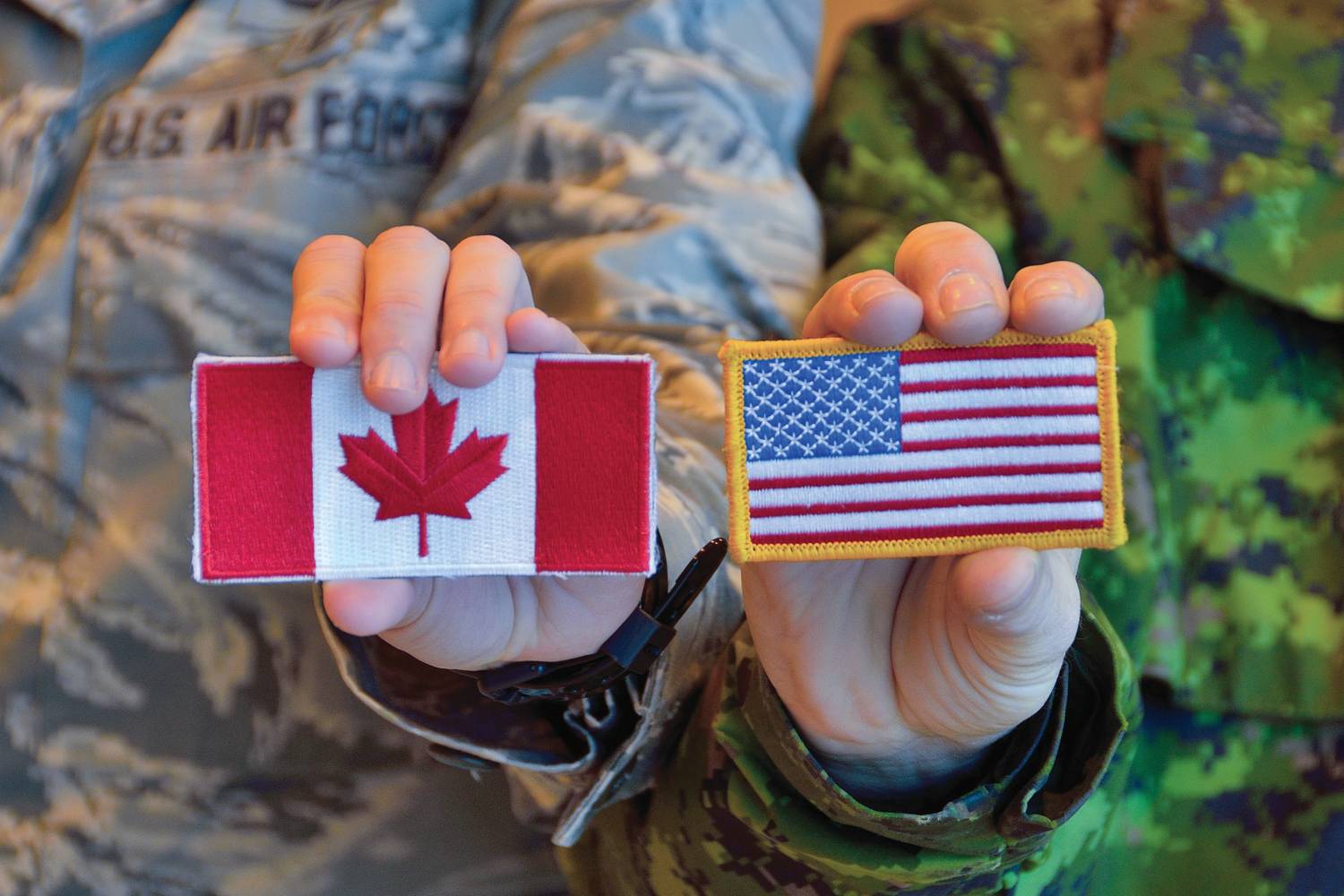
Canadian and American military members exchange their flags at 5 Wing Goose Bay, Newfoundland and Labrador during Exercise VIGILANT SHIELD 17 on October 17, 2016.
Renaud Bellais, Ph.D., is an Associate Researcher at CESICE, Université Grenoble Alpes (Grenoble), and co-head of the defence observatory at the Fondation Jean Jaurès (Paris). He is also Group chief defence economist at MBDA, a European defence company
What makes a country a good ally? Until the creation of the Atlantic Alliance, the criterion was quite simple: Do you fulfill your commitment? Alliances were a coalition of the willing, usually based on short-term, ad hoc objectives. A good ally was the one that goes to war when expected, with appropriate means and good tempo. Therefore, the robustness of an alliance was tested on the battlefield only, since treaties provided limited ex ante guarantees of commitment (if any). Moreover, most alliances were short-lived, especially in Europe due to the ever-changing balance of military powers.
Even when alliances were credible and robust, and even after the shock of the battle, the modern way of war based on the benefits of industrialization and science rendered traditional treaty-only-based alliances less effective. We have known at least since the First World War that allies need to coordinate operations, planning and the generation of military forces and capabilities. The outbreak of the Second World War also underlined the necessity to coordinate well before the beginning of military engagement to secure the readiness, deployability and sustainability of committed forces.
These developments explain why an alliance has become a long-term, structured partnership which cannot function effectively with doubts and uncertainties. Therefore, each ally must commit to and take on its share of the burden of collective security in due time and in a sustained manner. However, what does burden-sharing really mean? Is it possible to achieve a fair distribution of efforts among allies? This article presents an overview of such questions and of related stakes and issues to provide food for thought beyond political statements from the North Atlantic Treaty Organization (NATO).
A transatlantic debate on burden-sharing since… Eisenhower
Even though the burden-sharing debate took a dramatic and perhaps traumatic shape during the first Trump administration (2017–2021), it has strong roots in the 1970s, when the United States reduced its military efforts after the Vietnam War. Indeed, the imbalance of defence spending between the US and other NATO countries appears to be a long-term phenomenon. However, as early as 1959, President Eisenhower was already complaining about insufficient efforts from European allies, suggesting that Europeans were close to “making a sucker out of Uncle Sam,” according to Justin Logan.Footnote1
Since then, complaining about the reluctance of European (and under-the-radar Canadian) allies regarding defence spending has almost become a necessary statement for American presidents. The criticisms have become more systematic since the 1970s, when US defence expenditures shrank after the end of the Vietnam War. In 1974, the Jackson-Nunn Amendment requested that European allies support the costs of deploying American forces on European soil, as a prerequisite to maintaining them there. This was echoed by President Trump’s statement that higher military spending on the Bundeswehr (the German armed forces) was necessary to keep American bases in Germany.
Indeed, there are some grounds to the American complaint. After the end of the Cold War, most European countries did not face any major direct threat and, in the spirit of Fukuyama’s The End of History and the last Man,Footnote2 significantly reduced their military efforts. In 2024, Florian Dorn and his colleaguesFootnote3 calculated that, since 1991, European countries had extracted a total peace dividendFootnote4 of €1.8 trillion in excess of what their non-defence spending should have been if they had maintained defence spending at 2% of gross domestic product (GDP). The defence investment gap reached €600 billion, with a huge impact on the deployability and sustainability of European armed forces. This represents a classical “guns versus butter” arbitration. Dorn et al. underline that, after adjusting for inflation, social spending has grown by a factor of 2.4, while GDP has grown by a factor of only 1.9.
Even though the shortfall has been halved in the past decade, many European countries still appeared unable to reach the Alliance’s targets. However, the Ukraine war has changed this dynamic to some extent, as demonstrated with the new pledge, made during the NATO summit in The Hague in June 2025, to spend 3.5% of GDP on core defence by 2035.
However, implementation of the new target already appears quite challenging due to budget and debt issues in many European countries. Arnold Martin et al.Footnote5 note a gap of €56 billion a year. However, national priorities still differ. In the United States, defence has always been the top priority. Most European countries, with the exceptions of Poland, Latvia, Lithuania, and Estonia, have not switched to crisis mode, while the United States has kept its military efforts well above 3% of GDP despite the end of the Cold War.
In addition, because of high debt levels and rising interest rates, many European countries do not have much room to increase defence efforts. Dorn et al. provide a comprehensive analysis of how European states’ economic pressures hinder their ability to meet NATO commitments.ctn
Ceteris paribus, European countries have become more dependent on US armed forces to provide security in Europe. American military spending represented 66% of total defence spending inside the Atlantic Alliance in 2024, compared to only 61% in 1990. This has led to a tenser transatlantic debate regarding burden-sharing (even though we must keep in mind that the United States assumed 74% of Allied defence spending in 1970). Thus, the frustration at the unbalanced commitment from allies is understandable. Justin Logan does not hesitate to suggest that “the only way to produce more equitable burden-sharing is to make allies doubt the strength of the U.S. commitment.”Footnote6
“Accusations of free-riding have marred transatlantic relations ever since the creation of the Atlantic alliance in 1949,” as pointed out by Martial Foucault and Frédéric Mérand.Footnote7 “Then as now, the rhetoric of burden-sharing has served as a useful rhetorical weapon to blame those who were seen as not contributing enough to the cause.” However, such a burden-sharing debate is complex because not all stakeholders necessarily speak about the same stakes or understand them in the same way.
Decision makers do not use clear definitions and metrics regarding output. They use the normative language of justice, relying on a moralistic appraisal of other allies’ decisions. This is especially the case when Donald Trump threatens to reduce the involvement of the United States in NATO and accepts such commitment only “so long as European countries play fair” and do not take advantage of the American contribution. The confusion increased when, in an interview on British TV channel GB News in March 2024, he demanded that “NATO countries meet their financial obligations to the alliance.”
But what are those obligations? Usually, they are not detailed beyond the targets of 2% of GDP and 20% of military spending dedicated to investment set during the Newport Summit in 2014. The Hague declaration does not provide any further details, except regarding the repartition of the 5% target into 3.5% for core military expenditures and 1.5% for related efforts (infrastructure, cyber defence, etc.).
Even then, can we consider these targets as relevant when adopting an output perspective rather than an input one? This debate did not appear clearer when President Trump said, “NATO has to treat the U.S. fairly, because if it’s not for the United States, NATO literally doesn’t even exist.”Footnote8
As Justin Logan notes, “[H]istory and theory both suggest that hectoring allies is unlikely to produce much change.” He rightly explains that in alliance relations, there is a de facto trade-off between the fair distribution of defence burden and control over alliance policy. Despite its longstanding complaints, the United States seems to prioritize control of its allies, using the burden-sharing issue as a means to push them to increase their defence efforts. Reciprocally, European countries are likely to accept the United States’ leadership if that “golden cage” goes hand in hand with reduced military expenditures.
It takes two to tango. Paul PoastFootnote9 defines this strange interaction as “the quadrilateral dilemma of transatlantic defense: Europeans fear American abandonment, Americans complain about ‘free-riding’ Europeans, Americans oppose independent European defence, and Europeans complain about overbearing Americans.”
Beyond the fetishism of the magic number
Debates about burden-sharing are biased by several misunderstandings about how countries are supposed to contribute to the collective security. The classical approach in economics and political science is to assess the level of defence efforts within the Alliance based on an input approach. Collin MeiselFootnote10 remarks that the “obsession with the 2% of GDP metric belies a fundamental misunderstanding of military capabilities and national preparedness for conflict. Spending is important, but there is much more that matters.”
Defence spending is a relevant indicator, but it is far from sufficient because this approach in terms of within-alliance fiscal federalism does not take into consideration two dimensions: first, how to consider the collective production of international security, and second, how to assess the effectiveness of outlays, that is, the effective output compared to the expected collective security.
Indeed, the apparent imbalance between the two sides of the Atlantic reflects the heterogeneity of allied countries’ preferences and needs. An alliance remains a collective effort towards a shared goal, but that goal could be one among several that determine the defence policy of participating countries. This is particularly true regarding the United States. Europe is only one possible theatre for American stakes. Since President Obama, the pivot to East Asia that began in 2012 has clearly revealed such multiplicity of American commitments.
In addition, the United States and Canada cannot perceive the stakes and issues in the same manner as their European allies because of their geography. European security is crucial for Europeans because they are on the potential battlefield and the threat is at their borders, not only in the east with Russia but also in the south-east and south with an unstable Middle East and in the south with a more and more destabilized Western Africa.
Moreover, the core question should concern the military effectiveness of an alliance. Without adequate military forces, an alliance has no credibility and cannot deter a potential enemy: it would have no more force than a flapping sheet of paper, as the historian Geoffrey Blainey pointed out in The Causes of War.Footnote11
Sharing costs among nations should be easy to define for the management of an ongoing war. In this configuration, indeed, costs must be shared in order to have a fair contribution from each nation. However, such logic does not necessarily apply in peacetime, since, unlike in wartime, it is difficult to assess the level of production of international security.
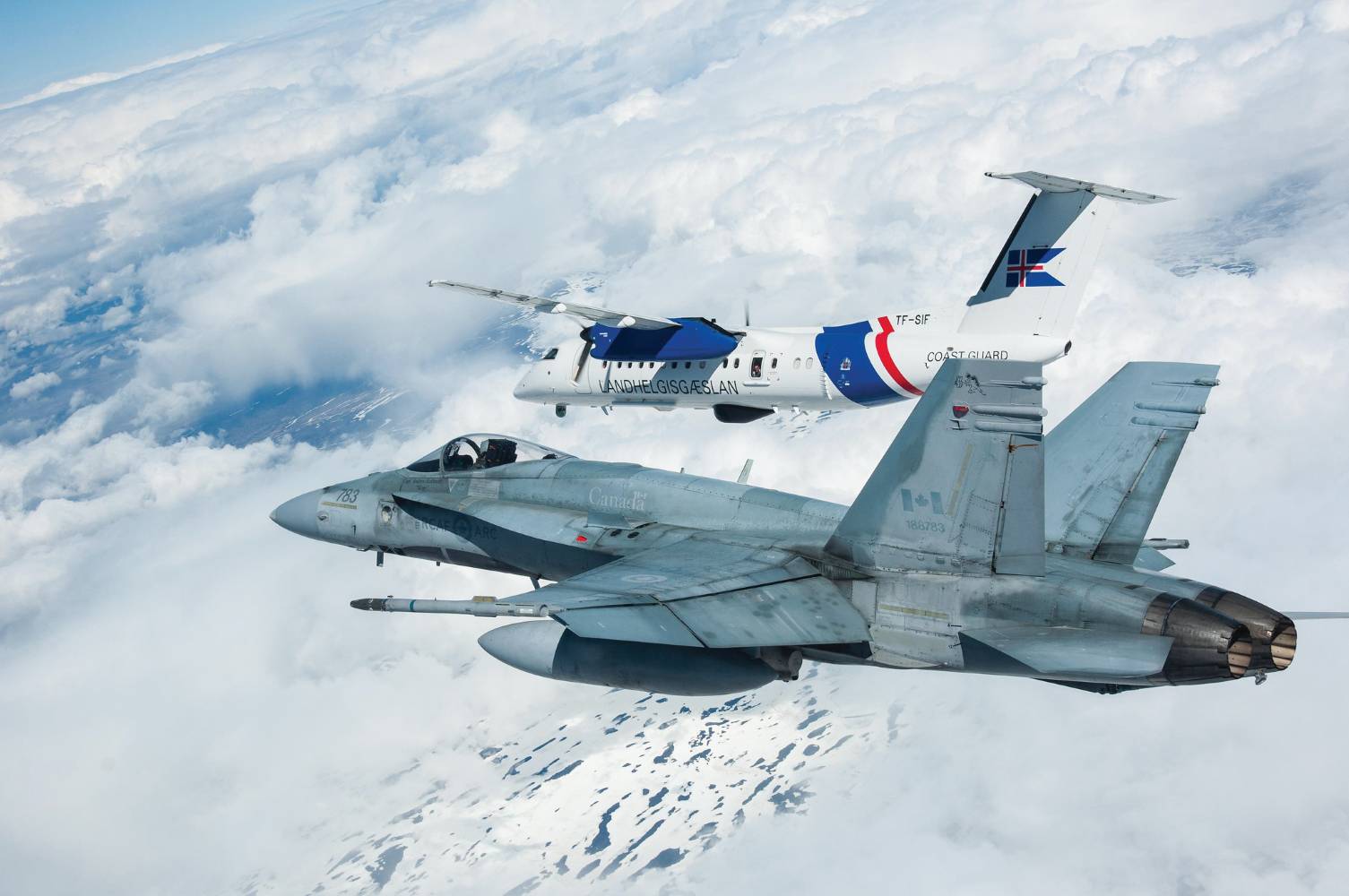
Photo: Corporal Gary Calvé. Imagery Technician ATF-ICELAND
A Royal Canadian Air Force CF-188 Hornet fighter from 433 Tactical Fighter Squadron and an Icelandic Coast Guard Dash-8 patrol aircraft fly over Iceland on May 31, 2017 during an Operation REASSURANCE interception exercise.
Moreover, domestic military expenditures result from different objectives, as underlined by the joint production concept. We can distinguish three circles: sharing costs of a common effort; providing collective security through domestic contributions; and engaging efforts related to stakes outside the perimeter of the alliance. The notion of fairness in the burden of collective security must be analyzed in accordance with these complementary circles.
Common efforts or fair commitment to the Alliance?
The effectiveness of an alliance can require setting up a common organization that pools shared efforts. This is the true meaning of NATO as a permanent staff and planning organization to guarantee the readiness of allied forces in case Article 5 of the North Atlantic Treaty is activated. Member states make direct contributions to NATO to fund collective budgets and programs. Those funds enable NATO to deliver capabilities and run the organization per se and its military commands.
Here, burden-sharing is not a problem at all, since each ally contributes to funding NATO using an agreed cost-share formula derived from the gross national income of member countries. As stated by NATO, “this is the principle of common funding and it demonstrates burden-sharing in action.”Footnote12 For 2024, states struck a fair balance in which the United States’ contribution is capped at 15.88% of total funding, the same percentage as that of the other largest provider, Germany, followed by the United Kingdom (10.96%) and France (10.19%). At the other extreme are Montenegro (0.03%), Iceland (0.06%) and North Macedonia (0.08%).
Nevertheless, states’ direct contributions to NATO represent only 0.3% of total allied defence spending, that is, circa €4.6 billion for 2024. The core question lies in the indirect contributions, that is, domestic expenditures and how they contribute to collective security.
In general, NATO has failed to induce states to increase joint efforts. Most NATO capability programs had limited results or were eventually terminated (most of the time, so-called NATO programs were actually multilateral programs under NATO rules). Common investment represents a very small share of states’ military spending, and those programs, such as Alliance Ground Surveillance (AGS) or the Air Command and Control System (ACCS), have faced a lot of issues and troubles.
The second circle corresponds to the commitment defined in Article 3 of the treaty: “the Parties, separately and jointly, by means of continuous and effective self-help and mutual aid, will maintain and develop their individual and collective capacity to resist armed attack.” This is the core mission of an alliance: making sure that domestic resources are aligned with treaty-related objectives.
The level of preparedness is essential, and the solidarity in sharing efforts is important, as underlined by the NATO Defence Planning Process (NDPP), which is an essential process for coordinating domestic military efforts. NDPP is a collective mechanism that assesses threats and determines the level of collective effort required in order to guarantee the ability to deter the threats, or at least control them, by allocating these collective targets among allies. This process aims to secure the Alliance’s readiness and interoperability to maximize its military effectiveness. Thus, such a process can deliver expected results if there is a common agreement about a shared scenario with regard to a collective threat.
This explicit coordination works quite well when it is implemented against a clearly defined common enemy which must be deterred, for a given geographic area defined by the treaty. An alliance aims to prevent the adversary from attacking, or at least to guarantee that any attack will be countered and that there will be a high probability of defeating the adversary. The Atlantic Alliance was effective during the Cold War because of the Soviet threat. After the collapse of the USSR and the Warsaw Pact, identifying an adversary became less obvious. In fact, an alliance is less effective when it defines means rather than objectives.
Indeed, the assessment of burden-sharing would be simple if and only if an alliance would aim to produce a pure public good of deterrence, following Olson and Zeckhauser’s 1966 model.Footnote13 In such a context, the exploitation hypothesis is easy to evaluate because, as noted by Todd Sandler and Keith Hartley,Footnote14 “the economic theory of alliances rested on the notion that allies jointly contribute to a defence activity that is a pure public good with non-rival and non-excludable benefits.”
Their model rests on very strong hypotheses which Sandler and Hartley summarize as follows:
- Allies share a single purely public defence output.
- A unitary actor decides defence spending in each ally.
- Defence costs per unit are identical in each ally.
- All decisions are made simultaneously.
- Allied defence efforts are perfectly substitutable.
Although these hypotheses were quite realistic during the 1960s, the evolution of threats, states’ military objectives and military means, particularly since the beginning of the 21st century, has led to change in the way we can assess the notion of burden-sharing within an alliance—and, above all, the Atlantic Alliance.
Linking the burden-sharing to an exclusive effort through an alliance could appear to participating countries as an excessive demand. This was the case in the late 1990s when European countries had expressed the desire to develop a European pillar for European security. Would it be relevant to consider that such a regional dynamic could undercut NATO, as then US Secretary of State Madeleine Albright underlined?Footnote15
The third circle creates challenges in assessing the mutualization of efforts. If some countries allocate part of their defence spending to missions and operations beyond the perimeter of the Alliance, how can we valorize such efforts in the production of collective security? The question is even more complex given that most of the time this is a grey area because military resources can serve both alliance-related commitments and specific domestic objectives.
Jack Hirshleifer’s seminal article on aggregation technologyFootnote16 highlighted the need to take into consideration the relationship between national contributions and the overall level of collective security as a public good. This field of research underlines the increasing difficulty of translating inputs into outputs when collective security relies less and less primarily on nuclear deterrence.
In 1967, Jacques van Ypersele de StrihouFootnote17 pointed out that ally-specific benefits can be private among allies, but public within an ally. Not only are defence outputs then either (partially) excludable by the provider or partially rival among the allies, but in addition the provider can choose such defence efforts for motives that are beyond the scope of the alliance. The joint product model of alliances raised many questions about how to assess the fairness of burden-sharing, especially with regard to the Atlantic Alliance today.
As soon as the Atlantic Alliance was formed, allies were pursuing different objectives which only partially corresponded to the Alliance’s raison d’être. The example of the United States illustrates this challenge. Usually, decision makers point out that the United States provides 66% of collective efforts inside the Atlantic Alliance. Indeed, US defence spending amounts to two thirds of the total defence expenditures made by Allies. However, only a share of these efforts is specifically dedicated to the security of Europe or the North Atlantic region.
NATO and beyond: Which burden for which threats?
Assessing burden-sharing was quite simple during the Cold War because of the nature of the threat and the ways to counter it. Actually, that period represented an exceptional geostrategic and military setup which is not representative of the dynamics of alliances before and after the second half of the 20th century. During the Cold War, everything was aligned, and there was a direct and clear correlation between reasons to spend on defence, where to put efforts and what to deliver. Beyond the question of pure or impure public goods, North Atlantic countries had agreed on the burden, therefore defining whether it was shared fairly appeared straightforward.
While analyzing the stakes for NATO at 75, Barbara Kunz and Dan Smith clearlyFootnote18 summarize the divergences of strategic stakes inside the Atlantic Alliance: “Much has changed since the Cold War ended. The international system is no longer bipolar. The fact that the United States considers China the ‘pacing threat’ and bases much of its thinking on the ‘Taiwan scenario’ also has implications for Europe.”
If there is no agreement on what the perimeter and the content of collective security are, how can it be possible to agree on metrics that determine the value of this collective public good and which efforts are necessary to achieve an optimal level of production that should be shared fairly between allies?
Marion Bogers and her colleaguesFootnote19 completed a comprehensive survey on the burden-sharing literature. They identify three paradigms, focusing respectively on the distribution of defence burdens among NATO member states, the determinants of NATO burden-sharing behaviour, and how contributions to the public good of individual member states merge to determine the overall level of the public good available for consumption. However, the three paradigms suppose that the above-mentioned questions have been solved, which is not the case.
This is why Bogers et al. conclude, “Whereas during the Cold War era the burden could indeed be measured by using a single parameter of defence expenditures as a percentage of GDP, nowadays, since NATO engagement in out of area operations, one single comprehensive indicator to quantify the multiproduct and multidimensional character of the allies’ separate contributions to NATO out of area operations simply does not exist.”
Why do NATO countries spend money on defence? Motives are more heterogeneous than we might expect. Joshua Alley and Matthew FuhrmannFootnote20 estimate that making one additional commitment vis-à-vis a new strategic partner increases the size of the US defence budget by between $11 billion and $21 billion. Regarding the Atlantic Alliance, Barry PosenFootnote21 considers that the United States’ commitment to European security could represent an additional effort of $70 billion to $80 billion a year compared to a stand-alone defence policy. Even though that is a sizable amount, it is less than one tenth of total American military efforts, while such investment secures a strategic footprint in a key region for the international security of the United States.
Reciprocally, it would be fair to estimate that about 25% of American military spending goes toward European security. Even though this represents a large amount, the Pentagon dedicates twice that much to the Pacific, where there is no real burden-sharing and there is even a new and somewhat competing alliance with AUKUS. However, even though the United States is the sole global military power, it is not the only ally with multiple objectives inside the Atlantic Alliance.
If Greece spends 3% of its GDP today (and around 5% historically), much of that spending focuses on countering Turkey, which is also a NATO ally, not on getting ready to face another external threat. Inside the Atlantic Alliance, some countries design their defence budget based on objectives that are outside the geographic perimeter defined by the treaty. That is particularly true of France and the United Kingdom, which have global commitments due to their colonial pasts and their current level of ambition in international relations.
Although legitimate with regard to the security stakes of countries, non-alliance missions can impact the deployability and readiness of allied armed forces. Josselin Droff and his colleaguesFootnote22 analyzed the competition for military resources linked to contingency operations. Their work demonstrates that engaging excessively in such operations leads to a relative “demilitarisation trap.” Those operations burn off the operational potential of armed forces and result in an opportunity cost in terms of readiness for alliance-related missions. At best, there is an inter-temporal trade-off. At worst, armed forces are not able to achieve the collective objectives due to the lack of appropriate capabilities and training. Hence the concept of a “demilitarisation trap” that can correspond to a spatial rivalry in the form of force-thinning to some extent.
Wukki Kim and Todd SandlerFootnote23 note that “we cannot attribute an ally’s defence spending to particular geographical areas—i.e., we cannot separate US defence expenditures into those that only protect Europe. In a world where threats can come from anywhere and power can be projected great distances, there is little or no reason to compute such separations.” This makes the assessment of burden-sharing quite difficult, especially if the goals of the alliance are not clearly specified or are blurred, as was the case for the Atlantic Alliance after 1991.
In 2010, Jens RingsmoseFootnote24 noted a core evolution of the Atlantic Alliance from a provider of defence and deterrence to an exporter of stability. From an “alliance in being,” it has become an “alliance in doing” with an enlarged, less defined agenda. This latter helps in reaching a consensus among nations but raises the question of the collective nature of resulting output and outcomes. What is the common security space between, for instance, Poland (which is focused on the Russian threat) and the United States (whose strategy is concentrated on China and global influence)? Can these countries really share the same definition of the international public good that NATO should manage, beyond sharing and promoting democratic values?
Defence beyond defence: the appropriate perimeter of efforts
The burden-sharing debate does not take into account the output of military spending with regard to how such funding is used. Indeed, stand-alone spending appears less effective than mutualized resources. Allies can pool and share resources so that the impact of one euro invested can be higher than if it were spent in a purely domestic approach.
For instance, the Netherlands and Belgium do not spend as much as Poland as a percentage of GDP, but they have pooled efforts, for instance in the naval domain together, or separately in land forces with Germany and France respectively. Then they are able to deliver a bigger bang for the buck than in a stand-alone approach. The same could be said about Canada and the United States in NORAD, as underlined by Ugurhan Berkok et al.Footnote25
Moreover, defence policy is not implemented in isolation. As the Nordic concept of total defence underlines, armed forces use a number of civilian resources to achieve their operations. The quantity and quality of such civilian means provide a lever effect. This non-military dimension was excluded from the definition of defence efforts for a long period, but The Hague 2025 declaration revealed its importance in achieving military objectives.
In fact, this leads to questioning the completeness of statistics regarding military efforts. Three decades ago, Rémy HerreraFootnote26 explained the difficulty of building up homogeneous and comprehensive data on military spending. However, his analysis looked only at the inputs for the core military missions. The concept of total defence demonstrates that military efforts are necessary but not sufficient to guarantee and deliver military effectiveness.
As Pieter Balcaen and his colleaguesFootnote27 point out in their seminal article on hybrid threats, the evaluation of burden-sharing needs to take into account expenditures beyond the core defence perimeter and evaluate the outcomes of policies in grey zones in which military operations take place today. This echoes what Todd Sandler and Keith Hartley underlined concerning how the type of warfare influences the mix of joint products, but Balcaen et al. go beyond that when they demonstrate the deepening of the heterogeneity of military efforts among allies (beyond political and geographical stakes). The true evolution of warfare makes a basic assessment of burden-sharing through simple indicators less and less accurate and less and less relevant.
If we try to assess burden-sharing in an output perspective, we need to enlarge the relevant perimeter to include non-military expenditures and policies that help increase the effectiveness of military efforts. This question is not overly exotic in the field of defence. For instance, NATO has been putting the issue of military mobility on the table for a long time. Even the Pentagon relies heavily on commercial space assets for communications or Earth observation.
Is it possible to understand the effectiveness of American armed forces without considering Starlink? How does the Galileo Global Navigation Satellite System help European armed forces to deliver? National preparedness contributes to domestic resilience that helps armed forces to carry on their missions. Logistics are the real strength in order to sustain military engagement. Systemic resilience goes beyond the scope of the military realm. Military engagements rely on several levers provided by non-defence assets and stakeholders.
Wukki Kim and Todd SandlerFootnote28 show that a broader definition of security spending or commitment (including military expenditures, foreign assistance, and UN peacekeeping) remains consistent with marked evidence of NATO free riding during the period from 1991 to 2020. However, they acknowledge that the perimeter they had chosen needs to be enlarged to cover all efforts related to international security. Non-defence public policies are not a substitute for military spending, but they indirectly support the implementation of defence objectives. Therefore, they provide a multiplier effect that has to be conceptualized and understood.
In The Wealth of Nations, Adam Smith stated that the security of a country results from the wisdom of the state that leads it to preserve the military spirit among hedonistic civilians by forcing a social division of labour that enables the production of robust defence. Nowadays, the wisdom needs to include non-defence domains. Here, European nations are far ahead of the United States regarding contributions to stability, economic development, social stakes, and peacekeeping and peace restoring – notably through community funding that adds up to the domestic spending of each country. We need to better integrate these security spillovers to understand the burden-sharing of international security in an output perspective.
Such an enlarged perimeter extends from defence to civilian domains but also reciprocally when we try to understand the effectiveness of military capacities. “While the U.S. spends extraordinary amounts on health care,” notes Collin Meisel, “it does so inefficiently, leading to much poorer health outcomes— and thus degraded human capital—relative to several European NATO member countries.”Footnote29 The ability to sustain military operations from a long-term perspective, as demonstrated in Ukraine, remains the key factor required in order to prevail in any conflict.
Is there any role for the European Union in the burden-sharing?
Paradoxically, higher military spending does not necessarily result in improved security. The real stake consists in using military expenditures to maximize the resulting output, both at the domestic level and through the Atlantic Alliance. Thus, increasing defence effort is necessary but insufficient. The stakes are even higher when international security is considered as a collective good.
“What logically follows,” note Barbara Kunz and Dan Smith, “is the centrality of perceptions and an understanding that no strategy can ever be devised without at least an attempt to understand the adversary, its values and its ambitions. This also implies an acceptance that perceptions cannot be dictated and that one side’s declared intentions will never be automatically convincing to the other.”Footnote30 The credibility of one country’s defence represents a better deterrent than a purely quantitative definition of defence efforts, and the question of burden-sharing needs to be re-assessed from that perspective.
Such credibility is achieved through a better pooling of efforts. An alliance cannot be defined only as the sum of domestic efforts. We need to coordinate better in order to improve the collective output, rather than looking primarily at the individual input. A given effort should be estimated in terms of its usefulness in either deterring an adversary or containing its aggression. “An optimal alliance,” note Todd Sandler and Keith Hartley, “might also be characterized by specialization based on comparative advantage with the principle applied to both armed forces and defence industries.”Footnote31 However, as underlined previously, even NATO—the most advanced alliance ever—has not been able to promote common investment.
Within the Atlantic Alliance, European countries have a specific feature: most of them are also members of the European Union. Even though collective defence remains a marginal topic, the European Commission has created new mechanisms since 2016 that could help promote such pooling. The real challenge for the European side of the Atlantic Alliance is to achieve better spending rather than, or before, spending much more. Together, European countries spend the equivalent of half of the Pentagon budget, but that spending is spread over more than thirty countries and markets. This fragmentation on both the demand and supply sides significantly reduces the output of such expenditures. Overcoming the fragmentation can help deliver better value for money, which is particularly important if military expenditures are likely to increase significantly.
The European Commission recently released a European Defence Industry Strategy, and it will be interesting to analyze whether it would help overcome today’s limits of the European defence market. It would be useful to assess whether related mechanisms are able to improve the burden-sharing inside the Atlantic Alliance thanks to public policies that are beyond the scope of NATO but fully support its core objectives.