

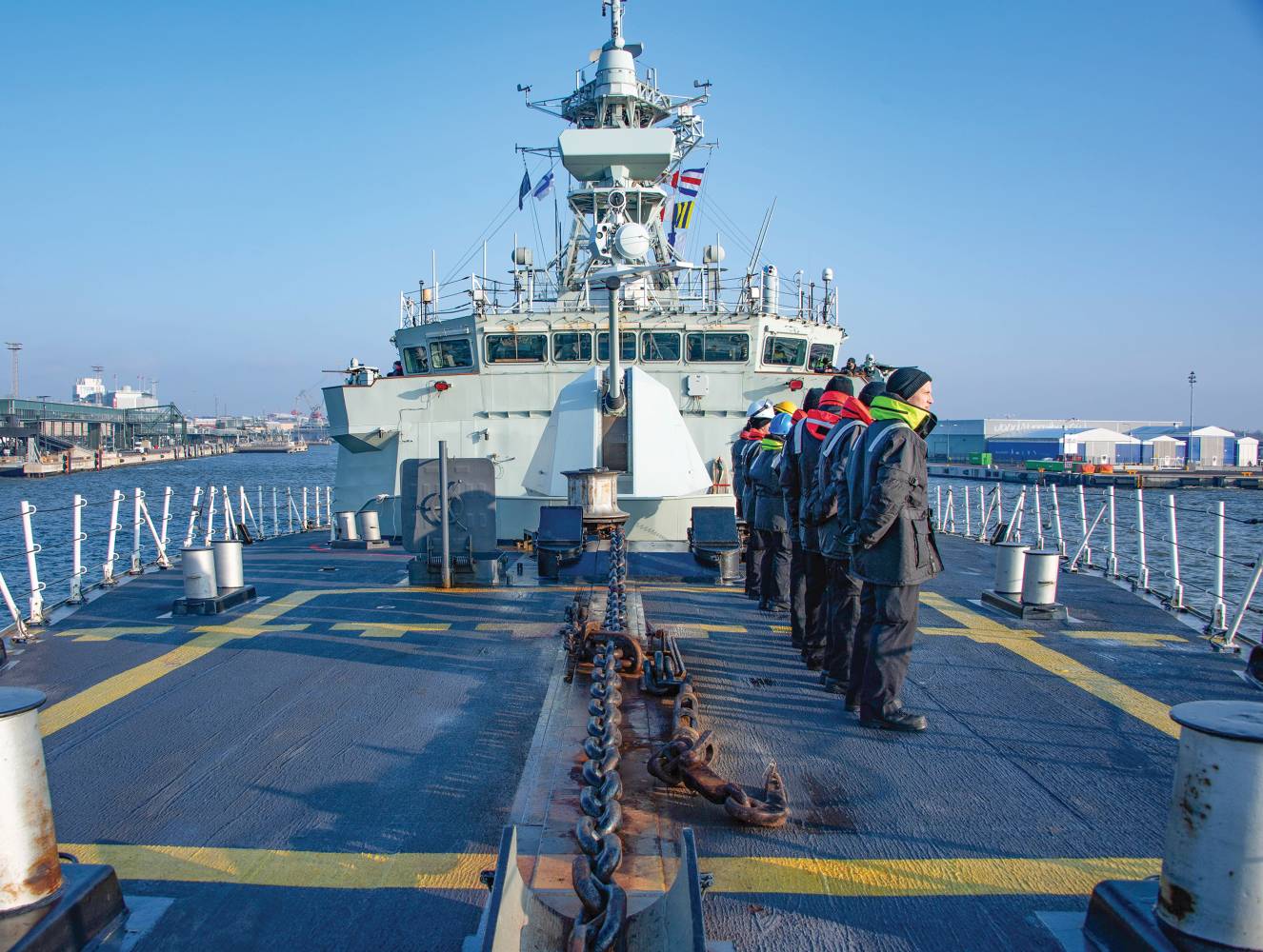
Photo: Cpl Laura Landry, Canadian Armed Forces photo
Afghan refugees who supported Canada’s mission in Afghanistan arrive at Toronto Pearson International Airport on August 24, 2021.
Alexander Dalziel is a senior fellow at the Macdonald-Laurier Institute in Ottawa, where he writes about geopolitical and security issues. He has over 20 years of experience in Canada’s national security community. Previously, he held positions with the Privy Council Office, the Canada School of Public Service, the Department of National Defence, and the Canada Border Services Agency. He has a master’s degree in history from Memorial University of Newfoundland and Labrador, and a certificate in Karelia, Russia and the Baltic Area from the University of Eastern Finland.Footnote1
Finland’s accession to NATO in April 2023 strengthened the Alliance. Together with Sweden’s accession in 2024, it consolidated NATO’s position in northern Europe through the admission of two of the emblematic “neutral” states of the Cold War. Canada signalled its support by being the first country to ratify Finland’s accession.
Such support was an obvious choice. Finland is known for its strong democratic institutions, highly educated society, comprehensive social safety net, strong media, and commitment to international law.
But Finland’s conduct from the start of the Cold War until today is also an exemplar of strategic practice. Canadian leaders and officials will now be able to work as close allies with a country that has a distinctive history of foreign, defence, and security policy. This article will argue that Finland’s strategic history since the end of World War II provides insights and lessons with broader applicability to the conduct of international affairs, including for Canadian decision makers, and that it can be used as a lens to consider opportunities and approaches for Canada’s geopolitics.
While Finland’s history and circumstances differ from Canada’s, its example throws into sharp relief the themes of non-major powers in interstate competition, agency, security, and legitimacy. To get to these insights, this article will first provide an account of Finnish strategic history in relation to sovereignty and security since 1945. The account will illustrate the grand themes and the strategic inheritance of contemporary Finnish policy makers by charting how Finland preserved its independence during the Cold War, and the adjustments it made to new geopolitical circumstances after 1991, 2014 and 2022.
To analyze this history, I will look at concepts such as strategic culture, armed deterrence, political leadership, public engagement, and managing major powers, and then draw potential insights for Canadian decision makers. The article, I hope, may also serve as a concise historical primer for officials looking to better understand their new ally.
Theoretical and Historiographical Underpinnings
The justifications for looking at Finland from a strategic perspective are strong. Elements of the academic literature on grand strategy express this. Finland illustrates elements of the definitions of grand strategy as formulated and debated by historians and political scientists, while pushing back against these definitions as a small power. As the political scientist Paul Kennedy has pointed out, grand strategy is as much about managing and keeping peace as it is about winning wars.Footnote2 From that perspective, Finland managed and kept peace while hard-pressed during the Cold War, and its move towards NATO since 2022 was also designed to deter a revisionist Russia and maintain strategic stability in Europe.
Finland reflects the value of a durable core of concepts to successful strategy. Hallmarks of an effective strategy, according to historians Hal Brands and Paul Feaver, are its purposefulness, coherence, and future orientation, as well as its expression of a logic rooted in historical experience which shapes forward-looking goals.Footnote3 Finnish strategic history embodies those elements, albeit at times imperfectly. Finland had a core of concepts that allowed it to keep Soviet military power at bay—for instance, maintaining a strong military—while maintaining and steadily nourishing a political economic leaning towards the West during the Cold War, which was visible, for example, in its trade relationships. During the post–Cold War period, it integrated fully into European political and economic structures, most significantly the European Union and the euro common currency, and made it clear that seeking membership in NATO was an option it could exercise as a sovereign country. This article will discuss, and supports, the idea that strategy is emergent and deliberative, arising creatively from the interface of human intention and external events over which a government and its population may have limited to no control.
Finland exemplifies the success that grand strategizing by a small democratic state can achieve.Footnote4 Many theorists and historians have been skeptical and even dismissive of the ability of small states to reach their strategic goals; for example, Paul Kennedy deemed their interests too “local.”Footnote5 Finland’s history rebuts elements of these positions. According to political scientist Anders Wivel, the post–World War II environment gave smaller states more latitude in international relations, because of the trends towards greater self-determination, more robust international institutions, and a growing preference for peaceful conflict resolution;Footnote6 Finland can serve as a case study of many of these trends. And as Thierry Balzacq and Ronald Krebs observe, having a relatively more limited resource base may in fact make acts of grand strategizing more important for smaller states than for large ones.Footnote7 Over the decades since the end of World War II, Finland has employed a problem-oriented approach to managing an unpredictable and at times coercive neighbour, the Soviet Union and the Russian Federation, while integrating its own politics, economy, and security into European, transatlantic, and international institutions. Insight into Finnish behaviour is captured by Lawrence Friedman’s observation that “it may be better to think of acting strategically than having a strategy.”Footnote8
The Finnish Example and Its Relevance to Canadian Strategic Practice
What relevance does this have for Canada? After all, Canada is a much larger country, in terms of population and territory. Like Finland, Canada has a very large neighbour—in our case, the United States of America—but that neighbour has (largely) been a cooperative one for well over a century, oriented for most of that period towards mutually beneficial outcomes in North America and beyond.
I will make two high-level points in this regard. First, Finland illustrates the benefits of strategic behaviour and how crucial it is to act purposefully and coherently. If Canada wants to contribute to global security in a manner commensurate with its resources as a wealthy, middle-sized state, it can learn from the Finnish example regarding the value of acting in line with a stable core of strategic objectives. In concrete terms, such a strategy will be centred on ensuring the persistence of a high degree of collaboration with the US, across the full range of government competencies. Part of that coherence emerges from the dictates of geography in a multidimensional fashion, through deft balancing and realism, with a stable orientation to the fundamental values of democracy.
Second, for Canada, Finnish history highlights not just the necessary cognitive dispositions, but also the essential role of means for strategic accomplishment. While this speaks to diplomatic and domestic security assets, the point of real value for Canadian audiences is the importance of military capabilities, which were at the core of Finnish strategic behaviour. In Canada’s case, it is less a question of deterrence than of communicating its full stewardship and responsibility for its extensive land and sea territories, most importantly in the Arctic, as well as signalling its proactivity in contributing to international security in more distant theatres, where Canada has a stake in international stability and security.
In short, Finland’s history since 1945 is a case study in the potential of strategic behaviour for a small state, even in highly unfavourable circumstances. If a small country like Finland can manage such a fraught geopolitical position, then Canada, in far more favourable geopolitical conditions, has considerable latitude. Finland’s example encourages geopolitical imagination in Canada, as this article will argue.
The Strategic Inheritance: Finland in the Cold War
Finland’s strategic history was shaped by its experience in World War II and the Cold War. Finland fought three distinct campaigns between 1939 and 1944: the Winter War from November 1939 until March 1940, which was a defensive war against Soviet aggression; the Continuation War from June 1941 until September 1944, in which Finland attacked the Soviet Union as a co-belligerent of Nazi Germany; and lastly the Lapland War from September to November 1944, in which Finland ejected German forces from its northern territories as part of its armistice with the Soviet Union.Footnote9
Emerging from these struggles, defeated but not occupied, having largely denied the Soviet Union its maximalist objectives, Finland plotted a delicate course during the Cold War. Its signature foreign policy was the Paasikivi-Kekkonen line, a policy that, under President Juho Paasikivi (1946–1956) and his successor, Urho Kekkonen (1956–1982), evolved into neutrality over the period after 1947. It was upheld by Finland’s final Cold War president, Mauno Koivisto (1982–1994). Under the threat of Soviet aggression and the pressures of interstate competition between the Soviet Union and the US and their respective blocs, it was the product of Finnish calculations of how to preserve its independence, sovereignty, and democratic institutions, as well as a market-guided, trade-oriented economic system.
The essence of the Paasikivi-Kekkonen line was to convince the Soviets that Finland could be trusted to defend its own territory against foreign aggression, thereby denying its use as a corridor for attacks on the Soviet Union, in particular against Leningrad (now St. Petersburg) and the Kola Peninsula. Paasikivi institutionalized that goal in negotiations with the Soviets through the Paris Peace Treaty of 1947 and, more importantly, the Agreement of Friendship, Cooperation and Mutual Assistance of 1948. Under Kekkonen, Finland advanced the goal with diplomacy to convince the US and Western European powers that it was outside their rivalry with the Soviet bloc (and not a Soviet satellite). The United Nations and peacekeeping became central elements of Finland’s efforts to demonstrate its commitment to international stability and peaceful conflict resolution.Footnote10 At the same time, it avoided stands on principle or strong statements on particular human rights issues, in order to distance itself from perceived association with one or the other bloc.
From a historical perspective, Finland’s foreign policy during the Cold War enabled it to preserve its political institutions and the growth of its economy, amid great pressure, particularly in the 1940s through the 1960s. Neutralizing the Soviet threat allowed the Finnish leadership to shelter and stimulate internal development of the country. Internationally, it augmented its stock as a convenor and mediator, for instance by hosting the discussions in the 1970s that led to the signing of the Helsinki Final Act and the creation of the Conference on Security and Cooperation in Europe treaty.
In terms of economic policy, Finnish diplomacy strove to depoliticize trade relations, portraying trade as a function of independent economic development. In the early Cold War, this entailed rejecting Marshall Fund aid. Throughout the 1960s, 1970s, and 1980s, it involved carefully ensuring that economic outreach to the other Nordic countries and Western Europe did not upset ties with the Soviet Union. Nonetheless, Finland steadily and determinedly pursued economic integration with Western democracies, quietly diversifying trade to minimize dependency on the Soviet Union.Footnote11
All of this was not without a cost. Soviet pressure fostered negative dynamics in Finnish politics, such as President Kekkonen’s overreach in limiting the Finnish media’s coverage of the Soviet Union, and the aggressive policing of political expression by Finnish Stalinists. These were two of the prominent factors that led to self-censorship in the media and academia. Moreover, pressure from the Soviet embassy in Helsinki stimulated a culture of political exclusion in Finnish parliamentary politics: for instance, in showing disfavour for certain Social Democratic Party leaders and sidelining the conservative National Coalition Party from participating in government. Kekkonen in particular invested heavily in ties to senior Soviet leaders and had backchannels to the KGB as part of his personal portfolio of techniques. Questions about the extent to which President Kekkonen managed Soviet leaders or was managed by them tainted his political legacy.Footnote12
Realignment: Finland After the Cold War
After the end of the Cold War and the collapse of the Soviet Union, Finnish strategy evolved to manage the unwinding of the long shadow of Soviet dominance. Finland’s relative success in comparison to most central and eastern European states in weathering the Cold War convinced its leaders of the merits of its self-reliant, independent foreign policy. Finland consciously decided that its democracy, prosperity, and security would depend on the recognized possibility of participating in comprehensive relationships with Europe and other countries; those relationships would be of its choice and not dictated by Moscow. Balancing Russia in this context, however, remained a priority of Finnish policy, based on a sensitivity to Russian concerns and a desire of some politicians and business leaders to bring it aboard the European project.
Overall, two themes from the period between 1939 and 1991 emerge as relevant to the discussion of Finland’s international affairs in the subsequent decades. Those themes are wariness and confidence. Finland’s inability to generate meaningful alliance or defence networks in the interwar years, its failure to secure external support in the Winter War, and its isolation in the Continuation War’s aftermath left the Finnish political class and public wary of promises of support from the outside. The fact of having navigated the vagaries of the Cold War, on the other hand, inspired confidence in leadership circles that Finland had the right foreign policy instincts.
At that point, Finland pursued two main lines in strengthening its security. The first was expressing its unfettered national sovereignty; the second was adjusting its approach to Russia. In terms of expressing its sovereignty, it moved quickly to forge closer integration with the political and economic institutions of western Europe. Acceding to the European Union in 1995 and joining the single European currency in 1999 were the crowning achievements of this line of effort—and they effectively ended Finland’s neutrality. Instead, it adopted the term “militarily non-aligned.”
For Finland, western European structures were also a source of pressure, creating a dilemma about whether newly won room for manoeuvre should be pooled in the EU. The dilemma coincided with the unleashing of globalization in earnest. It raised basic strategic questions about Finland’s ability to compete economically and maintain prosperity. And, at a fundamental level, it was a question of security: Finland’s presence in a durable political framework mitigated against geopolitical isolation.Footnote13 In a referendum in late 1994, the Finnish population agreed and voted to join the EU.
The caution was about the depth of defence cooperation with transatlantic institutions—namely NATO. Helsinki opted for a gradual tightening of relations with NATO and the United States on defence and security, along two prongs of effort: more cooperation and greater interoperability.Footnote14 To do so, Finland joined NATO’s Partnership for Peace initiative in 1994. The purchase of F18C fighter aircraft in 1992, replacing its fleet of Swedish and Soviet jets, was a powerful statement. This was not only a question of obtaining one of the world’s most advanced aircraft but also one of asserting Finland’s right to procure military hardware from NATO sources, an option that had been unavailable to it during the Cold War.
Capping these moves was a statement about sovereignty. Finland’s defence choices and alignments, consistent with the Helsinki Final Act, would not be dictated by foreign countries. That became the centrepiece of its policy, framed in the 1990s as the NATO option: the policy that, should circumstances change, Finland was free to pursue membership in the Alliance. This policy lasted until early 2022.
Why take this approach? Primarily, it was because Finland did not jettison a careful approach to Russia. Finland made it clear that it would continue to take Russian concerns in the changing setting of Europe into account in its foreign policy. For instance, under President Koivisto, Finland moved to modify and then abandon the sovereignty limitations of the 1947 Paris Peace Treaty and the 1948 Agreement of Friendship, mixing unilateral moves and negotiating to reach a new bilateral treaty with Soviet and then Russian authorities, which came into effect in 1992.Footnote15 During the presidency of Martti Ahtisaari (1994–2000), Finland began to articulate a policy of having a “NATO option,”Footnote16 as a sovereign state able to choose its foreign policy directions. At the time, it was not an option that Finnish leaders felt they needed to exercise.
Over that period, Finland strove to rebuild a relationship with Russia on liberal foundations, encouraging people-to-people contacts, trade, investment, and economic cooperation. It encouraged Russian integration into European structures through initiatives like the EU’s Northern Dimension policy, the Council of Baltic Sea States, and the Arctic Council. Russian and Finnish leaders met frequently, a policy extending from Ahtisaari’s tenure through those of subsequent presidents Tarja Halonen (2000–2012) and Sauli Niinistö (2012–2024). Helsinki became a trusted interlocutor, on speaking terms with Moscow and the EU, which was especially valuable once Russia had invaded Ukraine in 2014. Finland also acted as a convenor for the US and Russia: for example, it hosted Russian President Boris Yeltsin and US President Bill Clinton to discuss NATO enlargement and arms control in March 1997.
At the same time, Finnish policy retained a healthy skepticism about Russia’s political prospects. Believing that Russia’s peaceful future was not assured, Finland decided to maintain a robust military deterrence. Finnish analysts were more likely to see Russia through a historical lens than a normative one, and thus attributed less significance to the idea of the transformative potential of democracy and free-market economics to change Russia than to the likely persistence of its deeply ingrained imperial political culture.Footnote17 A strong military backstop thus remained central to Finnish geopolitical calculations—although not to those of many of its EU partners.
Strategic Consolidation: Finland Since 2014
Beginning in 2014, Russia’s actions in Ukraine—annexing the Crimean peninsula and fomenting an armed insurrection in eastern Ukraine—eroded Finland’s integrationist policy line towards Russia. Finland’s defence policy evolved accordingly, tightening its relationship with NATO, the US, and the Nordic countries (in particular, Sweden).
Finland began enhancing its collaboration with NATO, for instance by participating in the Partnership Interoperability Initiative as of 2014. It tightened bilateral security arrangements with the United States, including the signing of a Statement of Intent in 2016 that enhanced the scope and scale of military cooperation.Footnote18 In the region, it doubled down on defence ties with Sweden and enhanced its connections to Nordic security structures such as the Nordic Defence Cooperation, commonly known as NORDEFCO, which foster military cooperation among Finland, Sweden, Norway, Denmark, and Iceland. It engaged in NATO and EU debates and policy formulation on shared threats, most notably through the creation in Helsinki in 2017 of the European Centre of Excellence for Countering Hybrid Threats.
At the same time, Finland maintained a policy of engagement with Russia, and President Niinistö and his Russian counterpart, Vladimir Putin, were in regular contact, including holding in-person meetings. It supported Russia’s continued membership in the Arctic Council, as well as economic cooperation, such as on the construction of the Hanhikivi nuclear power plant. (The project was cancelled in 2022.) All the while, Helsinki gave its public support to Ukraine, citing the illegality of Russia’s annexation of Crimea.
Finland’s effort to position itself as a convenor and contributor to a stable global environment was manifest in President Niinistö’s initiative to revive the “spirit of Helsinki,” referring to the gathering of European and transatlantic states in Finland for the negotiations that led to the signing of the Helsinki Final Act in 1975, which provides the foundation for today’s Organization for Security and Cooperation in Europe. The idea in the new formulation was to again push the idea of talks, now extended to the global community, to forge a set of principles, confidence-building measures, and areas of cooperation for 21st-century international politics, with its growing Indo-Pacific dimension and the proliferation of revolutionary digital technologies.Footnote19
Although Russia’s full invasion of Ukraine in February 2022 initiated Finland’s move to NATO accession in earnest, the immediate impetus occurred in December 2021, when Russia put forward a “plan” for “negotiations” with the US and NATO to avoid war.Footnote20 It advanced extreme Russian positions requiring NATO to withdraw allied forces from countries added to the alliance after 1997—effectively a call to lessen the security of members in central and eastern Europe added since 1999—and committing to no further eastern enlargement. In Finland, that tipped the discussion towards NATO. The leadership in Helsinki and the country’s populace saw this as an immediate signal that Russia was failing to recognize the sovereignty of neighbouring states.Footnote21 The invasion of Ukraine in February 2022 confirmed that Russia’s lack of respect could entail military aggression and that it would use violent force. Russia did not understand or care to understand the security concerns of its neighbours, seeing them only as appendages of US power.
A principle had been breached. Finland’s leaders and population saw the link between their experiences in World War II and the Cold War and Russia’s behaviour towards Ukraine. They took exception to the notional limitation of national sovereignty that Russia’s poison-pill diplomacy implied. President Niinistö and Prime Minister Sanna Marin led the country in a democratic process involving parliamentary debate and ratification.
Finnish Strategy: Insights for Canada
This history is the strategic inheritance of today’s Finnish policymakers—the legacies that shaped the country’s path to NATO. More generally, it was the consolidation of a new western-oriented geostrategy focusing on Europe and transatlanticism, a 180-degree turn over 30 years from the Cold War eastward orientation to defanging the threat of Soviet invasion. What insights does this history have for Canadian strategy and decision making?
The particularities of the Finnish experience during the Cold War are many, and replicating policies of other countries or enacting copies of policy from the past are not options. But a few durable points of wider applicability stand out from the Finnish example. The first are general insights into geostrategy, which can be gleaned from the Finnish experience and applied to and contrasted with Canadian experience, imperatives, and obligations. These might inform the ethos of Canadian geopolitics, act as a foil for considering how Canadian circumstances affect its geostrategic decisions, or suggest starting points for Canadian adjustments to the current and evolving international context. These are insights on strategic culture, managing “great power” relationships, the connection of armed deterrence and diplomatic credibility, and the role of leadership.
Strategic Conduct.What was strategicFootnote22 about Finland’s conduct? Over time, the Finnish approach evolved from the Soviet focus of the Paasikivi-Kekkonen line, to the western integrationist line of the post–Cold War period, to the exercise of the NATO option in the post–February 2022 era. At each stage, there was a set of premises and logic to Finnish action, with the move from accommodation of Soviet security interests to integration along European and transatlantic lines being the primary shift. During the post–Cold War period, Finnish strategy was scalable to deal with the vagaries of the Russian threat. From 1939 onwards, there was always a clear recognition of what the security challenge to the homeland was.
Finnish strategic practice exemplified the wise use of basic geopolitical techniques for a non-major power. These were the value of having a seat at the table, the power of being a convenor, an awareness of the merits of initiative, and the importance of national self-reliance. At a more specific level, Finland’s history illustrates the value of determining the core problem set, devising basic goals, constructing a framework for its execution, and adjusting the framework as necessary.
Geopolitics in Public.A second merit closely related to the first is the importance of engaging the public in geopolitical discourse. This practice in Finland was largely built up from the 1980s onwards. Paasikivi and especially Kekkonen, with his personal cultivation of Soviet leaders and KGB backchannels, perceived limits to a democratic foreign policy. Koivisto, although using those backchannels at times until 1992, invested less in personalizing networks with the Soviets.Footnote23 That trend accelerated after the Soviet collapse. Since 1995, for instance, Finland’s government, in a process overseen by its parliament, has published a regular public report on foreign, security, and defence policy, usually one per government.Footnote24
Finland also produces other ad hoc strategic public documents in response to the issues of the day. A recent example is former Prime Minister Marin’s request for an expert report on the future of Arctic policy after Russia’s attack on Ukraine in 2022. That report, published in October 2022, did not constitute a consensus document but was commissioned and designed to provide considered material for reconsidering Finland’s comprehensive 2021 Arctic strategy. The update report harnessed input from Finland’s expert community in universities, think tanks, and the private sector.Footnote25 Those documents, and the culture of government openness that enables them, helped prepare the Finnish public to adjust to the most prominent break with past policy in the last 30 years.
Leadership.Another component of Finland’s strategic experience is the pronounced role of political leadership in guiding the country through geopolitical uncertainty. Finnish leaders, from Paasikivi (with some questionable moments under Kekkonen) to Niinistö, used democracy to their advantage, cleaving to its institutions and craftily deploying them to resist foreign pressure. The Conference on Security and Cooperation in Europe, initiated and hosted by Finland in the 1970s, was an example of such initiative, aspiring to institutionalize consistent democratic and rule-of-law norms during the major-power rivalry of the late Cold War.
The most recent and most pertinent example relates to the domestic politics of Finland’s accession to NATO. Opinion polling had shown for years that, left to themselves, Finns were cautious about NATO membership. But polling in January 2022 also showed that they were ready to follow if their leaders determined that, instead of military nonalignment and defence self-reliance, NATO was the best course to protect the nation.Footnote26 When Finland’s leaders saw a groundswell of support for joining NATO after Russia’s attempt to occupy Ukraine—and polling by late February showed for the first time in Finnish history that a majority supported it—they moved quickly to initiate the process. The fact that a centrist conservative president (whose instincts during most of his tenure had seemed to be against NATO membership) and a progressive left prime minister (who in early 2022 cast doubt on membership) came together to chart this final step in shifting Finland’s geopolitical orientation in the post–Cold War era speaks volumes about the power of leadership and a democratic, informed society in making nimble, interest-guided and therefore strategically sound strategic policy.Footnote27 Canada’s political elite would do well to model itself on its Finnish counterparts in this regard.
Armed Deterrence and Diplomatic Credibility.Finland is an extreme example of the relationship between armed deterrence and diplomatic credibility. Throughout the Cold War, and especially afterwards, Finland maintained a strong military focused on homeland defence and built around large trained reserves, recruited through conscription. The possession of such a deterrent was essential to the success of the Paasikvi-Kekkonen line.
It also helped pave the way into NATO by demonstrating that Finland would be a contributor to alliance security, an essential point during a period of renewed pressure from the United States on Europe and Canada to take up more of the costs of their security. Finland, with a total population of about 5.5 million and an economy ranked around 60th in the world in terms of real gross domestic product (GDP), entered the alliance with a small professional army that could add up to 280,000 soldiers from its reserves and was investing more than 2% of GDP in its armed forces heading into 2024, much of that in cutting-edge equipment. It was clear that Finland was going to add security to the alliance, not dilute it. Canada would do well to integrate a better-resourced military into its grand strategy.
Managing Major Powers.Finland is a case study of the small-power politics of dealing with a superpower neighbour. A few dimensions relevant to Canada are its multi-vector approach, agency-based action, and geopolitical mentality.
During the Cold War, the Soviet Union was a major consideration in all of Finland’s external policies (and some internal ones), be they defence, trade, or political. Yet the success of that policy hinged not only on persuading Russia, but also on convincing Western European countries, the US, and Canada (Kekkonen made a state visit to Canada in the fall of 1961) of that neutrality.Footnote28 Those multi-vectored approaches included economic outreach and planted seeds later harvested in the 1990s.
Notably, Finland’s interests in the 1990s largely shifted to the reality of the power and opportunities of the European Union, a policy shift as significant as the later NATO accession, giving it an integrative option that protected its sovereignty and managed national interests in Europe.Footnote29 Geopolitics is not just about dealing with major powers that have hostile intent, but also about finding space amid the interests of other states, relations that are no less charged with importance and demand a high level of commitment and investment. That is an essential message which extends to the importance of dynamic ties with the US on the global stage, as well as in North America, in the achievement of Canadian interests.
Also important is ensuring the attribution and acknowledgement of agency to smaller powers. Finland’s history is a testimony to the agency of non-major countries and the merits of self-reliance and national initiative in larger structures and contexts. As Forsberg and Pesu contend, Finland protected a “hard core” of principles and interests consistently throughout the Cold War: they cite “keeping the military intact, avoiding economic dependence, a patriotic spirit of the leadership, and the society at large with cultural distance” as that core.Footnote30 Canada would do well to emulate the identification of a hard core of interests, values and relationships and how protecting them might extend into broader Canadian foreign policy.
A final and related point is the importance of the intellectual fundamentals for smaller states in times of geopolitical rivalry. In a sort of geopolitical realism, Max Jakobson pithily captured the Finnish leadership’s unflinching attention to what he called the “facts of power” and the particular circumstances of the home country as essential for success. In Finland’s Cold War, the fundamentals were the overwhelming character of Soviet military power and the need to preserve the essential elements of Finnish sovereignty. At a behavioural level, Finnish authorities had to manage the Soviet perception that Finnish territory could be used to attack the Soviet Union. At times, this demanded accepting at face value the often-distorted threat perceptions on the part of the Soviet hierarchy. If the Soviets said they were afraid of German aggression, then they probably were, regardless of whether or not that perception was borne out by the facts of German, Western European, or US intentions.Footnote31
Conclusion
Finland’s and Sweden’s arrivals in the alliance bring a host of developments and opportunities to Canada at NATO. These include renewed attention to the Arctic; new perspectives on, debates about, and options for cooperation, burden-sharing, and resource allocation; and opportunities to exercise and train in new settings and with new allies in enhanced ways. The cooperation can also extend to broader political considerations and forms of cooperation, such as in economic security and climate science.
Finland’s Cold War and post–Cold War experience shows the irreducible importance of developing strategic thinking oriented towards specific goals and holding strategic assets that provide the means to achieve those goals. This involves making choices that are aligned with national capacities and advantages, developing the strategic and material tools to advance them, and defining an identity amid the tidal forces of geopolitical rivalry. These lessons will help policymakers wrestle with the implications of geopolitical competition today. During the Cold War, Finland carved out a space to survive and build its national vision. It has done so again by joining NATO. Finland’s experience is one lens that Canada can apply in developing its own geostrategic solutions to the predicaments of the 21st century.
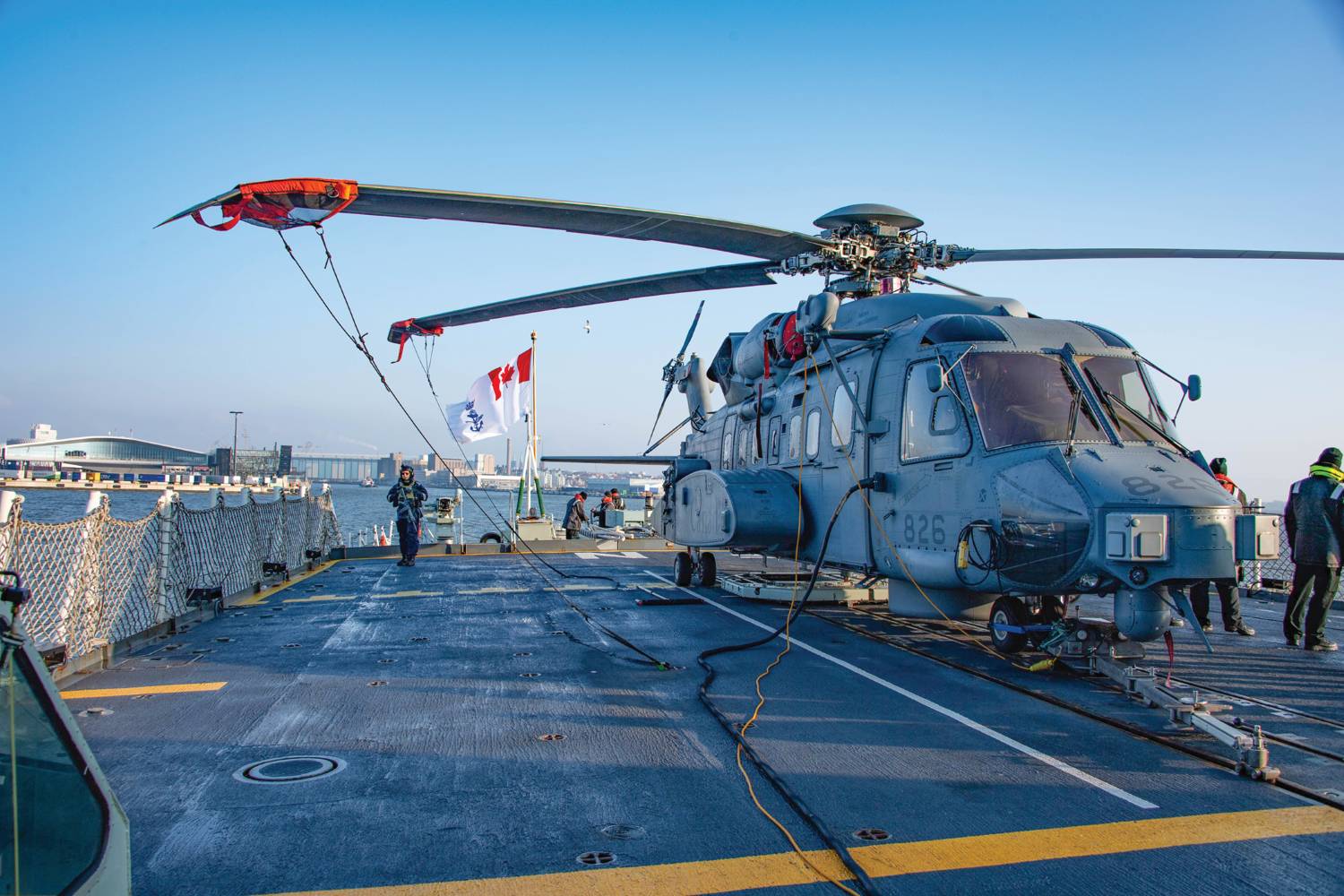
Photo: Cpl Laura Landry, Canadian Armed Forces photo
A CH-146 Cyclone helicopter sits on the flight deck of HMCS FREDERICTON as the ship departs the port of Helsinki, Finland during Operation REASSURANCE, November 2, 2021.