

Photo: Warrant Officer Amber Stuparyk
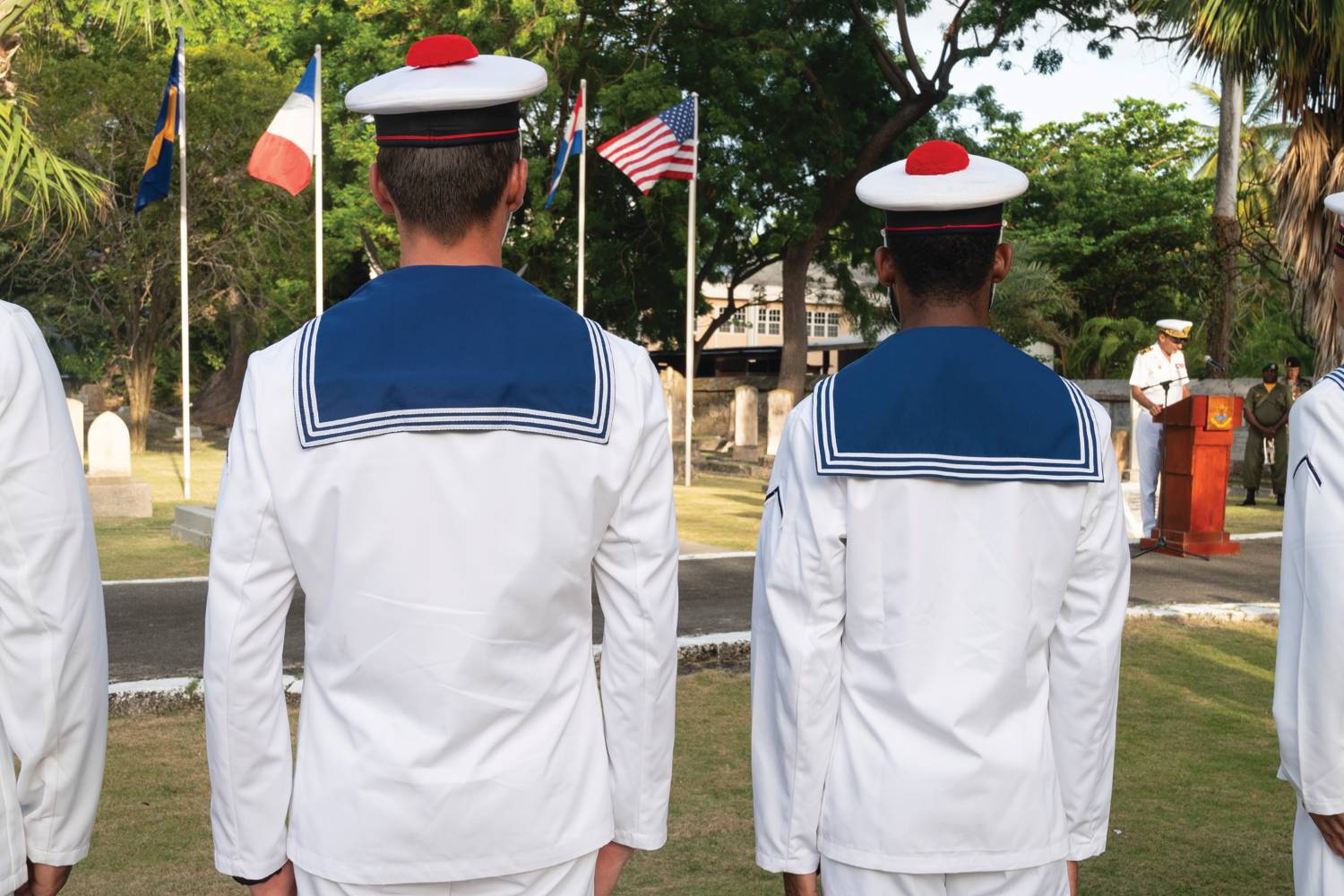
Participating nations for Exercise TRADEWINDS (TW24) including Canadian, American and Barbadian delegates, along with H.E. MS. Lilian Chatterjee, Ambassador of Canada and Małgorzata Wasilewska, Ambassador of the European union, gathered at The Barbados Military Cemetery at Needham’s Point, for a small ceremony facilitated by the French Naval command team, in honor of Victory in Europe Day (VE Day), a day celebrating the formal acceptance by the Allies of World War II of Germany’s unconditional surrender of its armed forces, on May 8, 2024.
Dr. Delphine Deschaux-Dutard is an Associate Professor of Political Science at Université Grenoble Alpes and a researcher at CESICE (UGA).
On the occasion of NATO’s recent summit in The Hague in June 2025, and in the strategic context opened up by the outbreak of the war in Ukraine and the return of Donald Trump to power in January 2025, it is interesting to look at how the two largest military powers in the European Union (EU), France and Germany, view NATO and contribute to the Alliance’s burden-sharing. The choice to compare France and Germany is all the more interesting because the two countries have been linked by a highly institutionalized military cooperation since the end of the 1980s, following the Treaty of Reconciliation (Elysée Treaty) signed in January 1963 and completed by the Treaty of Aachen in 2019. Indeed, both France and Germany pursue security strategies with a strong emphasis on collective security, although there are differences between them. This article summarizes their respective approaches to NATO within the global framework of European and collective security. The data used for the article are based on French and German strategic statements delivered by heads of state and defence ministers, as well as documents published since 2022. (In particular, France updated its 2022 Strategic Review and its 2023 Military Programming Act, and Germany’s first National Security Strategy was published in June 2023.) Those sources were complemented by some twenty semi-structured interviews conducted in 2022 and 2023 with French and German politico-military practitioners. The article will first outline the main features of French and German defence policies since the end of the Cold War in order to better understand NATO’s place in French and German defence policies and strategic visions. It will then assess the concrete aspects of France’s and Germany’s respective commitments to transatlantic burden-sharing and identify the main differences.
1. Main features of French and German defence policies
Although France and Germany are members of both NATO and the EU and regularly cooperate with their European counterparts on military issues, defence policy continues to be mostly formulated on a national basis. However, if we look at the most recent French and German strategic documents, published in 2022 and 2023, we can see elements of convergence in terms of threat assessment in the context of the war in Ukraine. First and foremost, both France and Germany share the idea that the fragmentation and contestation of the liberal world order poses new challenges and risks, in particular because of the rise of rivalries and the revisionist tendencies of some global and regional powers to pursue their own respective agendas. Therefore, both countries advocate for multilateralism and the preservation of the liberal international order. They also place particular emphasis on Russia as the main threat to peace and security on the European continent and on the need to consider China as both a trading partner and a strategic rival. In addition, Paris and Berlin share the need to support the growth of their defence budgets and to give their armies the means to act (although this may be more difficult in reality, as I show in the last part of the article). But beyond these elements of convergence, French and German defence policies remain very different, in terms of not only strategic ambitions, but also institutional frameworks and means.
The main features of French defence policy are characterized by continuity, albeit with some pragmatic inflections since the mandate of President Sarkozy (2007-2012), during which French officers once again became part of the military command structures of the Atlantic Alliance in 2009, following more than forty years of absence after France ceased that participation in 1966 during the presidency of Charles De Gaulle. Defence lies in the hands of the executive branch, and more precisely those of the French president as head of the armed forces. France’s post-Cold War defence policy relies on a gap between global strategic ambitions and limited available resources.Footnote1 France has all the attributes of a great power, with its seat on the the United Nations (UN) Security Council, its nuclear deterrence capability, its membership in the G8, and its diplomatic and cultural network, which is the second-largest in the world. However, it has limited military and financial resources in a context of dominance by the United States, coupled with economic competition from China. The challenge for French defence policy is twofold: to maintain France’s global ambition, which leads Paris to take an interest in all major international issues where it can exert influence, and to strengthen multilateral cooperation with its European and international partners. Thus, the idea of Europe as a power multiplier has shaped the French interpretation of European integration since the presidency of General de Gaulle,Footnote2 with the aim of enabling France to achieve greatness and influence beyond what its economic and demographic weight alone would allow.Footnote3 More specifically, French defence policy rests on two main pillars that shape France’s vision of its power: independence, based on national nuclear deterrence and military interventionism; and European cooperation. Therefore, French defence policy is based on the concept of strategic autonomy and aims to guarantee French independence by developing a national nuclear deterrence and a full-spectrum army dedicated to both territorial defence and military intervention. However, defence budget and recruitment constraints in recent decades have led the French army to be labelled as a “bonzai army”Footnote4 because it has broad capabilities, but in a limited way. Independence is a key driver of the French strategic discourse and explains why France decided to withdraw from the military structures of NATO in 1966, not so much because of a lack of confidence in the security guarantees of the United States, but rather to develop French global ambitions to weigh as an independent actor in world politics.Footnote5
The second pillar of French defence policy is European military cooperation. During the Cold War and in the context of France’s withdrawal from NATO’s military structures between 1966 and 2009, that cooperation was mainly conceived within the European integration process. However, France’s reintegration into NATO’s military structure in 2009 led to more pragmatism in French strategic discourse regarding NATO.Footnote6 Indeed, NATO has become the fifth priority out of ten in the 2022 Strategic Review. French strategic discourse stresses the importance of EU-NATO cooperation and invests in the notion of a European pillar within NATO—even more so since 2022—which helps create opportunities to cooperate with other NATO member states such as Germany.
The most important feature of German defence policy is still Bündnistradition, which means Germany’s commitment to military action only within multilateral frameworks such as NATO, the UN, or the EU. Therefore, Germany is strongly involved in all multilateral structures, including NATO, the EU, the UN, the Conference on Security and Cooperation in Europe, and the G8. Nevertheless, with the changing nature of the threats facing the international community after the Cold War, Germany has had to embark on a process of reflection, which it is still engaged in today, in order to redefine its place on the international stage and to move towards political normalization in the sense of the need for Berlin to become less dependent on its partners (including the US and NATO) and to assume its international responsibilities, which goes hand in hand with a reflection on the Bundeswehr and its role since the end of the 1990s.Footnote7
The main features of German defence policy until 2022 were mostly stable and relied on three main elements: multilateralism and international cooperation to maintain the international liberal order; NATO and European commitment; and a culture of restraint inherited from the past (with the notion of “never again war” and “peace policy”), coupled with an aversion to hegemony.Footnote8 The first characteristic led Germany to invest in a security policy based on the liberal premise that trade with other states helps stabilize the world, which explains Germany’s strategy towards Russia until recent years (Wandel durch Handel), inherited from the Ostpolitik of the 1970s. This has led to a recurrent neglect of defence spending over the past three decades in order to reap the peace dividend. However, following the outbreak of the Arab Spring in 2010, the civil wars in Syria and Libya, and the annexation of Crimea in 2014, the “Munich Consensus” (the German foreign and security policy review published by the German government in 2014) began to introduce a normative shift regarding the role Germany should play in international security and within security alliances (leadership from the centre). This shift has been reinforced by the Zeitenwende since 2022, although the first German National Security Strategy, published in June 2023, does not clearly define strategic priorities or offer concrete proposals to make German foreign and defence policy more effective. This is due to the fact that German defence policy, unlike that of France, is defined by several actors, such as the Minister of Defence (head of the army), the Minister of Foreign Affairs, and the Minister of Finance, with the Chancellor playing a mediating role. Moreover, the German Parliament plays a crucial role in the scrutiny of defence policy by not only voting on the defence budget but also allowing or disallowing military interventions and military exports.Footnote9 Since Germany, unlike France or the US, does not yet have a National Security Council, defence policy guidelines require intensive negotiations within the German coalition. Yet the new Chancellor, Friedrich Merz, who was elected in May 2025, has put the question of such an institution on the coalition’s menu and has advocated for a very significant investment in German defence policy and the Bundeswehr.
The second important feature of German defence policy is its commitment to European security, through both NATO and the EU. Atlanticism remains the cornerstone of German security to this day, even though Chancelor Merz has advocated for a much stronger European defence within the EU. Yet the primacy of NATO has been mentioned in every German strategic document since the Cold War and is evident in Foreign Affairs Minister Baerbock’s speech for NATO’s 75th anniversary on April 4, 2024, in which she referred to NATO as “our central security anchor.”Footnote10 As Markus Kaim argues,Footnote11 since Germany’s accession in 1955, NATO has been one of the two pillars on which German foreign and security policy has stood, together with European integration. Berlin therefore envisages European defence policy (also called Common Security and Defence Policy or CSDP) as a way to complement the Alliance by showing the Europeans’ commitment to their security. The importance of German engagement within NATO is particularly evident in Berlin’s proposal of the Framework Nation Concept (FNC) in 2013, which was adopted at the Alliance’s Wales Summit in 2014. Under this concept, NATO encourages multinational groups within the Alliance to develop deployable capabilities, led by a “framework nation,” to enhance regional specialization and mutual coordination to better cope with the European security landscape. The FNC, endorsed by the Alliance, was proposed by the German government not only to combine the “breadth before depth” philosophy, meaning that the Bundeswehr can regain its depth (operational sustainability lost due to defence budget cuts) through the contributions of others while maintaining its spectrum of capabilities (breadth), but also to demonstrate its willingness to take on more responsibility for European security while providing Washington with guarantees of transatlantic continuity.Footnote12 Chancellor Merz has also spoken about the utmost importance of NATO as a deterrent against the threat posed by Russia.Footnote13
Last but not least, German defence policy over the past three decades has been characterized by a third feature: a culture of restraint in the use of force, supported by the important role of the Bundestag in German military missions (Bundeswehr). This culture of restraint has meant only multinational military missions for German soldiers (within the UN, NATO or EU framework), but also a strong reluctance to use nuclear weapons and nuclear deterrence, which is envisaged only within the NATO framework.
Having established the broad outlines of French and German defence policy, let’s look now at what the Alliance means to Paris and Berlin.
2. French and German visions and practices of NATO
In the past decade, both France and Germany have dedicated important military capacities to the Alliance, and this has been even truer since the outbreak of the war in Ukraine. Both Paris and Berlin reaffirmed the importance of NATO in the bilateral Aachen Treaty signed in January 2019Footnote14 and participate in large-scale NATO military exercises such as BRILLIANT JUMP and COLD RESPONSE. However, disputes over NATO have been frequent between France and Germany: for example, during the 70th anniversary of NATO, when President Macron called the Alliance brain-dead whereas Chancellor Merkel argued for its importance. Paris and Berlin do not share exactly the same understanding of NATO within European security architecture. Moreover, France and Germany do not exactly consider NATO on an equal footing. Berlin sees it as both a military and a political arena, whereas Paris considers it to be mainly a military alliance. A comparative review of the current French and German national security strategy documents (France’s National Strategic Review [2022] and Germany’s national security strategy [2023]) reveals both some common principles and some notable differences. Both countries identify Russia as their primary threat, and both make frequent reference to the importance of the NATO alliance, although the emphasis in both cases is somewhat stronger in the German strategy, as shown in the table below. On the other hand, the French document places a considerable focus on national and European autonomy, something that is absent from the German strategy. It is clear from the strategies that, although both countries acknowledge the importance of NATO to their security, Germany is much more invested in the multilateral approach than is France. That difference is perhaps not surprising, given their respective experiences throughout the turbulent 20th century.
| French Strategic Review 2022 | German National Security Strategy 2023 | |
|---|---|---|
| NATO | 25 | 36 |
| European pillar | 2 | 4 |
| USA | 7 | 5 |
| European strategic autonomy | 7 | 0 |
| Autonomy | 27 | 0 |
A look at France’s vision of NATO reveals that France has long been a “reluctant Atlanticist,” not participating in the FNC and instead developing the European Intervention Initiative (EI2) outside the NATO and EU frameworks. The EI2 is a multinational initiative aimed at developing a European strategic culture by bringing the participating states together to regularly train parts of their armed forces.Footnote16 However, that vision has changed in recent years, and especially since 2022, as France has come to recognize the importance of NATO for European security and has argued for a European pillar within the Alliance. France therefore aims to present itself as an “exemplary ally” within the Atlantic Alliance, in particular by promoting France’s role within NATO and working towards greater NATO-EU cooperation. In the Defence Programme Law (LPM 2024-2030) adopted by the French Parliament in July 2023, France reaffirms its will to build a solid European defence pillar within NATO. This strategic discourse is backed up by the military resources that France makes available to the Alliance. Indeed, in recent years, with an allocation key of 10.39%, or €203 million (2022), France has become the third-largest contributor to NATO’s military and civilian budget, after the United States and Germany.Footnote17 In addition, 763 French military and civilian personnel are assigned to various NATO organizations. In 2022, France led the NATO Response Force (NRF), with nearly 8,000 French troops on rapid deployment standby as the spearhead of the NRF.Footnote18 Since Russia’s invasion of Ukraine, French forces have contributed to strengthening NATO’s deterrence and defence posture on the Eastern European flank with some 1,400 soldiers in NATO operations, including 300 in the Enhanced Forward Presence (EFP) elements and some 500 in the NATO Battle Group in Romania (Mission Eagle), and are participating in Mission Lynx in Estonia as part of the British-led NATO Battle Group. France also participates with naval and air forces through the “Groupe aéronaval” mission of the French Navy’s carrier strike group based on the aircraft carrier Charles De Gaulle in the Mediterranean, which carries out surveillance and air defence missions over Romania, Bulgaria, and Croatia, and through four Rafale fighter jets participating in the Enhanced Air Policing mission in Lithuania (2022–2023). This strong French commitment to NATO is politically supported by most French parties and public opinion, although the far right and the far left regularly criticize both NATO and European defence and tend to advocate French withdrawal from the Alliance. However, that position remains marginal, as in 2023 62% of French citizens considered NATO important for French security and said they would choose to remain in NATO if there were a referendum on the issue.Footnote19
As far as Germany is concerned, the National Security Strategy confirms the primacy of NATO for German and European security and defence. Germany is in favour of developing a European pillar within NATO in order to become a more reliable partner and to improve EU-NATO cooperation on military issues as well as on emerging issues such as cyber and artificial intelligence. Unlike France, Germany participates in NATO’s nuclear umbrella and launched the European Sky Shield Initiative (ESSI) in 2022 to strengthen European cooperation on this issue. France is not part of the initiative and was unpleasantly surprised by it, as it was launched without consultation. To participate in NATO’s deterrence, Germany signed a contract in 2022 for the purchase of up to 35 F-35 aircraft, which can carry out the Alliance’s nuclear deterrence in Europe. Financially, Germany is the second-largest contributor to NATO’s military and civilian budget, with a share of 16.34%, or about €424 billion (2022). The Bundeswehr is also heavily involved in NATO missions, with some 4,700 personnel, including some 1,000 soldiers in the German-led eFP Battle Group in Lithuania, some 50 soldiers in the Forward Command Element of the German Brigade for Lithuania, participation in the NATO Battle Group in Slovakia, and some 550 soldiers still deployed in Kosovo. In addition, a German brigade is dedicated exclusively to reinforcing Lithuania’s defence in case of urgent need, and Germany deploys a support ship in the Aegean Sea. In June 2023, Germany announced plans to increase the number of troops permanently stationed in Lithuania to approximately 5,000 by the end of 2025.Footnote20 In terms of domestic support for Germany’s commitment to NATO, the main political parties in Germany (SPD, CDU/CSU, FDP) are strongly in favour, as are the Greens, who have emphasized the importance of NATO much more since 2022. Only the extreme left (Die Linke) and right (AfD) parties tend to be critical of NATO. German public opinion is traditionally supportive of it, and the level of support has even increased since 2022, as in 2023 74% of German citizens stated that they consider NATO important for German security and 75% said that they would choose to remain in NATO if there were a referendum on the issue.Footnote21 A poll conducted in 2024 also shows that 61% of German citizens are in favour of more cooperation between NATO and the EU.Footnote22
Although French and German visions of NATO have long been divergent, the outbreak of the war in Ukraine seems to have created some space for convergence, at least at the level of strategic discourse, if not yet so much in terms of military assets deployed within the Alliance. The two countries’ investment in the idea of a European pillar within NATO offers significant opportunities for strategic convergence between Paris and Berlin, as well as with the other EU countries, especially in the context of the turbulences introduced into the transatlantic relation by the return to power of Donald Trump in the White House. However, this idea is not exactly the same in Paris (which sees it as a lever to make progress on European strategic autonomy) as it is in Berlin (which sees it as a means of demonstrating the reliability of European allies by securing the transatlantic link). The issue of burden-sharing within the Alliance has been at the centre of discussions between the European allies and Washington for several decades, and the current European strategic context and the rise of the Russian threat have put the question of both military and financial resources in the spotlight. How do France and Germany see their participation in NATO’s burden-sharing?
3. French and German participation in the Alliance’s burden-sharing: Efforts and limits
The war in Ukraine and the critical need for ammunition and military capacity show how important defence has become again since 2022, in light of not only the threat posed by Russia’s violent assertiveness, but also the return of realpolitik in international security. According to a recent NATO survey, both French and German citizens tend to support an increase in defence spending: in 2023, 40% of respondents in France and 55% of those in Germany supported the idea, while 35% and 23% respectively favoured stabilizing the defence budget at the current level.Footnote23 Both countries also advocate the 2% of national GDP standard set at the Alliance’s Wales summit in 2014.
However, France and Germany have long been divergent in terms of the financial and human resources allocated to their respective military forces. In recent years, France has regularly increased its defence spending and has largely followed NATO guidelines for spending on defence and equipment (20% of the defence budget), with 1.9% of GDP in 2023, i.e., €53.1 billion, including approximately €25.6 billion for equipment, €9.2 billion for military pensions, and €1.2 billion for military operations. For military operations, France has also made significant investments in its military capabilities. Moreover, the Ukraine war has reshaped European threat perceptions, pushing countries to prioritize readiness and rapid deployment capabilities. Droff and Malizard highlight how the determinants of defence spending in France are influenced by such strategic shocks, underscoring the need for context-specific analysis of spending patterns.Footnote24 Indeed, in 2022–2023, these investments in military capabilities include orders for ammunition worth €2 billion (October 2023); €5.6 billion for the modernization of France’s nuclear deterrent (representing about 12% of the French defence budget); €5 billion for the maintenance of operational effectiveness, of which 57% is earmarked for the three services’ airplanes and helicopters, and major investments in fighter aircraft: €1.3 billion for the Future Combat Air System (FCAS) program and €6.4 billion for Rafale. (Total payment appropriations already earmarked for these two programs amount to €1.6 billion and €1.7 billion respectively.) French investment in advanced capabilities such as fighter aircraft follows a twin-track approach, pursuing both national and cooperative international programs. This is in line with the country’s national security strategy, which emphasizes both national autonomy and collective defence and security.
In April 2024, the French Minister of Defence, Sébastien Lecornu, announced that France would reach 2% of GDP for defence spending by the end of 2024. LPM (2024–2030), adopted by the French Parliament in July 2023, provides for a defence budget of €413 billion for the period 2024–2030. In March 2024, the Minister did not rule out requisitioning factories if the arms industry was not producing fast enough. He also envisaged the right to give priority to military orders from companies that produce both civilian and military goods. The French government enjoys broad political support from the main political parties on defence spending: for example, the LPM, which sets out the budgetary trajectory for French defence over the following seven years, was adopted in July 2023 with 408 votes in favour and only 87 against. And the Minister’s announcement on the possible prioritization of military orders and even requisitions has not yet been the subject of parliamentary questions. In February 2025, President Macron even called for an increase in French defence expenditures to 5% in the coming years, long before NATO’s summit of June 2025.
However, France still faces a number of constraints and challenges, let alone the severity of French public debt, which I will come back to below. The French army is also frequently called a “Bonzai army” or “sample army,” terms used by several French military chiefs of staff to refer to the fact that the French armed forces has a full range of military capabilities but in very limited quantities, so that today the French army would find it difficult to defend more than 80 km of front in a conflict similar to the Russia-Ukraine war. Another important element is the significant expeditionary practice of the French army, which has been seriously affected by the war in Ukraine and the subsequent strategic situation of the European continent, faced with the renewal of the Russian threat and the security developments in the Sahel. Not only did France have to reorient its defence policy with the creation of a specific national military command (at the division level) dedicated to the European theatre in October 2023,Footnote25 but it is also currently rethinking its military interventions, as their intensification over the last three decades has created a significant gap in French military capabilities and tended to reduce the ability of the French army to generate operationally effective forces.Footnote26 These limits are important for the Alliance, as NATO needs to be able to rely on rapid force-generation capabilities in the current strategic context of Europe.
Last but not least, these deficits add up to a recruitment deficit, a situation that also exists in Germany. The French armed forces consist of 269,000 men and women (76.5% military, 23.5% civilian, with a target of 270,000 by 2030) and 35,000 reservists. By the end of 2024, however, there will be a shortfall of around 2,500 out of the 16,000 recruits needed each year. Therefore the LPM includes a clause aiming at not only reinforcing reserve strengths but also making the military profession more attractive so as to better fill positions in the armed forces. In the case of Germany, the Bundeswehr consists of 184,000 men and women (with a target of 203,000 by 2031) and 15,000 reservists, and is currently facing a shortfall of 18,000 new recruits, i.e., almost 16% of the military personnel in leadership positions (recruitment has fallen by 7% and the attrition rate is almost 21%). In spring 2024, Defence Minister Boris Pistorius insisted on the need to re-establish conscription, even though the topic tends to divide the political elite and public opinion in Germany. These issues raise concerns in both, as Trump issued quite vocal statements about NATO and the perceived lack of effort on the part of some European countries to share the burden of the Alliance in 2024. Both France and Germany have pleaded for an increase in defence spending, and Emmanuel MacronFootnote27 and Friedrich Merz have supported the new standard of spending 3.5% of GDP on core defence requirements in addition to 1.5% dedicated to civilian and critical infrastructure, collectively adopted by NATO in June 2025 in The Hague.Footnote28
Indeed, Germany had for a long time been frequently criticized for underinvestment in its defence budget over the past three decades. As Berlin sought to reap the peace dividend, German defence spending was quite low, well below the NATO standard of 2%. Before 2020, the German defence budget was around 1.4%. However, it received a boost from the annexation of Crimea and the Munich Consensus, and by 2023 it had reached €50.1 billion, which was in addition to €8.5 billion from the special fund.Footnote29 However, 54.9% (€27.78 billion) of that budget was allocated to operating costs, linked to the maintenance of personnel and equipment, while only 24.8% (€12.23 billion) was earmarked for investment, including €1.66 billion for research and development. The €100 billion special fund approved by the Bundestag in June 2022Footnote30 and the significant increase in the defence budget after the turn of the century have resulted in a defence budget of around 2% of German GDP as of February 2024, i.e., €51.8 billion plus €19.2 billion from the special fund, with the aim of maintaining the 2% share in the coming months and years. In addition, Germany continued to pursue major investments in military capabilities in 2022–2023, including the approval by the Bundestag (on December 14, 2022) of a €13 billion credit, in the frame of the Special Fund, for the purchase of fighter aircraft, transmission equipment, armoured vehicles, assault rifles, and other equipment; an order for 60 CH47F Chinook heavy-lift helicopters from Boeing for €8 billion (€2 billion more than planned); the confirmation of the order for 35 F35 fighter aircraft; an order for Arrow 3 air defence systems for €3.22 billion (under the ESSI) and the commitment to spend a global amount of €40 billion to be spread over the FCAS program until 2040.
However, Germany still faces a number of constraints and challenges. The lower house of the German Parliament, the Bundestag, plays a crucial role in defence policy, as military deployments require prior parliamentary approval (Parlementsarmee) and all purchases for the Bundeswehr over €25 million must be approved by the Bundestag. The Bundeswehr is also still suffering from 30 years of underinvestment and, as the German Chief of Staff pointed out in December 2023, it is still unable to fulfill its NATO commitments and barely has the resources to deploy a brigade in Lithuania, which might take until 2027.Footnote31 Indeed, as Droff, Malizard, and Schmitt’s analysis shows, personnel shortages undermine operational sustainability, which raises a critical issue for NATO missions on the Eastern Flank.Footnote32
Last but not least, France and Germany are facing difficulties both in their budgetary prospects and in their industrial cooperation. In terms of budgetary prospects, despite the fact that both governments have announced significant increases in defence spending in 2025, this upward trend is significantly constrained by the current financial situation of France, which is experiencing a level of public debt that will have an impact on the future state budget. The French government collapsed in December 2024, when faced with a parliament that did not vote on the 2025 state budget. The new government has kept defence spending as a major political priority, but French debt combined with significant underfunding of many public services will make it difficult to fully commit to the new 5% target for the coming decade without having to face important social choices. Similarly, the German coalition also collapsed in November 2024. The German financial situation has played an important part in this political crisis. Even though the new Chancellor, Friedrich Merz, has put a strong focus on defence and keeping up with the increase in German defence expenditures, the new coalition might face debate in the German Parliament if it comes to making hard choices (for instance, cutting back on social spending), as the Bundestag remains fragmented (as does the French parliament), with strong opposition voices.
Regarding French-German industrial cooperation, the future combat air system (FCAS) and main ground combat system (MGCS) programs have taken many months of negotiations and are still subject to major political and industrial constraints due to competition between the French and German industries involved in the projects. Industrial challenges, such as delays in the FCAS and MGCS programs, hinder France’s and Germany’s ability to deliver on defence commitments.Footnote33 The military industrial competition between Paris and Berlin also tends to be intensified by their diverging visions of EU instruments dedicated to boosting the EU defence industry, such as the European Defence Fund (EDF). France and Germany are involved in two different battle tank projects under EDF funding: Germany is acting as the coordinating authority for the Main Armoured Tank of Europe project, while France is participating in the FMBTech project. France has advocated for the establishment of a second European Defence Fund with augmented financial resources, whereas Germany has demonstrated reluctance, given that Berlin is a net contributor to the EDF. The impact of these factors on both countries’ defence capabilities is significant. In the German case, this adds up to tight parliamentary control over spending, which means that approvals to implement substantial changes take a long time, and so achieving the goal of strengthening the Bundeswehr’s capabilities will be a slow process. Some parties in the Bundestag have also regularly expressed their opposition to increasing defence spending to the NATO target of 2% of GDP, despite the government’s stated intention to do so. Finally, in contrast to France, and despite an evolution since 2022, public opinion in Germany remains divided on defence issues, with a survey conducted by the German Academy for Security and Defence in January 2024 showing that, in the event of military aggression against a NATO member state, only 37% of respondents would support the idea of Germany participating in a military intervention to help the country under attack, while 38% would support the idea of staying out.Footnote34 These limitations and constraints make it difficult for Germany to fully share NATO’s burden.
Lastly, the re-election of Donald Trump as US president is likely to play an important role in France’s and Germany’s attitudes towards NATO. While both countries are in favour of strengthening NATO’s European pillar and increasing the EU’s role on the international stage, they continue to differ on the method and on the question of the right distance from the United States. The French president’s statement in March 2024 on the possibility of sending troops to Ukraine was greeted coolly by other NATO members. And even though the Trump mandate poses a major concern for European NATO members, both Paris’s and Berlin’s leadership potential within the European member states is affected by France’s and Germany’s differing visions of NATO. Even though Chancellor Merz has made a move towards a more substantial European defence within the EU, NATO remains the anchor of Germany’s defence policy, more so than in the French case based on national independence. In this respect, both France and Germany will need to enhance and strengthen the dialogue with their Eastern European members within NATO. Yet, beyond the awareness at the European level and in the two countries of the necessity to reinvest in solid military capabilities, the war in Ukraine appears to have had more of a centrifugal than a centripetal effect on the issue. This is evidenced by the continued primacy of national strategic, economic, and industrial interests over the logic of cooperation, which is vital for the future. The necessity of Franco-German military cooperation is combined with the need to be better coordinated with their other European partners, starting with the Eastern European states that are directly facing the Russian threat. In this respect, NATO’s summit in The Hague in June 2025 showed potential for convergence within the EU member states: in the following EU summit the next day, they agreed on the need to increase their defence effort collectively and to better coordinate at the EU level.