

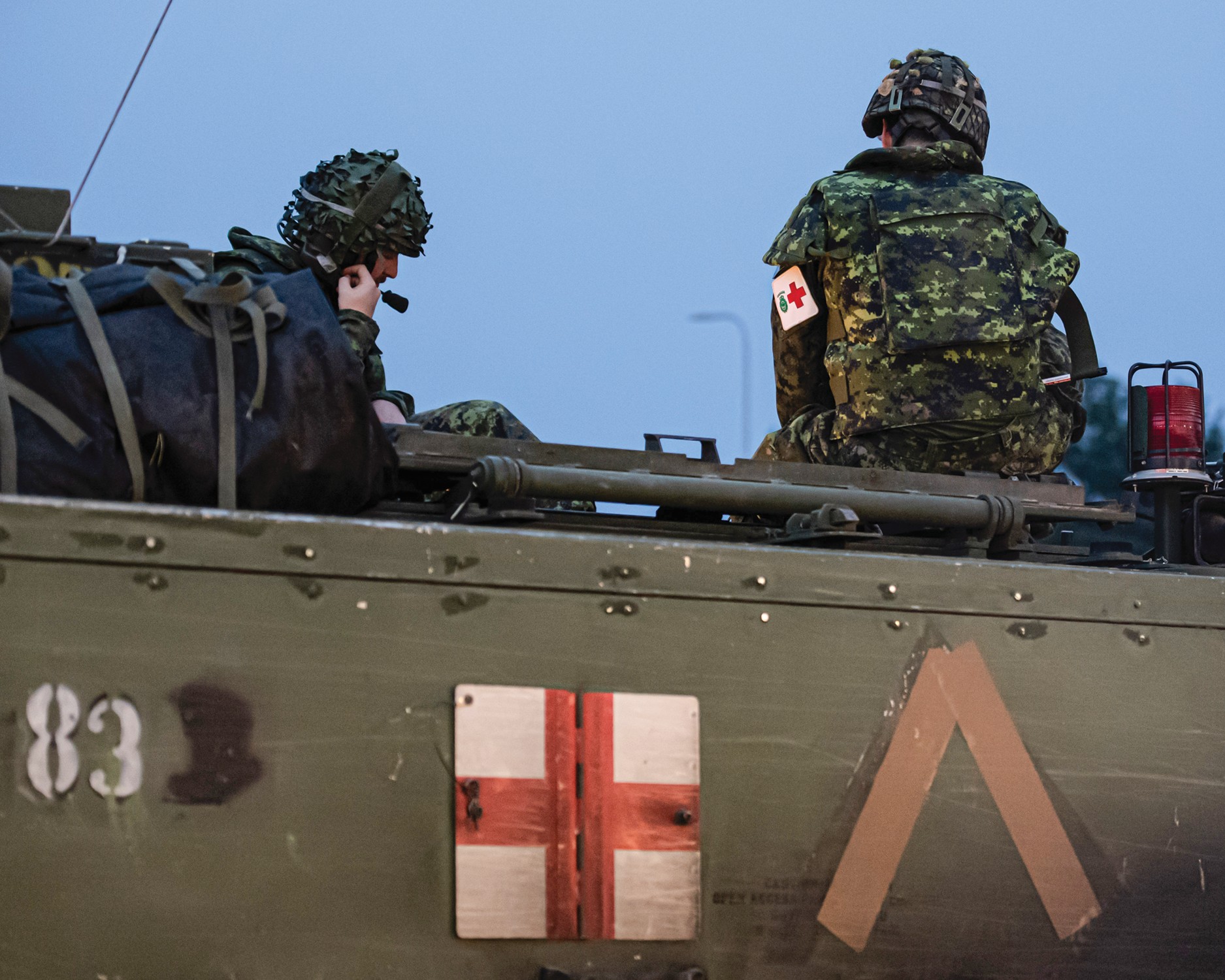
Photo: eFP BG Public Affairs Imagery Technician, Canadian Armed Forces Photo
Deployed members of the 2nd Royal Canadian Regiment currently serving in Latvia, congregate to commemorate Pashmul Day at Camp Adazi, Latvia, September 14, 2020.
Dr. Renaud Bellais is an Associate Researcher in economics at CESICE, Université Grenoble Alpes (Grenoble), and co-head of the defence observatory at the Fondation Jean Jaurès (Paris). He is also Group chief defence economist at MBDA, a European defence company.
How to achieve fair burden-sharing between the Allies of the Atlantic Alliance has been the subject of a recurring debate for decades, but the debate took a dramatic turn before the NATO summit in The Hague, Netherlands, in June 2025. US President Donald Trump requested a massive increase in other Allies’ military expenditures, to at least 5% of GDP, as the sine qua non condition for maintaining American involvement in the Alliance. Nobody should have been surprised given that, four years earlier President Trump had already pushed for increasing the NATO spending target to 4% from the 2% previously agreed upon at the 2014 summit in Newport, Wales.
The issues and stakes of burden-sharing are likely to play a major role in the forthcoming budgetary decision making in many NATO countries. All countries committed to increasing their military expenditures to reach the new target no later than 2035 and accepted that an evaluation would take place by 2029 in order to ensure follow-through by all countries. Thus, international pressures to deliver will remain strong, unlike what happened after the 2014 summit.
Even though the United States is right to complain that defence efforts in Europe and Canada are too limited, does an approach focusing on defence input truly correspond to the relevant requirement for an effective military alliance? Is it realistic to expect a linear relationship between the level of each Ally’s military expenditures and the provision of international security through the Alliance? Most of the political debates and academic literature on the subject adopt an input perspective, as if intensity of effort were the only way to assess the effectiveness of a military alliance.
This consideration is particularly important when countries are planning to implement a massive increase in military expenditures in the coming years in order to optimize the allocation of those resources and avoid wasting public funds. The Hague Summit resulted in a very short final statement, but that statement contains strong pledges. The indefectible commitment to collective security must go hand in hand with an ambitious new target for military spending: 5% of GDP by 2035. This is a real disruption, considering that the military expenditures of Allies other than the United States have just reached 2% of GDP in 2024, a decade after they committed to spend that much.
This collective decision represents a major change with regard to the era of peace dividends that most NATO countries experienced after the fall of the Berlin Wall in 1990. It raises many questions beyond the perspective of the United States concerning the collective production of international security. The new pledge represents a big leap forward. However, what does burden-sharing mean, especially in this context? How can it be accomplished, and with what contributions? After three decades of relative peace and low defence spending, implementing such a transformation of military efforts constitutes a major challenge for most member states of the Atlantic Alliance.
Beyond the obvious target with regard to military spending, the implementation of defence efforts is neither clear nor necessarily homogeneous between Allies, which differ significantly on several parameters, issues, and stakes. In other words, there is no reason why there would be a one-size-fits-all approach, even though Allies share the same desired output: peace and international security. Looking at domestic perspectives is therefore useful to assess how each Ally can understand collective security, define corresponding military efforts, and promote its own vision of burden sharing.
Analyzing domestic perspectives is even more relevant today given that The Hague Summit resulted in a new definition of defence efforts, marking an interesting but challenging disruption in the Alliance’s conception of national commitments. The global target is to spend 5% of GDP on defence by 2035, and, within that, the Allies agreed on a core military effort of 3.5% of GDP, corresponding to what the military staff has defined as required to meet the necessary capability targets. The remaining 1.5% of GDP is to be allocated to infrastructure, cyber-defence, and resilience as levers for armed forces.
The first of those two portions (3.5% of GDP) aims to adjust military expenditures to the new reality of international relations. Armed forces must have the means to deter and eventually defeat a potential adversary. The war in Ukraine has underlined the features of wars of attrition, which were largely forgotten in recent years because most post–Cold War military engagements were part of contingency operations. Increasing the collective target from 2% to 3.5% appears to be imperative. However, the stakes go beyond solely increasing efforts homothetically. It is possible to deter an adversary if and only if armed forces are credible and resilient. This requires spending effectively and wisely, in accordance with the needs of each domestic defence but also to the comparative advantage of national armed forces inside the Alliance.
The second part (1.5% of GDP) corresponds to the recognition that core defence is necessary but not sufficient in order to deal with an interstate, Clausewitzian war. When confronted with the latter, countries must set the grounds for a global resilience that encompasses robust civilian infrastructure and a supportive population. If military mobility is crucial, preventing the civilian society and economy from collapsing is critical today in a war of attrition in which military actions can also take place far from the front line.
However, it is more difficult to define the limits of military engagement when threats could come from deep-strike capabilities and from cyber attacks, targeting both military and civilian assets. Placing limits on the definition of military efforts appears to be quite challenging and subject to the analysis of threats and the choice of social organization to deal with them. Defence efforts cannot be assessed with a black-and-white dichotomy: we have to look at fifty shades of grey. This means that defence efforts could include several dimensions, which have to be analyzed with new metrics and interactive dynamics in order to understand the relevance and effectiveness of corresponding efforts.
After the Hague Summit, this new conception of military efforts also leads us to reconsider how much effort each Ally had expended in recent years beyond the 2% target. In other words, some states should not be blamed for spending too little on core defence if they were investing significantly in domains which were essential for implementation of military operations as defined through the new NATO approach. Nevertheless, this enlarged definition has less clear-cut boundaries, opening the door to divergences on how to interpret what should be counted as military efforts and what should not.
It is thus necessary to revisit the concept of burden-sharing and reconsider the domestic perspectives of each Ally with regard to the expected level of collective security. There is no reason why all countries should make the same contributions to the Alliance at different scales; that does not make military sense. Geography also matters: the balance in terms of contributions for core defence and additional efforts depends on several dimensions in order to maximize one country’s contribution to the collective security.
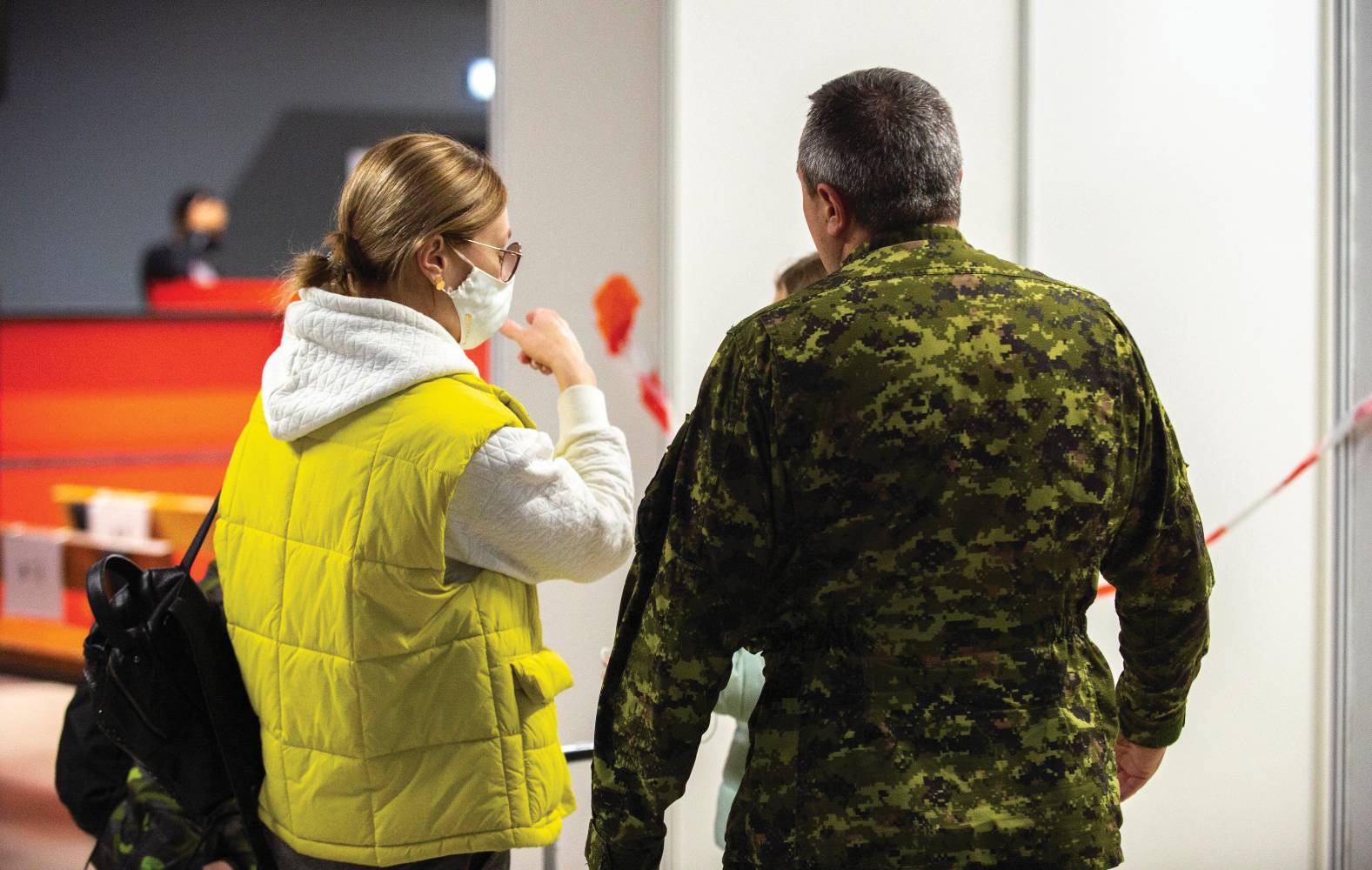
Photo: Cpl Tori Lake, Canadian Armed Forces Photo
A Canadian Armed Forces member provides humanitarian assistance at a reception centre for Ukrainian refugees in support of Task Force Poland on April 23, 2022 in Warsaw, Poland.
At the same time, the level of collective ambition has changed. Unlike the 2014 pledge, the new one is compulsory and is expected to be implemented quickly. Pressure on the European Allies and Canada is likely to remain high, especially as they will face a mid-course evaluation in 2029. It is therefore useful to understand where we are starting from in order to understand whether and how the 2035 target will be implemented. However, spending a lot of money quickly is not the best way to achieve a higher level of international security. It is necessary to develop some output metrics in addition to input targets, which are still relevant, especially in order to define a fair balance between Allies.
This special edition of the Canadian Military Journal aims to provide an overview of stakes and issues regarding the burden sharing between Allies, particularly between the United States on the one hand, and Canada and the European Allies on the other. Even though a single CMJ edition cannot cover all 32 countries of the Atlantic Alliance, the selected contributions that appear here underline the multiplicity of domestic perspectives and offer some insights into why there is no one-size-fits-all approach and why such an approach is not possible despite a collective and shared goal.