

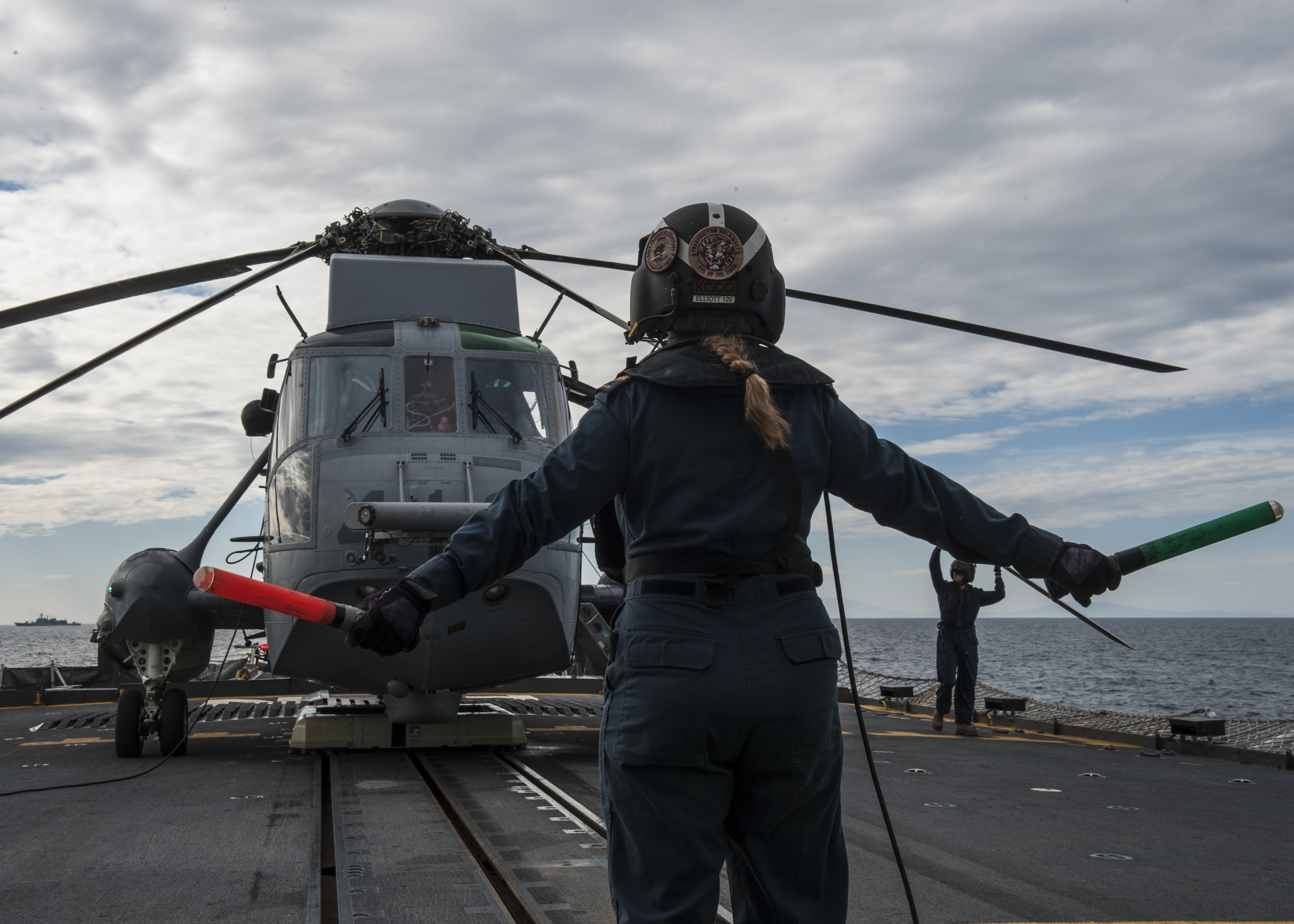
Photo: Maritime Task Force - OP Reassurance, DND HS41-2015-0043-025
Her Majesty's Canadian Ship FREDERICTON's Air Detachment deck director signals the deck crew during the start-up of the embarked CH-124 Sea King helicopter on Operation REASSURANCE on March 3, 2015.
Lieutenant-General (retired) Michel Maisonneuve served 35 years in the CAF and 10 more as Academic Director of RMC Saint-Jean. He served as the last Chief of Staff of NATO’s Supreme Allied Command Atlantic and the first Chief of Staff of NATO’s Supreme Allied Command Transformation in Norfolk, Va. He was named the 30th annual laureate of the Vimy Award in 2020.
Dear Dr. Leuprecht:
I am writing this letter to comment on your summer 2023 issue, Vol. 23, No. 3, which dealt primarily with the transformation of military culture. The magazine raises important issues and provides much fodder for discussion.
As a general comment, I am surprised that such an important topic was featured in the CAF’s professional journal without a single introductory comment from the editor. The editorial by the three civilian co-directors of the MINDS Network only served to further criticize the CAF and undermine morale: “Sexual misconduct is widespread as are discrimination and hostility towards women, two-spirit, lesbian, gay, bisexual, transgender, queer, intersex, inclusive (2SLGBTQI+), Indigenous, Black, and People of Colour military members” (emphasis added). Really? “Widespread”? By what measure is this judgment made, and how widespread is it compared to that of society in general? And are there really many examples of a “toxic leadership culture” still to be found within the CAF?
The CAF have been on the path of eliminating discrimination for many decades. I was serving at NDHQ in the 1980s when the CDS, General John De Chastelain, published the first CANFORGEN about harassment; it emphasized that the CAF needed to respect all persons, notwithstanding their gender or sexual orientation. It was a powerful message that was a step ahead of what other nations were doing in their armed forces. I was proud to see what followed, when all military positions were opened to women, including those on submarines. Who were we, the men, to say that a woman cannot serve in a position, whatever it may be, if she wanted to and if she met the required standards? As General Maurice Baril’s Executive Assistant, I remember him saying to me that removing barriers to women in the military is only a first step; making them feel welcome was still required, but we were not there yet. I also remember well the mandated programs of the 1990s such as SHARP (Standards for Harassment and Racism Prevention). Granted, some went through the programs with tongue firmly in cheek, but these programs have shown that the CAF recognized the need for a culture change in light of society’s changing norms, and that it was making an effort by involving all its members.
Following the investigation by Maclean’s (“Rape in the Military”) in 1998, a maelstrom of sexual misconduct issues emerged, leading to the CDS Operation Honour, the Deschamps report, senior officers being charged, the Morris Fish report, the Arbour report. It was an avalanche of “gathered” evidence claiming that the CAF was filled with horrible men who were racist Neanderthals. Very few or no interviews were held with servicewomen whose experience was nothing but positive, including in operations where the men were honourable and respectful. My basic training instructor in 1973, a Black sergeant, has a myriad of stories detailing how his white comrades came to his defence whenever he was slighted. And my personal impression of Ms. Deschamps’s visit to RMC Saint-Jean is that she was not really interested in positive experiences. Obviously, the sentence from the editorial in the second paragraph above leaves no room for reason or for what my friend and colleague Dr. John Cowan calls the “middle ground.”
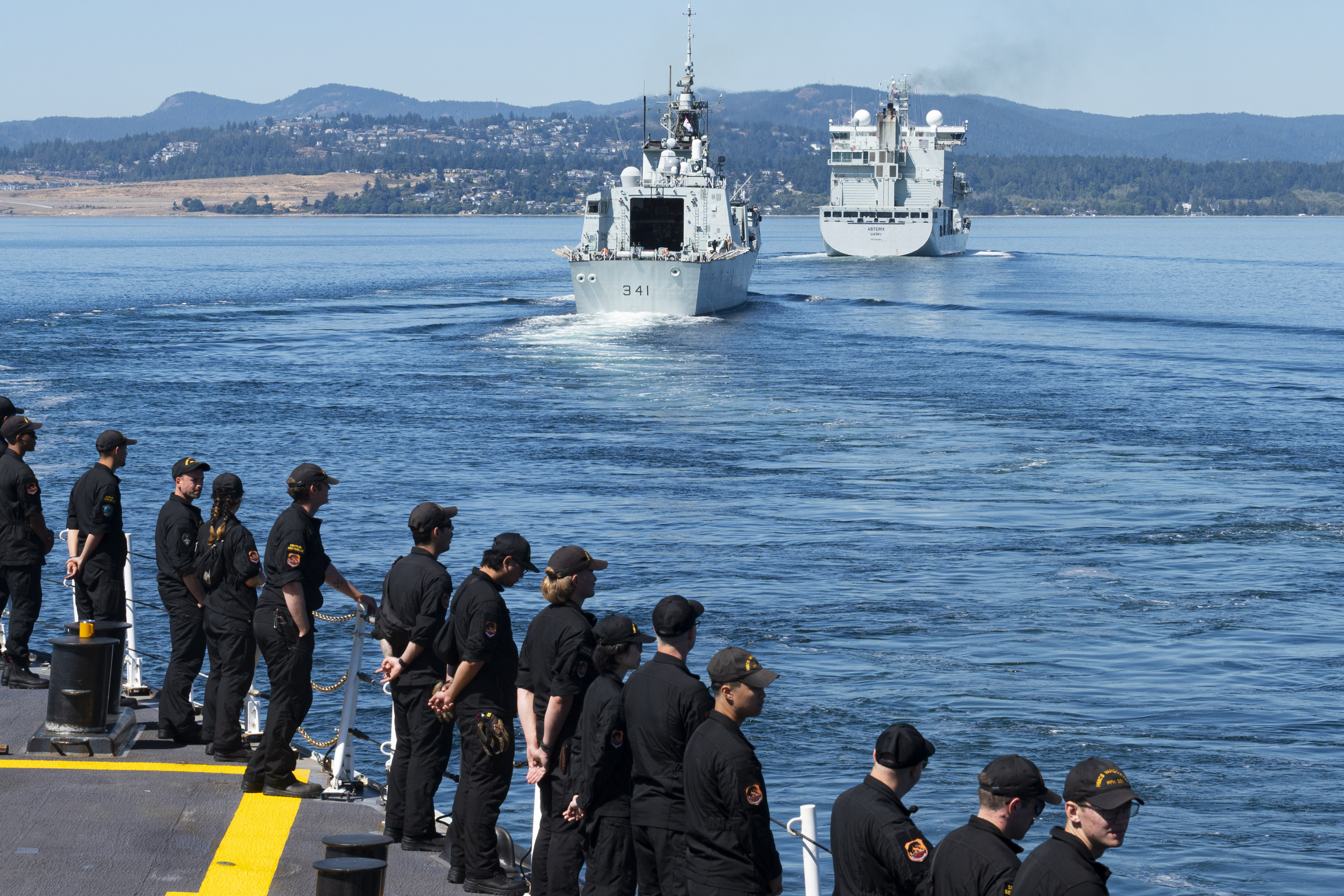
Photo: Corporal Alisa Strelley, Canadian Armed Forces
The Motor Vessel (MV) ASTERIX and His Majesty's Canadian Ship (HMCS) OTTAWA lead the way for HMCS VANCOUVER during a sail past of the Victoria shorelines after departing Canadian Forces Base Esquimalt, British Columbia, for the Indo-Pacific on August 14, 2023.
I have issues with a number of other precepts discussed in the published pieces. Must DEI offices really be created? Some major companies are now reducing their DEI efforts because they can make people feel tokenized. Are racist policies really embedded in our regulations? As per critical race theory, does the fact that a CAF member is white immediately make him or her racist in a binary manner? The editorial states that “military culture, policies and support are still largely informed by the heteronormative patriarchal assumption that families consist of a military man married to a civilian woman who cares for the family and home.” Traditional families undoubtedly still represent the great majority and thus need to be supported, but I would venture to say that our network of MFRCs caters well to all types of families, hopefully including our young single privates whose family consists of their parents and siblings. I know from personal experience that this wasn’t always the case, but it has improved and once again the CAF is given no credit for the steps already taken.
The editorial asserts that there has been no acknowledgement; I disagree totally. The scrutiny and proliferation of studies that have come about are vivid examples that acknowledgement has indeed occurred. There are so many root causes listed for the current situation that I had trouble reading them all: “Patriarchy, colonialism, white supremacy, heteronormativity, ableism, and classicism … sex, gender, sexuality, relationship status, parental status, race, ethnicity, skin colour, indigeneity, income, socioeconomic class, education, language, ability, age, region, and life experience.” Wow! There is no doubt that such a list will completely deter anyone from joining such a corrupt institution, and I still doubt that letting military personnel express their individuality with their uniforms will improve recruiting.
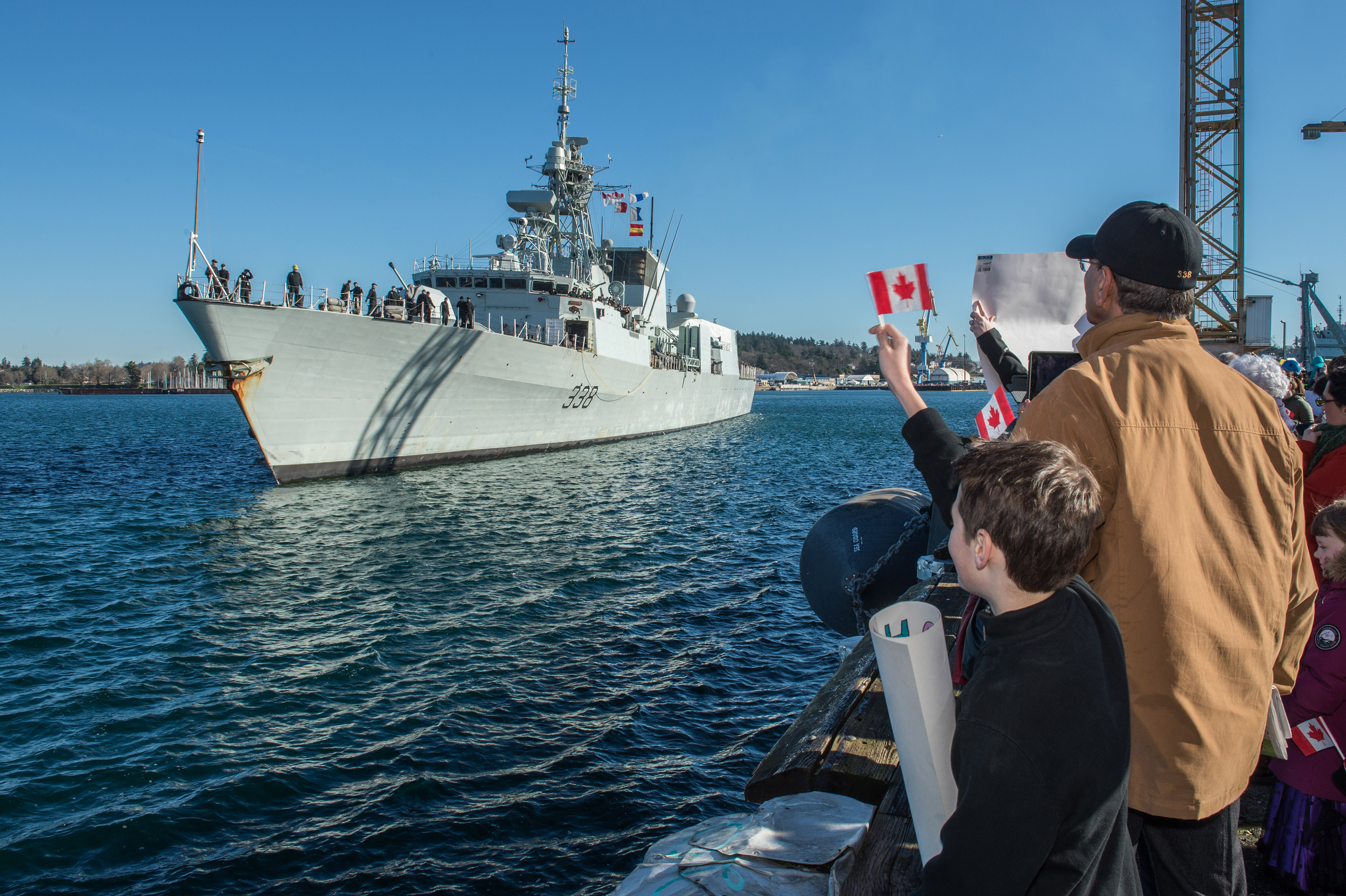
Photo: Cpl Brent Kenny, MARPAC Imaging Services ET2016-0056-13
A child patiently waits for his loved one as he waves his Canadian flag during the arrival Her Majesty’s Canadian Ship (HMCS) WINNIPEG, who is returning home after an eight and a half month deployment to Canadian Forces Base (CFB) Esquimalt on February 23, 2016.
Notwithstanding the opinion expressed in some of the articles, I believe meritocracy should still be paramount in progression decisions, with inclusion used as a means of deciding between equally qualified candidates; we could call it “inclusive meritocracy.” History and tradition are issues that must be considered carefully. History does not change despite those who want to rewrite it. But it must be understood in the context of the era, appreciated (not necessarily agreed with) and learned from—not destroyed. I agree that some examples of what is called “tradition,” such as Colonel Nobody, need to be removed; snuff can be kept in much more appropriate containers with just as much or more positive history. The Commanding Officer of that unit should have taken the initiative instead of waiting for a courageous subaltern to point it out. However, the example also shows that courageous young men and women within our CAF can be real agents of culture change. My personal experience with Happy Hours, for example, showed me that even in 1990, fitness-focussed young officers and soldiers were beginning to change attitudes towards alcohol and health. If young people don’t want to go curling, change the tradition! The aim of these events and ceremonies is to promote teamwork and inclusivity while celebrating unit history. They can be modified but should not be outlawed.
Regarding underrepresented groups in the CAF, our recruiting efforts have not been as successful as some would like. We could ask, “who will fight for Canada?” Here again, inclusive meritocracy should be the norm; we should encourage the groups we are targeting, focus on getting the best candidates, and not penalize those who are not from underrepresented groups. Perhaps our efforts to move bases away from urban centres have also not helped us recruit from underrepresented groups.
I take issue with the points in Dr. Taber’s article regarding warrior culture, including conformity and uniformity being the wrong paradigms for an effective, operationally ready military force. I thought we had done away with the harassment and abuse of the past and believe that our instructor cadre and non-commissioned officers have a better understanding of how to build an effective fighting force. I have total faith in these individuals. If our military’s most demanding fighting operations do not demand warriors with emotional fortitude and resilience, what do they require?
I found the articles by Capt (N)(retired) Al Okros and Dr. Karen Davis balanced and reasonable. As Karen states, there are (hopefully a majority of) women who were treated equitably in the CAF and who are frustrated by feminists who push for change without any experience. Al’s discussion of identity is useful; we who serve or have served in uniform have adopted an identity that is sometimes not understood. Any future culture change will need to consider identity as an important factor, notwithstanding its patriarchal roots.
At this point, we must ensure all these CULTURE CHANGE efforts are not put above the requirement for military effectiveness. In my view, the pendulum has swung too far. Culture change is necessary, but not everything and everyone is bad in our armed forces; the word “widespread” is inappropriate. The CAF are the protectors of our sovereignty and the defenders of our values. Leading our military forces in today’s world with the woke trends that permeate our society is a huge challenge for young officers and NCMs. The series of articles and other pieces in the issue paint everyone in the CAF with the same brush and will hurt the morale of those serving. It is time to end the self-flagellation.
Sincerely,
LGen J.O. Michel Maisonneuve (retired), CMM, MSC, CD
Academic Director, RMC Saint-Jean, 2007–2018