

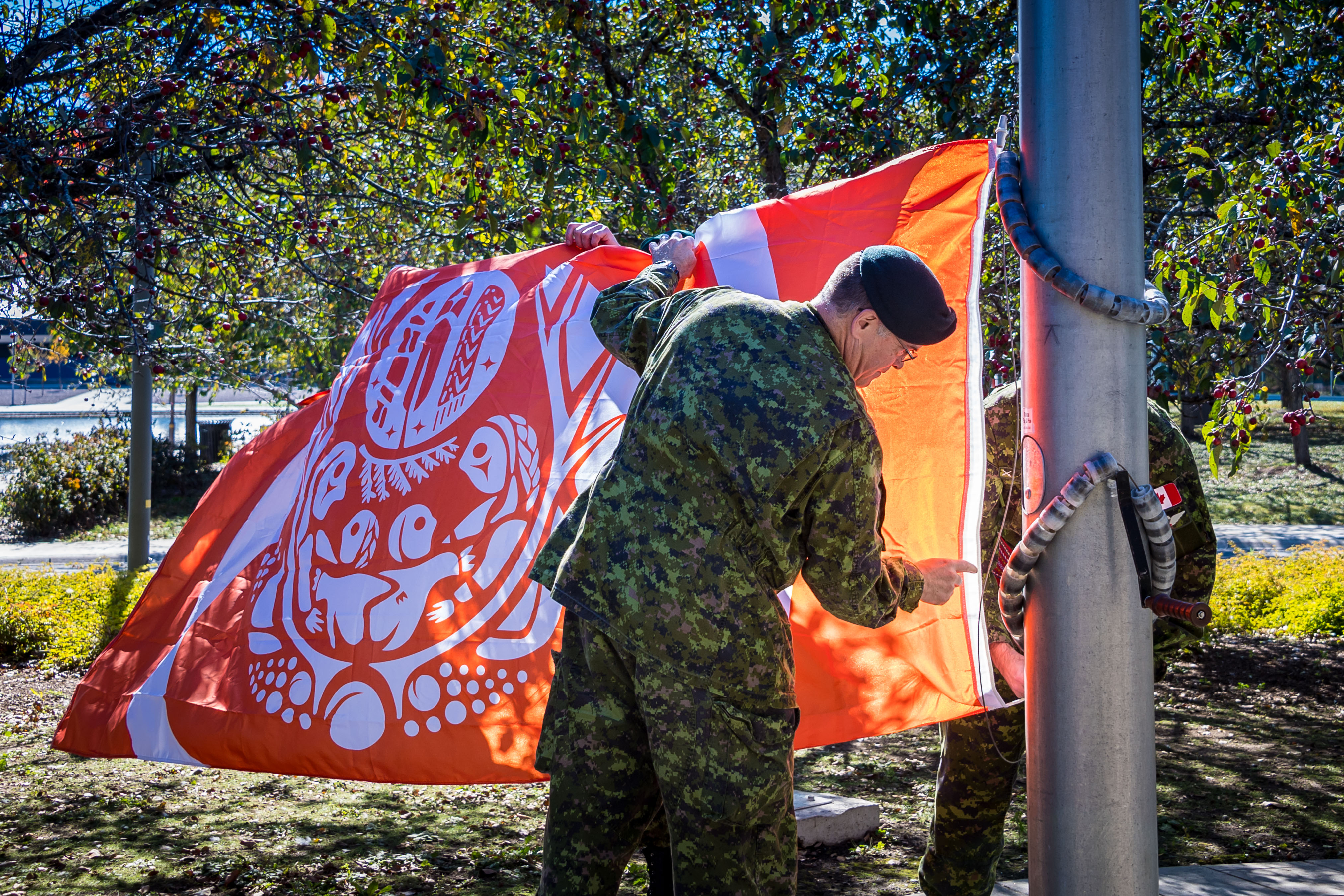
Photo: : Sailor First Class Anne-Marie Brisson, Directorate Army Public Affairs, Canadian Arm
Commander Canadian Army and Defence Team Champion for Indigenous People, attaches the Survivor’s Flag, during a ceremony commemorating the National Day for Truth and Reconciliation held at Carling Campus in Ottawa, Ontario on September 29, 2022.
Major Felix Odartey-Wellington PhD is the Senior Reserve Public Affairs Officer at 5th Canadian Division Headquarters, Halifax. He is also an Associate Professor of Communication at Cape Breton University, Sydney, Nova Scotia. Major Odartey- Wellington is currently a student in the Joint Command and Staff Programme at the Canadian Forces College, Toronto.
Introduction
The extent to which Canadian society and institutions reflect and include Indigenous and visible minorityFootnote1 demographics is topical.Footnote2 With the adoption of multiculturalism in Canada as manifested by policy objectives in the Multiculturalism Act,Footnote3 there is an imperative that state institutions would embrace diversity and inclusivity.Footnote4 This is made more pressing with the contemporary salience of employment equity and diversity issues, as well as by demographic shifts resulting from immigration.Footnote5 The Canadian Armed Forces (CAF), for example, launched a Diversity Strategy in 2016Footnote6 and Operation GENERATION in 2018, to, among other things, make its workforce more diverse and inclusive.Footnote7 Strong, Secure, Engaged: Canada’s Defence Policy espouses that “the Canadian Armed Forces must reflect the diversity of the country we defend. We need a military that looks like Canada.”Footnote8 It also states that, “The Canadian Armed Forces is committed to demonstrating leadership in reflecting Canadian ideals of diversity, respect and inclusion.”Footnote9 The most recent Canadian Armed Forces Ethos: Trusted to Serve also communicates CAF aspirations for inclusivity.Footnote10 While the CAF has embraced multiculturalism,Footnote11 and “has a rich history with respect to diversity,”Footnote12 studies and recent events contest this imageFootnote13. In 2022, the Minister of National Defence (MND) Advisory Panel on Systemic Racism and Discrimination issued a report identifying systemic racism in the CAF.Footnote14 As well, recruitment and retention of Indigenous and visible minority Canadians remains a challenge, even while overall recruiting is challenged.Footnote15 The Diversity Strategy speaks of an aspiration to position the CAF as “an Employer of Choice”Footnote16 for all Canadians. A thought-provoking essay in the Canadian Military Journal asks: “Can the Canadian Forces Reflect Canadian Society?”Footnote17 Writing as a visible minority immigrant who has had a positive experience serving in the CAF since 2010, my paper addresses this question with respect to Indigenous and visible minority Canadians. Drawing on legitimacy theory,Footnote18 leadership theory,Footnote19 and Erving Goffman’s concept of total institutions,Footnote20 it is suggested here that the CAF has the potential to position itself as an employer of choice for Indigenous and visible minority Canadians.
Background and Theoretical Context
In 1971, Canada adopted multiculturalism as an official policy (subsequently codified into law in 1985Footnote21), the first country in the world to do so.Footnote22 As public policy, multiculturalism has ramifications for the ordering of Canadian society and its institutions. To the extent that the former must be imaginable as a diverse and inclusive nation community, the latter must reflect diversity and inclusion in employment and leadership practices.Footnote23
Parliament’s Standing Committee on National Defence was sufficiently concerned about diversity in the CAF to initiate a study on the subject in 2018.Footnote24 Recognizing diversity in the CAF to be less than adequate vis-à-vis institutional targets, the resultant report argues for diversity on normative grounds: it is the right thing to do within the context of Canadian policy, law, and values. It also makes an argument on pragmatic grounds: a diverse military brings “strategic advantage”Footnote25 and is a “force enabler.”Footnote26 While the report is multifaceted, the focus of this paper is narrower: Indigenous and visible minority Canadians.
In May 2022, the Office of the Ombudsman for the Department of National Defence (DND) and CAF reported that despite institutional efforts, “The Department of National Defence and the Canadian Armed Forces have deeply embedded barriers to employment equity representation goals, recruitment, career advancement, retention, and culture, which are all intertwined.”Footnote27 Madame Louise Arbour made similar observations in the external review of the DND and CAF in 2022.Footnote28
Academic research recognizes the CAF’s lack of diversity and institutional attempts to address this.Footnote29 Tammy George’s 2016 doctoral thesisFootnote30 notes the same shortfalls with regard to visible minorities that the Chief of the Defence Staff (CDS) highlighted when he declared an unprecedented personnel crisis in 2022.Footnote31 George’s research suggests institutional inability to recruit and retain Indigenous and visible minority Canadians because of the systemic racism flowing from the nation’s origins that impacts Canadian society and its institutions.Footnote32 This is consistent with the MND Advisory Panel’s observations.Footnote33
In addition to articles authored by academics and CAF leaders in the Canadian Military Journal, highlighting the value of diversity and proposing diversity strategies,Footnote34 and studies conducted for the DND’s research institution, Defence Research and Development Canada (DRDC),Footnote35 the subject of diversity in the CAF has animated research in the Joint Command Staff Program, which develops CAF senior leadership. For example, Major Chris MacDonald proposes recognizing that visible minority demographics are not homogenous when designing recruitment strategies, involving visible minority communities in recruitment, using social media to connect with these demographics, and increasing visible minority representation in institutional leadership.Footnote36 Major Patrick Horsman proposes opening recruitment to eligible permanent residents awaiting citizenship, with appropriate caveats to manage risk.Footnote37 For Major Daniel Gregoire, “Changing policies, educating personnel on diversity, inclusion, and applying gender-based analysis methods contribute to changing the military culture to a culture more attractive to a diverse Canada.”Footnote38 Lieutenant-Colonel Leslie Rediger’s work, which focuses on the female experience within the CAF, explores how the CAF can become an employer of choice (EOC) for employment equity groups.Footnote39 Defining an EOC as “an organization that employees consciously aspire to work for, given more than one option, and one that they would recommend to others … an organization that is also able to retain its employees longterm,” Footnote40 Rediger argues that “the CAF needs to fundamentally change its organizational culture and its members’ attitudes towards diversity and social change in order to attract, retain and support a diverse workforce that serves Canadian interests.”Footnote41 And the CAF clearly wants to be an EOC, as evidenced not only by policy aspirations and institutional initiatives, but also by the academic and market research it routinely commissions to understand recruitment audience dynamics.Footnote42
The ideas presented in the relevant reports, policies, and research publications are best understood using legitimacy theory. Mark Suchman defines legitimacy as “a general perception or assumption that the actions of an entity are desirable, proper, or appropriate within some socially constructed system of norms, values, beliefs, and definitions.”Footnote43 Hence, legitimation is a process by which an organization positions its culture within the societal normative framework to justify its existence or operations. According to Suchman, institutional self-interest is in the realm of pragmatic legitimacy. Public perception of institutional adherence to the social normative system is in the realm of moral legitimacy.
Pragmatic and moral legitimacy account for self-interest- driven legitimation and legitimation informed by “the right thing to do,”Footnote44 respectively. This understanding captures the rationalizations given for diversity in the CAF. For example, Trusted to Serve, says: “As a national institution that needs to be credible and trustworthy, the CAF must be representative of the diversity of people, history and traditions of Canada.”Footnote45 Similarly, “Inclusion within an equitable professional culture is essential to creating a sense of belonging and cohesion. Within the CAF, inclusion makes our military teams stronger.”Footnote46 Also, the Diversity Strategy states that:
Maximizing the potential of a diverse workforce is not only a social imperative, but is also an operational advantage which was reinforced by our recent overseas experiences where diversity made significant contributions to CAF operations.Footnote47
The reports, policies, and literature suggest that culture change within the CAF is needed to facilitate legitimation. While definitions of culture are diverse across academic disciplines and professions, for the purposes of this paper, culture can be defined as “the learned beliefs, values, rules, norms, symbols, and traditions that are common to a group of people”Footnote48 and “… the set of artefacts, values and assumptions that emerge from interactions of organizational members.”Footnote49 This translates into “the way things are done around here”Footnote50 through institutional socialization. For example, what are the worldviews, perspectives, and lenses mainstreamed within the CAF? Are the organizational environment and practices welcoming and supportive of Indigenous and visible minority Canadians, given Canada’s (and the CAF’s) historical origins?
The CAF defines leadership as, “The process of directly or indirectly influencing others, by means of formal authority or personal attributes, to act in accordance with one’s intent or a shared purpose.”Footnote51 The goal is achieving “situational favourability.”Footnote52 In this case, within a contemporary multicultural context, how can the CAF achieve situational favourability to attract and retain Indigenous and visible minority members?Footnote53 Within CAF doctrine, transformational leadership, defined as “a pattern of leader influence intended to alter the characteristics of individuals, organizations, or societies in a fairly dramatic or substantial way,”Footnote54 is “rooted in the value systems of the Canadian military ethos and may refer either to the transformation of people or to organizational transformation.”Footnote55 Further:
Transformational leadership may be exercised by a talented individual with a compelling idea and the skill to communicate it to others, or by a leadership team united by conviction in its transformational aims … the professional socialization of new CAF members into the military ethos and its values represents the institutionalized transformation of people… Similarly, the adoption of CAF-wide practices that enable organizational learning and promote continuous improvement represents institutionalized transformation of the organization.Footnote56
It is useful to understand the CAF as what Erving Goffman calls a “total institution”Footnote57 or a unique organization bracketed outside the mainstream, and in which member conduct is regulated, all with the aim of achieving common organizational goals. This is not a novel conceptualization.Footnote58 The CAF as an institution is relatively bracketed out of the mainstream, and member cognition/ worldview is shaped to uniquely reflect institutional values. Members develop capabilities and perspectives that they would not have had but for their complete immersion within the total institution. The total institution is conducive to transformational leadership in this regard; it provides the incubation to keep members focused, and thus a “captive audience” for transformational leadership influence. It also possesses unique symbolic and cultural levers through which member behaviour and worldview are shaped.Footnote59 Divergences from appropriate behaviour can be quickly identified and corrected, or, when necessary, sources of negative influence can be expelled. The military total institution exists to engender public spiritedness, discipline, unlimited liability, courage, integrity, and other warrior attributes in the civilian recruit, and to sustain those attributes. Leadership inspires the cohesion and esprit de corps necessary for the military total institution to channel these warrior attributes for “militant mission”Footnote60 success, whether in traditional warfighting or in any other endeavour it undertakes. Similarly, through transformational leadership, an inclusive culture conducive to Indigenous and visible minority members can be fostered within the total institution in ways that would not be feasible in the mainstream.Footnote61 Therefore, though the total institution has been linked to problems of inappropriate behaviour and exclusion within the Canadian military, it is also recognized that this is not always the caseFootnote62 and, as is argued in this paper, the positive attributes of the total institution can be harnessed for culture change through leadership.
Points for Consideration
As mentioned in the introduction, the CAF has the potential to be the employer of choice for Indigenous and visible minority members. Suggestions are proposed below, all consistent with Trusted to Serve.Footnote63
1. Transformational Leadership for Culture Change
The CAF identifies leadership as critical for “the implementation of the strategy and the overall diversity climate within their organizations.”Footnote64 Thus, “active engagement of CAF leadership to accomplish culture change in favour of a diverse CAF that is representative of Canada’s population is paramount.”Footnote65 The CAF has been a learning organization,Footnote66 taking steps to increase Indigenous recruitment. However, as the MND Advisory Panel heard from Indigenous members: … Defence Team efforts seem concentrated on influencing individual Indigenous People to consider a career in the Canadian Armed Forces without subsequently offering them a culture that welcomes their unique perspectives or respects their traditions. Once these Indigenous recruits enter the military, ongoing initiatives to maintain or integrate Indigenous culture as advertised in the summer programs are not prevalent.Footnote67
Similarly, the CAF has expanded its outreach towards visible minorities, but:
Black people are not adequately represented at the senior leadership level. Their representation at mid-management level, such as director or senior officer, is also lower than that of other visible minority groups. The absence of Black representation and the failure of the organization to make meaningful strides in this regard at the leadership level have eroded trust in the DND/CAF among Black Defence Team members.Footnote68
In other words, more work needs to be done. The way forward, therefore, requires institutional acknowledgement of cultural deficiencies and culture change through transformational leadership (both arguably reflected in ongoing institutional initiativesFootnote69). While Goffman conceptualizes the total institution as a modernist disciplinary enterprise, it could be seen as a space where multicultural normative values can be nurtured, and where leaders socialize organizational members in a manner not feasible outside this disciplinary space. Leadership will have to continue addressing latent systems, structures, and (sub) cultures that reproduce a status quo that works against attracting and retaining Indigenous and visible minority members. In this regard, the MND Advisory Panel report is a useful source of direction because it consolidates previous studies as well as work done by Defence Advisory Groups (DAGs), such as the Defence Indigenous Advisory Group, the Defence Women’s Advisory Organization, the Defence Visible Minorities Advisory Group, the Defence Advisory Group for Persons with Disabilities, the Defence Team Pride Advisory Organization, and Defence Team Black Employee Network. The Panel bemoans the fact that previous findings are merely gathering dust. However, transformational leadership has the potential to harness norms grounded in the institutional ethosFootnote70 to shape member behaviour within the institution. This recalls that “dignity of all persons” is the highest principle in the pantheon of the CAF’s ethical regime which speaks to “diversity, equity and inclusion.”Footnote71 The total institutional cultural, administrative, and disciplinary levers give leadership unique capabilities to shape the organizational space by denying cultural terrain to, or disrupting/interdicting, elements such as White supremacy groups that challenge an inclusive environment.Footnote72
It is important that members understand the need for change, and not merely pay lip service just for the sake of political correctness. As has been argued in reaction to the MND Advisory Panel’s report, “Historically, responses to racism and discrimination in the CAF have been superficial and reactionary in nature, for example, focusing on providing courses or modules, with a lack of buy-in and continued internal resistance.”Footnote73 The socialization process within a total institution must be understood as negotiated rather than being strictly top-down. Grassroot adoption is necessary because passive or active member resistance are always possible within the total institution.Footnote74 As Rediger notes, given the size of the CAF, its dispersed nature, and its deep traditions, member friction resulting from culture change must be anticipated and pre-empted through communication and education; “instant obedience and uniformity”Footnote75 are not guaranteed. Thus, transformational leadership requires role modelling, constant feedback, and measurable culture change.Footnote76 As Alan Okros observes,Footnote77 it is not unusual for dominant institutional elements to define benchmarks for success when “accommodating” minorities. Thus, feedback from Indigenous and visible minority members on their institutional experiences is important if they are to have agency in the diversity and inclusion process.Footnote78 It is in this spirit that Brian Selmeski’s study proposes a path of negotiation between leadership and Indigenous communities on cultural elements that will make them “feel like full members of the profession”Footnote79 while ensuring institutional viability is maintained. Naturally, as a profession of arms, “individual values and beliefs must align with CAF values and be balanced against the constraints of operational effectiveness and the principle of universality of service.”Footnote80 In this regard, Rediger observes:
Balancing diversity and culture change initiatives with the critical needs of the organization is a delicate process. Critical needs should not be confused with established practices, procedures, culture and traditions. The needs of an organization for operational readiness, or critical capabilities need to be identified, validated and screened for bias in order to really understand what the CAF needs to be successful rather than what it has used to be successful in the past.Footnote81
A classic illustration of the transformational leadership referenced in this section is the initiative taken by the commanding officer of the Princess Louise Fusiliers in Halifax, Nova Scotia, to launch the Diversity Soldier Experience Program (DSEP) in 2020.Footnote82 This program creates internal awareness about societal diversity as well as historical Indigenous, racialized, and gendered realities. This not only ensures that the unit is able to engage in community outreach to obtain recruits, but also eliminates potential sources of othering that might militate against meaningful participation by Indigenous and visible minority members once they join.
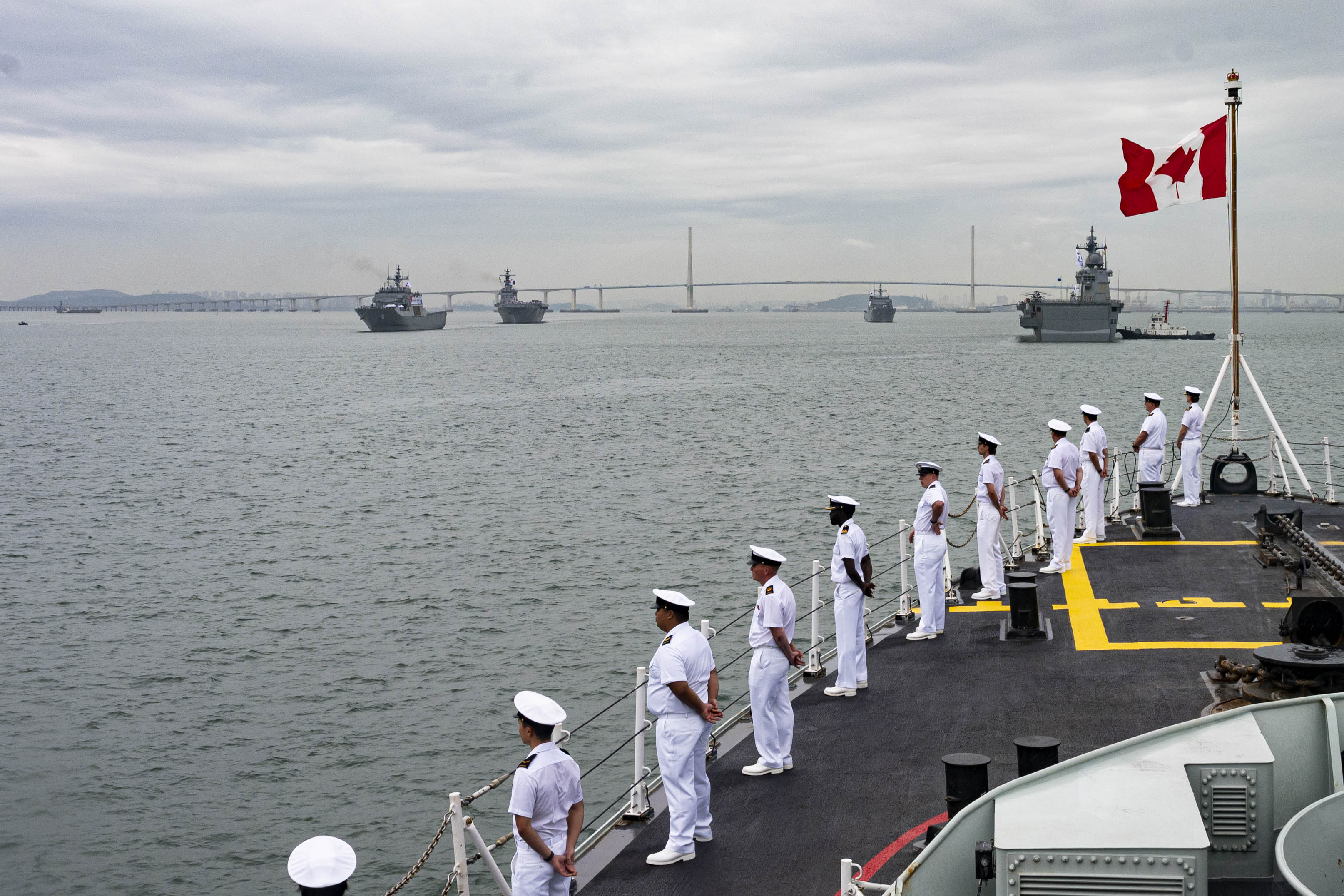
Photo: Corporal Alisa Strelley, Canadian Armed Forces Photo
Majesty’s Canadian Ship (HMCS) Vancouver participates in a reenactment of the Incheon Landing Operation and a Fleet Review with Republic of Korea Navy Ships and United States Ship (USS) America on September 15, 2023 in Incheon, South Korea.
Indigenous and visible minority members must be integrated into CAF leadership by means of a succession plan. This will help signal inclusivity at the highest levels, help ensure that diverse realities are reflected in decision-making, and reduce unconscious bias and privilege.Footnote83
In addition, the CAF’s diversity and inclusion space has a multiplicity of groups. These produce discourses, that, in the “Sense” operational function,Footnote84 will need to be consolidated and communicated for action by leadership and sharing as best practices among groups. This requires dedicated vehicles within higher headquarters to manage this function. And where changes are not possible, leadership must be able to communicate this candidly.
2. Public Communication
The CAF sets out the following diversity strategic communication objective:
To remain relevant in an increasingly changing Canadian society, the CAF must strive to effectively communicate how it values and promotes diversity not only to build the reputation as an employer of choice, but to foster deeper more respectful relationships with all of Canada.Footnote85
Drawing on EOC literature, Rediger suggests that:
Awareness of initiatives, cultures, values and work content is key in becoming an EOC, as a choice can only be made if the information is available, communicated and accessible. It is about attracting people but also about selling the organization. However, the messages need to be authentic and backed up by honest testimonials.Footnote86
As previously mentioned, the CAF is a learning organization and has evolved institutional norms and practices to be more supportive of Indigenous and visible minority members. For example, the CAF has established the following programs for Indigenous recruitment:Footnote87
- Indigenous Leadership Opportunities Year;
- Canadian Forces Indigenous Entry Program; and,
- Summer training programs such as
- Bold Eagle;
- Raven;
- Black Bear;
- Carcajou; and,
- Grey Wolf.
Research suggests that these programs resonate with Indigenous communities as gateways for entry into the CAFFootnote88 and thus must be sustained. The CAF also employs diverse members in recruitment, “and has addressed concerns that minorities sometimes have regarding the military.”Footnote89 However, without an informed, active, strategic public communication of opportunities for service in the CAF, Indigenous and visible minority Canadians would not be attracted to join.Footnote90 It has been said that, “the under-representation of visible minorities may in part reflect the fact that in some countries of origin (e.g., in Africa, the Middle East, Asia and South America—increasingly the countries of origin of immigrants to Canada) the military is not seen as a career of choice or the defender of a nation, but as a machine of oppression.” Footnote91 This may discount the agency exercised by immigrants who make a conscious choice to make Canada their home based on the distinction between Canada and their native countries. Certainly, there is evidence that some immigrants conflate the CAF with militaries in their countries of origin and this might be a barrier to recruitment.Footnote92 But, as Christian Leuprecht puts it, “immigrants to Canada readily distinguish between armed forces in their home country and the CAF.”Footnote93 Yet, the issue of community awareness of CAF career options is a live one, as Justin Wright and Felix Fonséca found in their 2016 focus group studies among CAF members from immigrant communities.Footnote94 Indeed, Ipsos Reid surveys of visible minority demographics for the CAF in 2011, 2012, and 2014, corroborated by Wright and Fonséca’s research, indicate nuanced attitudes towards employment in the CAF, informed by pragmatic concerns and comparisons with other professional opportunities, similar to attitudes found within the general public.Footnote95 The 2012 Ipsos Reid survey found that:
Compared to general public youth respondents, Asian and Arab-Canadian youth were more likely to see joining the Canadian Forces “as a good way to help others” (78% v. 69%), as a way to gain “experience that is valuable experience outside of the military” (72% v. 64%), and “as a good way to serve the country” (72% v. 58%).Footnote96
Similarly, 82% of parents within the immigrant demographic surveyed indicated that, “joining the Canadian Forces is a good way to serve the country,” with a comparable percentage agreeing that “joining the Canadian Forces is a good way to help others.”Footnote97 It is also observed that “legitimacy, integration, membership, and formal citizenship status”Footnote98 are benefits that visible minority Canadians who choose to serve derive. Military service is a means for Indigenous and visible minorities, especially new Canadians, to assert their agency, identity, citizenship, and sense of belonging in society.Footnote99 All three Ipsos Reid surveys, however, indicate limited familiarity with the CAF among visible minority communities.Footnote100 Anecdotally, most new Canadians I speak to as a visible minority immigrant are astonished to find out that they are welcome in the CAF. New Canadians might be oblivious to the fact that barriers to service in their countries of origin (e.g., age, gender, sexual orientation) do not exist in Canada. Therefore, public communications focusing on new Canadians across multiple media platforms is important. The choice of channels must be strategic, as should the choice of messaging. Messaging and imagery must highlight professional opportunities in the CAF, some of which might not be as accessible in the civilian space.Footnote101 For example, it is noted that:
… recent immigrants to Canada face high rates of both underemployment and unemployment. Statistics Canada reported that between 1991 and 2006, “the proportion of immigrants with a university degree in jobs with low educational requirements (such as clerks, truck drivers, salespersons, cashiers, and taxi drivers) increased.” Even after being in Canada for fifteen years, “immigrants with a university degree are still more likely than the native-born to be in low-skilled jobs.”Footnote102
However, visible minority new Canadians who, interested in a military career, enter the CAF and complete their training are guaranteed fulfilling positions. Whether serving in the Regular Force or as a Reservist, they are eligible for financial support to complete post-secondary education and skills training, and to obtain valuable career training and experience that they can leverage in the mainstream economy. Thus, the practice of conducting recruiting outreach during citizenship ceremonies in urban areasFootnote103 must be sustained and expanded to non-urban areas as well. Indigenous and visible minority members must also have a role in recruiting and instructing to provide candid perspectives to prospective or new recruits.Footnote104
It is important that the historical military service of Indigenous and visible minority Canadians is woven into the institutional narrative. The recent recognition of the efforts of Indigenous Peoples like Tommy PrinceFootnote105 and Black soldiers in the No. 2 Construction Battalion,Footnote106 in the face of institutional prejudice and rejection during the First World War, are examples of that kind of inclusive narrative. Such narratives would build trust with audiences in demonstrating that the organization acknowledges its wrongs, and values/reflects people like them. For example, Felix Fonséca and Jason Dunn’s study found that many Indigenous members joined because of family histories tied to CAF service.Footnote107 But the narratives are also “culture embedding mechanisms”Footnote108 for institutional members. This is important as leaders are expected to socialize and reinforce the institutional ethos,Footnote109 e.g., by being “good teachers of unit and CAF heritage and history” Footnote110 to “create the conditions that will foster acceptance and internalization of the ethos.”Footnote111
Based on audience research, leadership can direct recruiting advertisements with rhetorical/semiotic appeals directly focusing on immigrant communities and in media that cater to these communities.Footnote112 It is also important that CAF leadership build dialogic relationships with relevant community representatives, such as Indigenous and immigrant community stakeholder group leadership. These representatives are gatekeepers or “influencers” Footnote113 who can provide access to their communities once they understand what the CAF has to offer. They can articulate community concerns with regard to the CAF and advise on shaping the CAF workplace into a more inclusive one. This should be the kind of respectful, dialogic relationship that Selmeski suggestsFootnote114 and which has been enacted in programs such as the DSEP. The preceding points are consistent with the “targeted attraction and recruitment” strategy for underrepresented groups in the CAF’s Employment Equity PlanFootnote115 and suggestions made by respondents to the Ipsos Reid surveys.Footnote116 Feedback gathered from the 2012 survey (and reflected in the 2011 and 2014 surveys) is noteworthy:
… personal involvement of Canadian Armed Forces members— at cultural events, in the mosque, in community centres and in schools—could go a long way towards addressing their communities’ lack of familiarity with the Forces and in making the CAF a real, rather than remote or abstract, career option. Putting members of their community who wear the CAF uniform at the front and centre of efforts in their communities would help to alleviate some of the conflicted feelings they have about military service in Canada. It would also impress upon them that the CAF is serious about becoming diverse and can truly include them, while enabling them to retain their cultural identities and values.Footnote117
In addition, with regard to engagement approaches, respondents recommended:
involving members from their ethnic community in recruitment efforts, showcasing former CAF members from within their community who had gone on to become successful outside the CAF, and involving Asian and Arab-Canadians who are highly ranked members of the Canadian Forces.Footnote118
Interviewees in the 2014 survey stressed, “the importance of going beyond the ‘tokenism’ in which visible minorities simply appear in advertisements and brochures, towards a more personal engagement.”Footnote119
Conclusion
The CAF can certainly reflect Canadian society within its ranks, and is making efforts at achieving this. Drawing on legitimacy theory, leadership theory, and Goffman’s concept of total institutions, the argument is advanced that the CAF can be made an employer of choice for Indigenous and visible minorities through 1) transformational leadership for enduring culture change, and 2) robust public communication of what the CAF has to offer Indigenous and visible minority communities.
While this could be seen as an attempt to instrumentalize certain demographics, it is important to recognize that the CAF is a societal resource or “an important national program”Footnote120 that must be equally and equitably available as a service opportunity. Without appropriate communications strategies, Indigenous and visible minorities would be oblivious to this opportunity. As well, ensuring that the CAF is welcoming of these demographics is already part of the institutional ethos.
However, a diverse CAF is not necessarily an inclusive CAFFootnote121 one in which diversity is not merely approached to meet regulatory imperatives but rather, one in which members have relative agency to participate meaningfully. This is consistent with the CAF’s aspiration for “an inclusive environment where everyone feels empowered to contribute their full potential in the execution of their military duties.”Footnote122 It is also consistent with the CAF’s understanding that, “Inclusion means producing a work environment in which all employees have a sense of belonging, are valued for their unique capabilities, are encouraged to be their authentic selves and are supported in achieving their full potential.” Footnote123 Thus, transformational leadership must start with culture change that mainstreams multiculturalism as a non-negotiable value and eschews ethnocentrism. In this regard, transformational leadership must be conscious of the fact that while overt racism and discrimination may be untenable in contemporary times and “may have all but disappeared” in the CAF,Footnote124 inferential or subliminal racism exists,Footnote125 especially when rendered as institutional “common sense.”Footnote126