

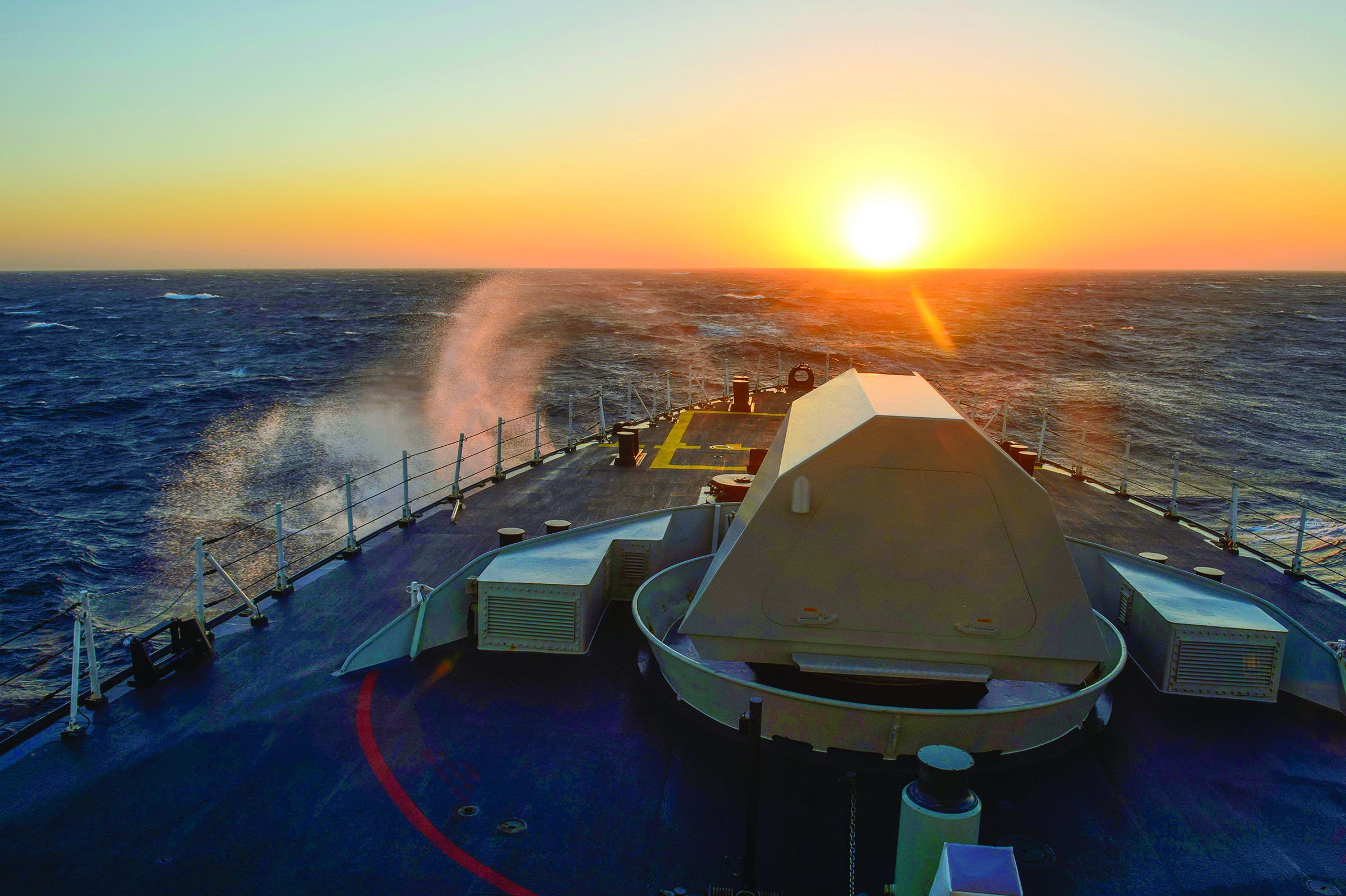
Photo: Cpl Stuart MacNeil, HMCS WINNIPEG ET2015-5136-001
Her Majesty's Canadian Ship WINNIPEG sails into a sunrise in the Eastern Atlantic Ocean on the morning of November 8, 2015 during Operation REASSURANCE.
As the Canadian Military Journal approaches its 25th anniversary, recent debate highlights the publication's evolution over the past quarter-century. Initial articles tended to cover more conventional topics in military studies, such as equipment, doctrine, strategy, and history. CIMIC operations, parliamentary roles in NATO, and tactical nuclear doctrine, exemplify topics that dominated earlier issues. That is, CMJ's articles have always reflected the concerns and priorities of the day.
CMJ emerged from the realization that the post-Cold War Canadian Forces were struggling with uncertainty about future security threats. Post-Somalia, critics highlighted to then Minister Young the liability of an anti-intellectual climate within the CAF. There are interesting and important continuities between concerns raised with Minister Young at the time, and what, a quarter-century later, Madame Arbour reported to then Minister of National Defence Anand. These echoes bolster the rationale for CMJ, and the editor's renewed steps to strengthen intellectual debates and exchanges of ideas among military professionals, scholars, and defence scientists. CMJ's role, then as now, is to kindle a spirit of inquiry within the profession of arms.
CMJ aims to strike a balance. Articles may examine external factors that will cause the military to adapt, such as shifting security threats, new roles/missions, and new technology, or they may look internally at facets of organizational or professional functions that may need to be changed. For drivers of external change, CMJ can stimulate debate on professional judgment regarding how to adapt and implement changes. But in all democracies, there is also a recurring debate in civil-military relations about the extent to which the military should adapt to societal change. As the CAF's institutional culture, personnel system, approaches to leadership, and professional values have been coming under extensive scrutiny, the way forward is necessarily subject to intense debate, especially in an organization whose members sign up for unlimited liability.
Traditionalist disciples of Samuel Huntington insist on protecting the military's martial culture from the perceived threat of broader societal changes to set the military apart from society as a force capable of fighting high-intensity conflict. By contrast, progressive critics inspired by Morris Janowicz believe that a military that relies on volunteer service should not be isolated from broader societal change. They contend that a volunteer military's functional imperative is best served when it reflects, represents, and practises the same societal values it purports to defend.
The mandate of CMJ's Editor-in-Chief is enshrined in ministerial serial #63: “To create further intellectual debate among military professionals, public servants, researchers, academics, students and Canadians generally.” CMJ's relevance and timeliness hinges on remaining true to its mandate. That means not all readers will necessarily agree with what they read. The disclaimer at the bottom of the Table of Contents states: “Opinions expressed or implied in this publication are those of the author, and do not necessarily represent the views of the Department of National Defence, the Canadian Armed Forces, Canadian Military Journal, or any agency of the Government of Canada.” As the former CDS insists in his foreword to this issue: “The purpose of professional journals, such as CMJ, is to provide a forum for informed discussion to strengthen professionalism and acknowledge we cannot assume to have all the answers.”
By means of rigorous peer review as enabled by the editorial board, the Editor-in-Chief ensures that CMJ is a constructive contributor to professional debate. To this end, contributions need to meet standards of scholarly merit, including consideration of different identity attributes. CMJ's quality assurance process benchmarks professionalism and strives to balance academic rigour with professional knowledge. Professions exercise a degree of self-regulation, including over which ideas are endorsed as relevant. This can lead to “the closing of the profession mind” or, worse, the institution's social isolation. CMJ's mission is to create space for debate that might otherwise be difficult or impossible to have. In an institution whose role some claim is to defend democracy, not to practise it, CMJ mitigates professional isolation by counteracting the risk that restrictive echo chambers pose by creating and championing a free(er) marketplace of ideas concerning the profession of arms in Canada.
CMJ 23.3 was a milestone: the first special issue, curated by an accomplished all-female guest editorial team and fostering debate on military culture. The Special Issue brought together authors who are serving and former military members, defence scientists, and civilian academics. It reflects concerns that service members and civilians working together are having about diversity, equity, inclusion, and fairness. Not unlike debates that Canadian society has been having for decades, they have just taken longer to play out in the military, and they manifest somewhat differently given the organization's unique mandate in Canadian society. The Federal Public Service is the largest employer in the country. As the largest employer in the Federal Public Service, Canadians expect their armed forces to lead by example. Despite vigorous debate within and outside the CAF on how to move forward, there seems to be a broad consensus that the CAF has fallen short of the golden rule: the principle of treating others the way one would want to be treated by them.
Is the answer revolution or evolution? Far from impugning and tearing down the whole edifice to start anew, articles in 23.3 make the case for rehabilitating the CAF, akin to renovating a venerable institution whose institutional culture shows the same structural deficiencies as some of its physical infrastructure and fighting platforms. That renovation is up for debate, and the critics are right insofar as the stakes are far too high to get it wrong (again).
The same, of course, holds for many other dimensions of the CAF. The silver lining of an organization in need of reconstitution and modernization is the opportunity for debate to shape its future. To this end, contributors can submit articles, op-eds, commentaries, letters to the Editor, and book reviews on CMJ's new online submission portal. CMJ is, after all, the official journal of the profession of arms in Canada. In that spirit, the editorial team cherishes engagement and feedback from readers. As authors, readers have the opportunity to shape the organizational odyssey.
In the spirit of debate, this issue starts with a Foreword by Canada's Former Chief of the Defence Staff. From among the letters to the editor received, the editorial team, guided by the aforementioned principles, has selected to publish two letters that represent the spectrum of views expressed. These letters have scholarly merit insofar as they make a professional and constructive contribution to the debate on the profession of arms. One contributor's rejoinder to 23.3 follows.
The following section contains three articles on military personnel. The first article is by the former CDS, co-authored with Lieutenant-Colonel (retired) Bill Cummings: reflections on character-based leadership, a topic we’ll be revisiting in forthcoming issues of CMJ.
In “GOFO Selection,” Major T. Kelley examines the lack of background diversity among General and Flag Officers (GOFOs) within the Canadian Armed Forces. Major Kelley analyzed a decade of GOFOs and identified their trades of origin. The data revealed that specific trades, such as the armoured corps, are disproportionately overrepresented among GOFOs. In comparison, support trades (such as personnel selection) are underrepresented. The Canadian Armed Forces can overcome this gap by identifying support trade personnel for operational command positions, thus broadening the leadership pool and fostering diversity of trade backgrounds among senior leadership.
In their article, “RISE to Resilience: A Strategy for Leveraging Positive Emotions,” Cherif, Wood, and Lt Parnell discuss the prevalence of stress following the pandemic and the need for the Canadian Armed Forces to develop strategies to address these stressors. They propose the RISE framework (recognize, investigate, savour, and enhance) as a potential mindfulness-based practice for leveraging positive emotions. When properly harnessed, mindfulness can improve cognitive function and resiliency, reduce stress and reactivity, and minimize the effects of burnout. The article concludes that mindfulness can be combined with positive emotions to navigate the post-pandemic period and challenges within the workplace.
In “The CAF as an Employer of Choice for Indigenous and Visible Minority Canadians,” Major Odartey-Wellington, Ph.D., discusses diversity and inclusion within Canadian institutions and focuses particularly on the Canadian Armed Forces. In his article, he notes that the CAF can become an employer of choice for Indigenous and visible minority Canadians if it creates an inclusive environment, fosters a sense of belonging and empowerment, and embraces transformational leadership.
Major-General (retired) J. G. Milne examines the income replacement benefits (IRB) provided to disabled Reserve Veterans in the Canadian Armed Forces in “Assessing VAC’s research and its influence on income replacement policy for disabled Reserve Force Veterans.” He finds that Reserve Veterans, who represent 47% of Veterans and 17% of IRB recipients, face potential unfairness in the calculation of their benefits, partly because the income for Reserve Veterans (a crucial component) is based solely on their military salary at the time of the injury and excludes civilian income. The article makes the case for an income definition that better represents a reservist’s civilian earnings, so IRBs can be more equitable.
“The Roles, Duties, and Recollections of Chief Petty Officers in the Royal Canadian Navy,” by Samantha Olson, delves into the role of Chief Petty Officers (CPOs) in the Royal Canadian Navy (RCN). Her interviews with retired CPOs provide a more nuanced understanding of the value of their roles, which are often overlooked and classified as organizational. This article offers excellent insights into the day-to-day responsibilities of CPOs, including the distinctions between sea and shore duties, the CPO’s role as an intermediary, and their efforts to fill an advisory role.
Finally, Captain Nicolas Provencher emphasizes the importance of military intelligence. His article, “Trench Raids and Patrols in Intelligence Gathering,” revisits the summer of 1916 to review the consequences for soldiers who were not properly informed about the terrain, the enemy, and the purpose of their relief operations. He describes the “baptism by fire” of the soldiers of the 2nd Division experienced in the Saint-Éloi sector during the First World War.
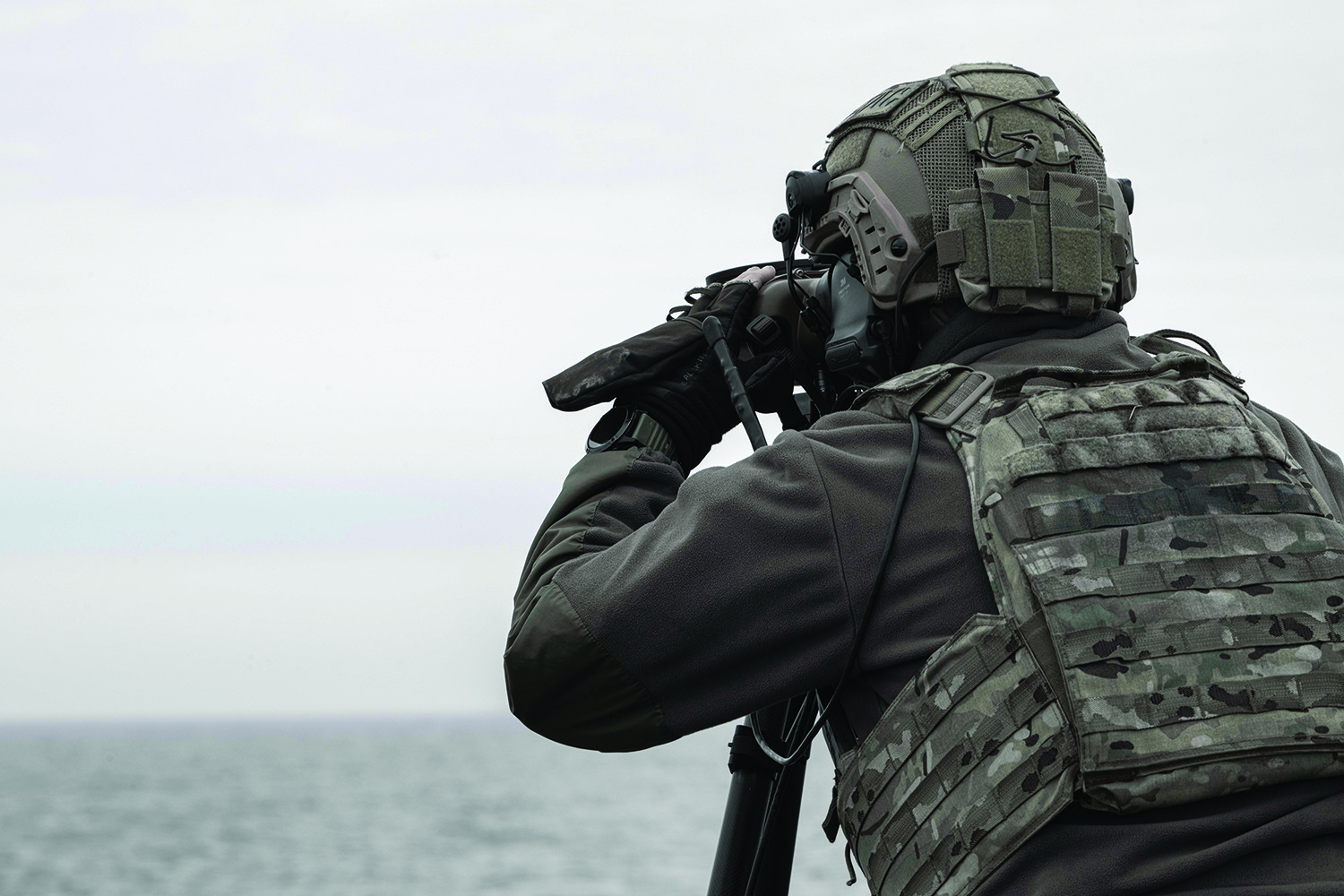
Photo: Corporal Bryan Bodo, Canadian Armed Forces Imagery Technician
NATO Maritime Group 1 conducts naval gunfire drills in coordination with Forward Observers and Joint Terminal Attack Controllers from Canada, Latvia and Spain in Liepāja, Latvia, on April 10, 2024.