

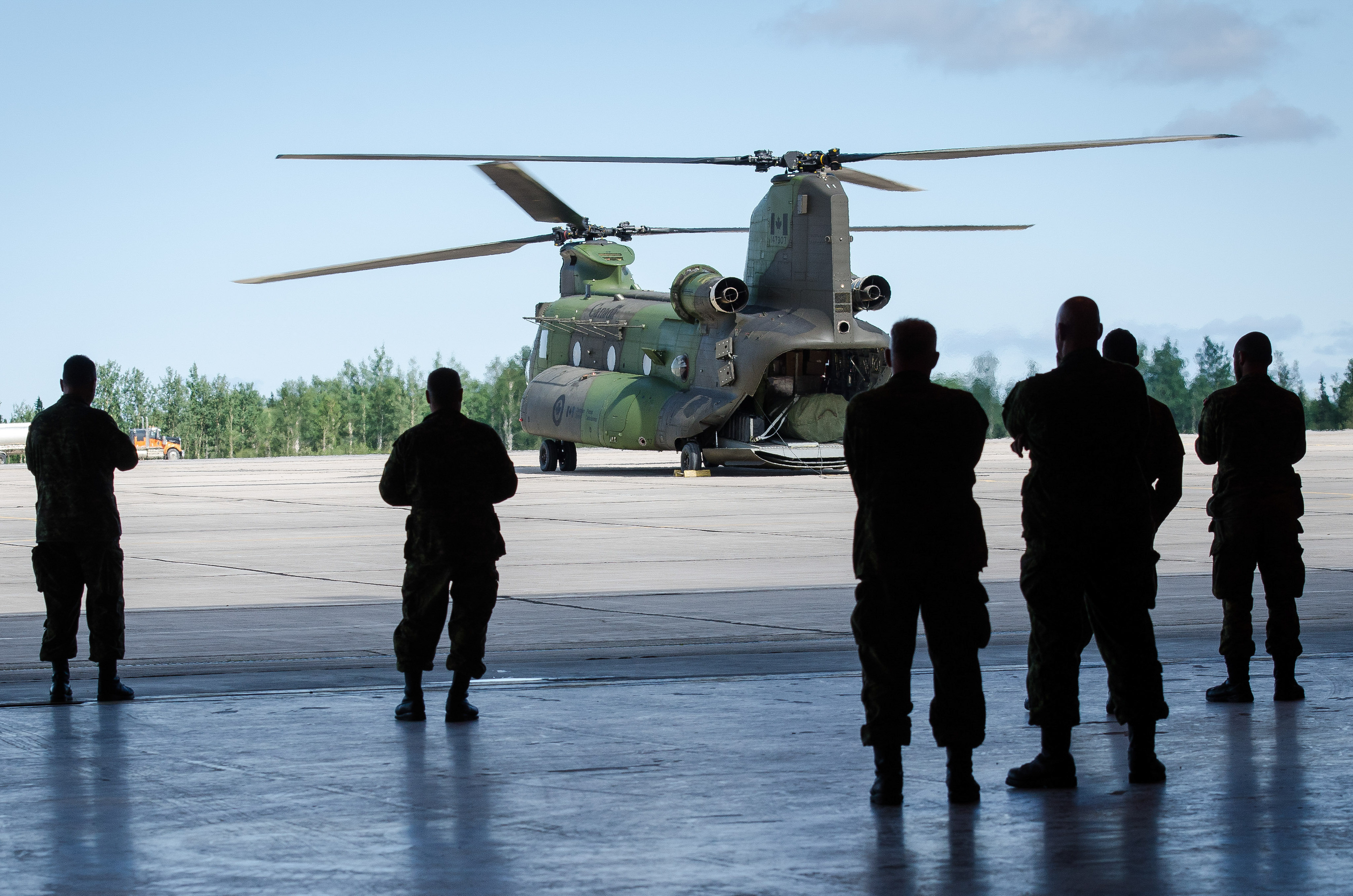
Photo: Mona Ghiz, MARLANT PA NK50-2017-223-028
Canadian Army troops and Canadian Rangers deploy from Goose Bay to northern Labrador on a Royal Canadian Air Force-piloted Chinook helicopter during Operation NANOOK on August 18, 2017.
Dr. Alan C. Okros is a full professor at the Royal Military College Department of Defence Studies and has been supporting Chief Professional Conduct and Culture initiatives.
To echo the Editor and the former CDS, the CMJ’s goal is to provide a forum for informed exchanges of ideas that have scholarly merit. On occasion, it also seeks to provide responsible journalists the opportunity to convey ideas to a broader audience by preparing balanced articles that are subject to fact-checking and their editor’s review of tone and bias. One may suggest that the recent CMJ Special Issue on Transforming Military Cultures has achieved the first of these outcomes.
The Special Issue brought together authors who are serving and former military members, defence scientists, and civilian academics. As a contributor to that special issue, I offer some comments to “continue the conversation.” inform a specific profession such as medicine, law or, in this case, the profession of arms. I will start with my reference to “scholarly merit,” particularly for journals intended to inform a specific profession such as medicine, law, or, in this case, the profession of arms. I see scholarly merit as coming either from arguments that have academic rigour or those based on reflective professional experience. Individuals’ perspectives drawn from their relevant professional experience are a valid component of the informed discussions CMJ seeks to facilitate. However, I added “reflective” to indicate there is a difference between one having accumulated 25 years of experience (and a degree of professional wisdom) and having experienced the same thing every day for 25 years.
Some who seek to defend the status quo have done so drawing on their own experiences without fully recognizing that the same experience is not shared universally by all who have served in the CAF. Following the report by Justice Deschamps and again that of Justice Arbour, I have had numerous exchanges with CAF members who take exception to descriptions of the CAF as having a problematic culture of systematic harassment, discrimination, and sexual assaults, usually justified by, “I’ve never seen any of this nor would I tolerate it.” Following the 1998 Maclean’s articles highlighting rape in the military, my colleague Karol Wenek explained that round of “never seen/wouldn’t tolerate” statements by CAF senior officers of the day—and the rash of inside stories leaked to the media—by describing what he called the “unresponsive chain of command.”Footnote 1 He highlighted how “inability to hear” and “unwillingness to listen” combined to enable those in the chain of command to claim they had been unaware of issues.
This may explain why some readers might concur with Michel Maisonneuve’s skepticism that sexual misconduct and discrimination towards those in several equity-deserving groups are “widespread.” The facts speak for themselves: 25,916Footnote 2 serving or former CAF members have become claimants under the Heyder-Beattie sexual harassment class action settlementFootnote 3 (42% of whom are menFootnote 4 ); during 2022, 3.5% of Regular Force (7.5% of women, 2.8% of men) and 3.4% of Primary Reservists (8.9% of women, 2.2% of men) were subject to criminal code sexual assaults in the previous 12 months; 34% of women in the Regular Force and 38% of women in the Primary Reserves experienced a sexualized or discriminatory behaviour in the previous 12 months; and 61% of Regular Force and 67% of Primary Reservists agreed that sexual misconduct is a problem in the CAF.Footnote 5 It should be noted that the “good news” from this survey was that the percentage of Regular Force members who stated that they witnessed (saw or heard) or personally experienced sexualized behaviour or discrimination based on gender, gender identity, or sexual orientation in the military workplace or involving military members in the 12 months prior to the survey has dropped to only 67% from 2018 (70%) and 2016 (80%). So, to the almost 26,000 who have experienced sexual misconduct, the CAF is adding almost 20% of the Regular Force each year and the majority of those in uniform know it is happening.
Michel is correct that the CAF has been on the path of eliminating discrimination for many decades, which the Special Issue as a whole also highlights. I contributed to the initial development of the SHARP programme and provided input to aspects of Operation HONOUR (i.e., challenged some of the assumptions on which this programme was based). Unfortunately, the 2022 StatsCan data amply demonstrate that these initiatives have not yielded the expected results.
Why does the CAF still have the number of sexual assaults and extent of harm reported by StatsCan? The CAF responded quickly when troops started encountering improvised explosive devices (IEDs) particularly when driving the padded roller skates that were the Iltis jeeps. Would we just write off 8% of soldiers being killed and 37% wounded every year due to IEDs? Bonnie Robichaud filed her sexual harassment complaint against a CAF supervisor with the Canadian Human Rights Commission on 26 January 1980, so it has been 44 years since this issue was formally brought to the attention of senior military leadership. Would folks have walked around in 1961 saying, “Yup, that ridge up there in Vimy is a tough nut to crack; pity about all the troops we’ve lost each year but let’s try the same mass assault one more time!”
To distinguish between lessons identified and lessons learned, there are two parts to the issue of acknowledgement that Michel highlights: properly understanding (and acknowledging) what the core problem is and developing effective solutions (including verifying the solution actually worked). We have difficulty even achieving the first when criticisms are dismissed because the researchers ostensibly did not talk to the right people,Footnote 6 or when someone drags out a great anecdote from a senior NCO to trump rigorous social science analyses. The research conducted by the Canadian Forces Personnel Applied Research Unit in the mid-80s clearly illustrated there was a problem—so it’s not for want of initial lesson identification.Footnote 7 In moving to solutions and lessons learned, Connie Kristiansen’s scathing 1989Footnote 8 critique of the way in which some of the research data were interpreted and the dismissive rationalizations by senior officers in order to preserve the status quo served as an early indicator that external perspectives were likely to disrupt the comfortable narratives that tended to dominate the internal military echo chamber.
Let’s start with the reality stated by the former CDS and incorporated in the introductory article by the guest editors: yes, there is something wrong with military culture and no, the current military leadership does not purport to have all the answers. Successive Ministers of National Defence have stated they want it addressed as a high priority. Thus, the political authority has issued definitive intent. This is where the CMJ Special Issue comes in. The various articles present different scholarly perspectives in the spirit of assisting Defence leadership and serving CAF members. As recognized by Stephen Saideman and Stéfanie von Hlatky, the intent is to present ideas, frameworks, and questions—drawn from scholarship that has applied these specifically to the context of the armed forces—to assist leaders to avoid finding new ways to make old mistakes. These include focussing on competence but not attending to characterFootnote 9; rewarding mission success but not assessing toxic leadership, demoralized teams, or broken individualsFootnote 10; overemphasis on a narrow set of war-fighting skills as the basis for delivering the full range of integrated security solutionsFootnote 11; leaders relying solely on position power and not earning subordinates’ trust and confidence to be able to draw on personal powerFootnote 12; applying legal mechanisms to enforce the law rather than professional approaches to ensure discipline and maintain professional standardsFootnote 13; and, seeking to change the behaviours of individuals (offenders, potential complainants, bystanders, commanders) without amending dysfunctional aspects of the social systems in which they are embedded. As stated by the co-editors of the Special Issue in their introductory article, the authors are, in fact, answering the call from CAF leadership for informed scholarship and seeking to engage with those who have the intellectual confidence to consider perspectives that can help them understand deeper causal factors.
Steve and Stéfanie identified the vitriol evident in certain responses to some of the concepts, particularly, critical race theory (CRT). Reference to CRT appears a total of five times in four of the 14 articles in the special issue but drew some attention in certain ideological echo chambers. CRT is an example of academic work that has been subject to significant misinformation and disinformationFootnote 14. It can be traced to scholars at the Frankfurt School in the 1930s and emerged in the late 1970s through work by Derrick Bell, Richard Delgado, and Jean Stefancic, among others. CRT puts an emphasis on structures and systems that produce broad social outcomes, not on the beliefs of individuals. It does not label all white persons as racist but, when properly understood, can enable those responsible for changing the underlying systems and structures to take (more) informed decisions. We do need to root out bad apples but also understand the consequences of putting good apples in warped barrels. CRT and other theories can enable us to understand how the social systems in which we are embedded shape our thinking and actions. The Truth and Reconciliation Commission called on us to find ways for each person to consider how they know certain facts, why they hold certain assumptions, and how their personal preferences influence their decisions and actions. We all hold our own worldview which embodies a host of stereotypes, mental schemas, preferences, and biases; when we act on biased information without consciously thinking about it, we can cause preventable harm or discrimination. Thus, just as with drawing on ethical frameworks or enhancing our understanding of Indigenous ways of knowing and doing, CRT informs self-insight and self-understanding.
The two letters presented in response to the Special Issue also highlight another recurring clash of narratives: the social imperatives for culture change related to addressing harm and ensuring the CAF reflects the population it serves versus the perception that changes will erode morale and military effectiveness. Elsewhere, I have argued that this is not a zero-sum game.Footnote 15 To be sure, the military demands individuals with emotional fortitude and resilience, but the CAF does require more. This starts with the secondary outcomes highlighted in CAF leadership doctrine: maintaining the profession’s reputation and earning public trust, confidence, and support. Footnote 16 As the doctrine identifies, reputation, trust, confidence, and support are enhanced or eroded through the public’s perceptions of the CAF’s effectiveness and legitimacy. As demonstrated in the fallout of the Somalia affair, both are assessed based on whether the behaviours members exhibit reflect principles that Canadians value. So, at the individual level, the more important of the two is maintaining high standards of professional conduct and, again, the StatsCan data is discouraging—as was the parade of senior officers who were parked in the penalty box when juniors finally had some confidence they would be listened to if they came forward.
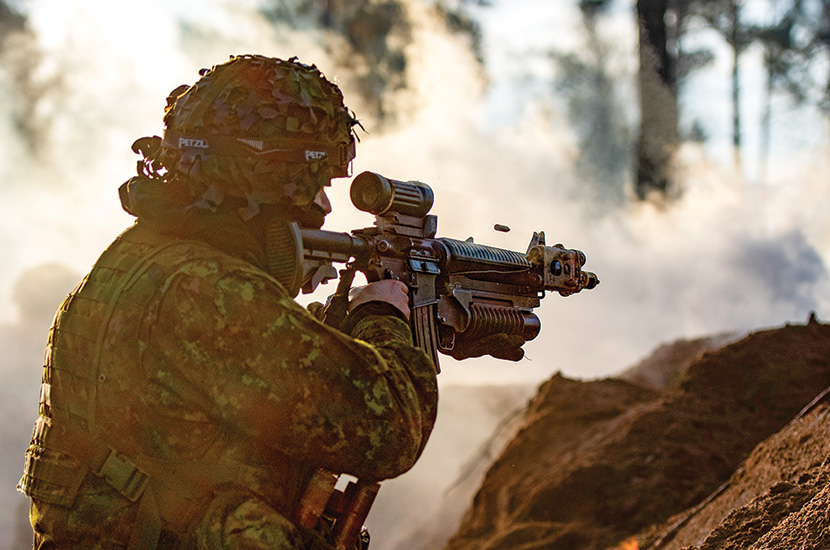
Photo: Captain Joffray Provencher, eFP BG Latvia Public Affairs and Imagery Section, Canadian Armed Forces Photo
A Canadian Armed Forces member of NATO’s enhanced Forward Presence Battle Group Latvia fires a C7A2 Automatic Rifle from a defensive position against 1st Fusiliers, Royal Regiment of Fusiliers, British Army from eFP BG Estonia acting as opposition forces during Exercise BOLD FUSILIER in Tapa, Estonia on 13 October 2023.
More critically, the CAF does not rely primarily on individuals to be successful, the emphasis being on building cohesive, effective teams that will succeed under arduous conditions. And we are not going to have cohesive teams when some members experience being shunned, marginalized, discriminated against, or subject to harmful actions. Also crucial is that the key idea missing in the conflicting narratives on culture change and combat effectiveness comes from the literature on why soldiers fight. In the context of the US military in Iraq, Wong et al. (2003) picked up on the academic consideration of this issue from seminal publications by Shils & Janowitz (1948) and Stouffer et al. (1949), along with the still debated and often misquoted work of S.L.A. Marshall (1947). In his 2005 reply to commentary on his work, Wong (2005) asserted, “today’s soldiers, just as those in the past, fight for each other. Why They Fight also reports, however, that today’s soldiers are motivated in combat by notions of freedom and democracy.”
Issuing orders informs when soldiers engage in combat; understanding peer loyalty and internalized values explains why they do so and, more critically, why they persist when the going gets really tough. As for the importance of cohesive, effective teams and professional socialization, none of the articles in the special issue argue against these concepts. However, as I presented in my article:
“The focus on teams explains the emphasis given to small group cohesion and the personal judgments that occur in policing social hierarchies: individuals assess whether their peers will be able to ‘cut it’ when the moment arises and if they will have their buddy’s back. As illustrated in Brown and Tait-Signal’s work, the challenge is that many military members are using gendered and racialized stereotypes to erroneously judge others.”
Lenny Wong’s comment on the shift in motivation to notions of freedom and democracy and Michel’s statement that “the CAF are the protectors of our sovereignty and the defenders of our values” raise an interesting question. There has been an ongoing professional debate since the Somalia Commission on the values integrated in the military ethos. But which values? Those interested in the most recent updates might wish to read the article in this journal by Martinelli et al. on the 2022 publication of The Canadian Armed Forces’ Ethos: Trusted to Serve. As they pointed out, “as part of CAF efforts to address the harmful subcultures that led to such class actions”Footnote 17, the Chief of the Defence Staff (CDS) ordered the renewal of Duty with Honour. Reflecting an idea incorporated in the original Duty with HonourFootnote 18 is the need to balance continuity with change. This means acknowledging that some will look back to history and tradition seeking to see certain facets preserved; however, also recognizing that the profession of arms is never static and must evolve.
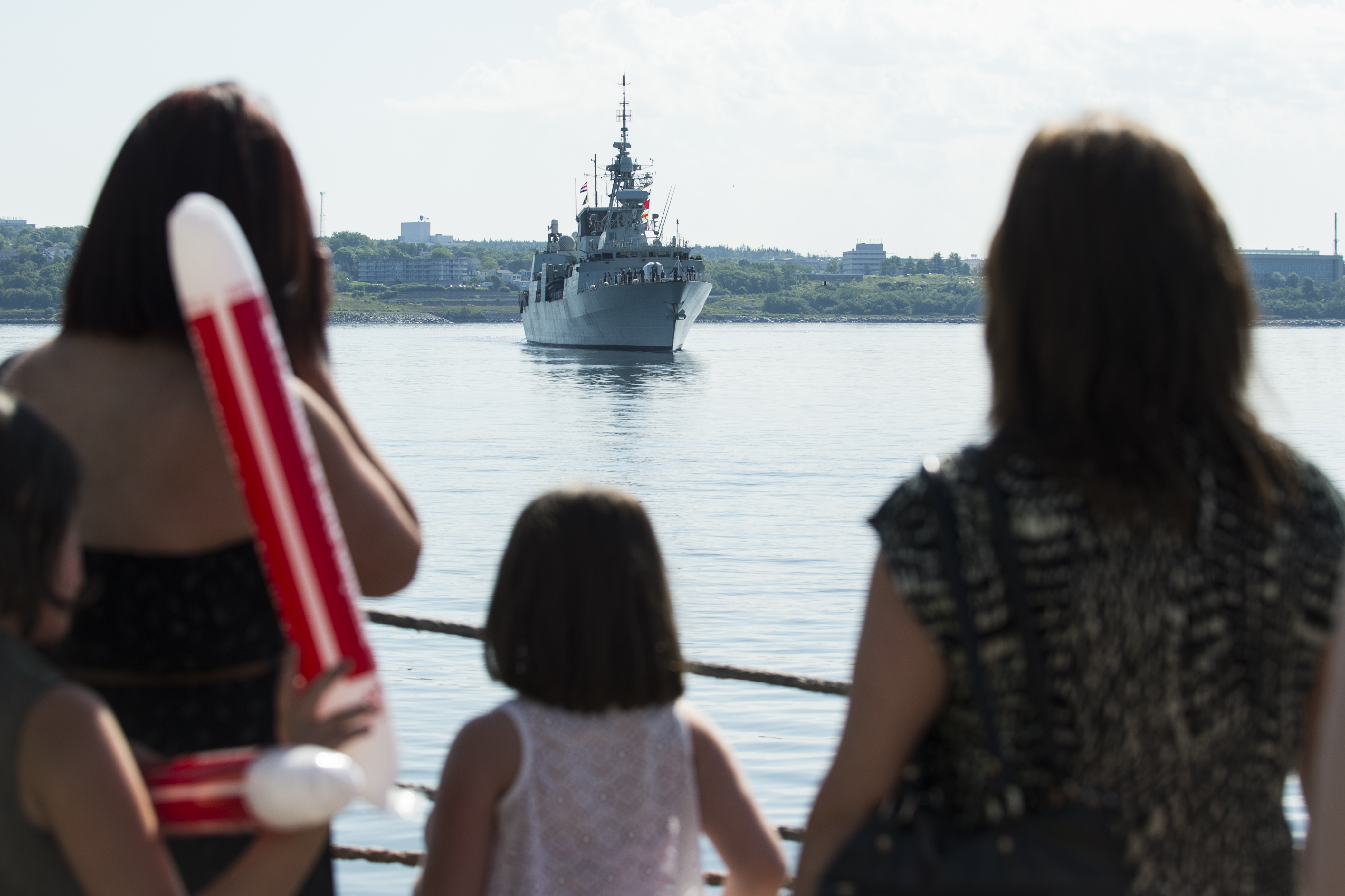
Photo: MS Ronnie Kinnie, Formation Imaging Services Halifax
Family members and friends wait for the arrival of Her Majesty’s Canadian Ship (HMCS) FREDERICTON, which returns from Operation REASSURANCE, at Halifax, Nova Scotia, July 5, 2016.
I will offer three key points from the work on Trusted to Serve. First, for the majority of those currently serving who agreed with the StatsCan survey that sexual misconduct is a problem in the CAF, Trusted to Serve , along with initiatives such as character-based leadership and emphasis on inclusive behaviours, demonstrate that senior military leadership is giving thoughtful consideration to academic input and is not rejecting novel ideas or being misled by disinformation campaigns or manipulative dog whistles. As the former CDS highlights in his comments, the CDS exercises control over the regulation of professional standards and professional practices—which also means charting the course for needed culture changes. Those who suggest current culture initiatives have been politicized are not criticizing the government of the day; they undermine the vital ground of the CDS as the head of the profession of arms.
Second, the associated work on character-based leadership illustrates that CAF doctrine and daily leadership practices also need to be kept up to date. While some have stated that the current CAF description of effective leadership reflects what has always been emphasized, the reality is this is an example of the type of wishful misremembering used to justify the status quo. As part of the review our team conducted in 2001–2003, I noted three key aspects of the doctrine that was in force at that time. The first was that there were separate manuals for junior officers and non-commissioned members and none for senior officers. The two assumptions were that officers and NCMs led in different ways and that once one was promoted to Major/Lieutenant Commander, there was nothing more to learn. Second, there were 14 instances in the Junior Officer manual that emphasized that the reason one undertook these leadership activities was to get promoted. My favourite was the statement, “Commanding Officers should closely monitor the work the men do as they will always do the least possible.”
Third, the primary rationale for an update to leadership doctrine is to address the “huge challenge for young officers and NCMs” presented by Michel. Instead of turning the clock back, the solution is to inform and enable leaders at all levels. Character-based leadership and inclusive behaviours exemplify the continued evolution of leadership concepts and practices which will enable the CAF to harness the strengths of Canadian diversity and enable each person who chooses to serve in uniform with the opportunity to attain their career potential. The vast majority of the CAF consists of straight, white men. In view of the recruitment crisis, this is not sustainable. Let’s combine a few statistics: almost 58% of all Canadian undergrads are womenFootnote 19, 37% are visible minoritiesFootnote 20, and 4% of adult Canadians identify as part of the 2SLGBTQI+ communitiesFootnote 21 This means that about two thirds of the Canadian university population is not straight, white men. The CAF needs and eagerly wants as many of these men who wish to join as possible. However, contrary to critics who claimed the special issue eschewed recruitment challenges, this is precisely one of the central points conveyed throughout the articles in this issue. . Because the CAF has not successfully diversified, it is not meeting minimum levels of recruitment or retention, let alone harnessing the full range of talents, worldviews, and lived experiences of those who might join.Footnote 22 Demographic trends are unequivocal, especially on natural birth rates as well as family composition.Footnote 23 The 2021 census revealed almost 25,000 Regular Force members were either in common-law relationships or single parentsFootnote 24. When combined with dual-service couples and those whose partners also have a demanding career, the chain of command and supporting Military Family Resource Centres must find “workarounds” to enable all families to survive and ideally thrive when constrained by policies designed for traditional family structures. Whistling past the graveyard and asking external academics not to make pointed observations does little to help senior leaders move from lessons identified to effective lessons learned.
Thus, my fourth comment from the work on Trusted to Serve and my observation on diversity statistics, is to turn to Michel’s valuable contribution on the concept of “inclusive meritocracy.” In other fora I have put forward the idea of preserving merit-based career decisions while attaining the objectives under the Employment Equity Act by applying selection based on the concept of “first amongst equals”: amongst individuals who are equally qualified, base initial selection on institutional goals (not quotas) to increase representation across all levels. Articles that examine how the CAF might advance inclusive meritocracy are likely to pique the interest of the CMJ readership.
As for my overall comment on responses and reactions to the special issue, there are significant problems when some believe the best course of action to move forward is to rely solely on using a rose-coloured rear-view mirror. The fundamental reality remains that a significant number of those currently serving—women, men, and diverse individuals—are being subjected to preventable military sexual traumaFootnote 25, physical abuse, bullying, and harassment. The actions needed to address required changes while preserving critical professional capacities requires that senior CAF leaders sift through a wide range of perspectives to take decisions. Fortunately, they are prepared to consider concepts, theories, and empirical research that challenge taken-for-granted assumptions, professional worldviews, and their personal preferences to do what is right for those serving, and for the Canadians who rely on the CAF to deliver the military component of integrated national security.